
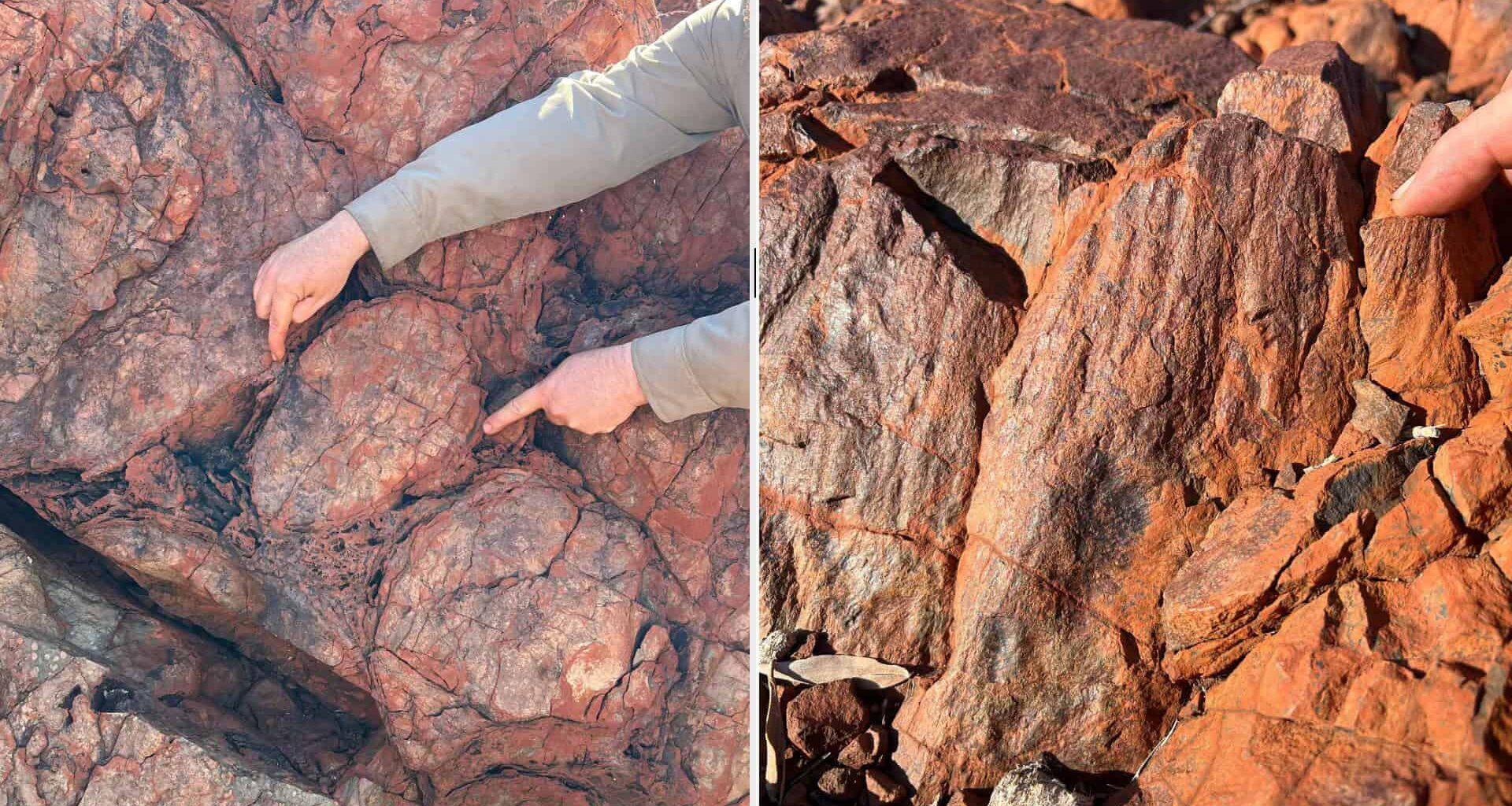
 Credit: Curtin University.
Three billion years ago, before there were any animals, forests, and even before oxygen filled the air, something slammed into what is now Western Australia with enough force to scar the young planet. We can still see the signs of this violent impact today.
The crater, if the new interpretation holds, lies in the Pilbara, a rust-red region famous for some of Earth’s oldest rocks. There, at a place called the North Pole Dome, scientists say they have dated the oldest known impact crater on Earth — a structure left by an asteroid strike during the Archean eon, when early continents were still taking shape and life was mostly made of microbes.
Using tiny minerals that acted like clocks inside damaged rock, researchers from Curtin University and the Geological Survey of Western Australia dated the event to about 3.02 billion years ago.
That would make the North Pole Dome older than Yarrabubba, also in Western Australia, which had held the title of the oldest well-dated impact structure at about 2.2 billion years old.
We don’t yet know how large or powerful the impact was, but there are already many fascinating aspects to this discovery.
The Crater’s Mineral Timer
 Pilbara landscape. Credit: Curtin University.
The North Pole Dome lies about 1,600 kilometers north of Perth. It is part of the East Pilbara Terrane, a rare patch of crust that preserves rocks more than 3 billion years old.
That impressive age is what makes the site valuable — and sometimes controversial. Last year, researchers reported a field of shatter cones there. These are distinctive, striated fractures that geologists generally regard as strong evidence of a meteorite impact. But the claim raised two separate questions: Were all the rocks truly part of the same impact structure? And if they were, when did the impact actually happen?
Some scientists argued the crater could be much younger than first proposed, pointing to nearby rocks they linked to a formation about 2.77 billion years old. Others questioned whether later hot fluids moving through the Pilbara might have altered the minerals and confused the age.
×
Thank you! One more thing…
Please check your inbox and confirm your subscription.
The new study tries to answer that debate from inside the rocks themselves. Instead of relying only on the shape of the shatter cones, the researchers dated tiny minerals that appear to have been changed or newly grown when the rocks were shocked and heated.
“The impact left a ‘mineral clock’ behind,” said Professor Chris Kirkland, the study’s lead author. “By dating minerals that were remade or newly grown in the damaged rocks, we can now pin down when this extraordinary event happened.”
A Mineral Clock
 Chris Kirkland was the lead author of the study. Credit: Curtin University.
The most important mineral was zircon. Geologists often use zircon to date ancient rocks because it can hold uranium and lead in a stable crystal structure for billions of years.
In the North Pole Dome samples, the researchers found zircon grains with unusual skeletal, branching shapes. These were not ordinary crystals from the original rock. The team interprets them as older zircons that were partly disrupted, recrystallized and in some places regrown during the heat and fluid movement that followed the impact.
The team dated the clearest skeletal zircon signal to 3024 million years ago, with an uncertainty of just 7 million years. That is remarkably precise for rocks this ancient.
Then they checked the clock against another mineral: apatite. This mineral grew as hot fluids moved through fractures in the shocked rock after the event. Its age came out nearly the same: about 3019 million years old, with a wider uncertainty.
“The agreement between two different mineral systems gives us confidence that we are seeing the signature of a single major event — a meteorite impact,” Kirkland said.
Why This Ancient Crater Matters
 The age of ‘little lightning bolts’ of zircon embedded in the basalt rock were analysed by scientists. Photograph: Curtin University
Meteorites are the solar system’s leftovers. They are material that weren’t incorporated into forming planets or the debris left after a space collision. These leftovers can tell us a lot about Earth’s formation and the solar system more broadly.
Meteorite impacts were much more common on the early Earth than they are today. Just looking at the battered surface of the Moon gives a sense of the kind of onslaught our planet must have also experienced. You can’t see it for yourself today because Earth constantly destroys its own evidence. Wind and water erode craters. Plate tectonics buries, folds and recycles crust. Then heat and fluids alter minerals long after the original event.
That makes Archean impact structures exceptionally hard to find, let alone date.
Associate Professor Bruce Schaefer, a geochemist at Macquarie University who was not involved in the study, told The Guardian that early Earth was continuously “pummelled” by meteorites.
“To be able to find evidence of those same impact events on Earth is really exciting. We know it must have happened, but to actually see it, and put your hands on it, is very significant,” he said.
The Pilbara is one of the few places where such evidence might survive. Three billion years ago, Earth was not the familiar blue-green planet of today. It had little continental crust compared with the modern world. The Sun was dimmer. The Moon was much closer and must have looked at least twice as big in the night’s sky. Life, as far as we know, consisted of microbes, including organisms that built stromatolites in shallow waters.
Scientists hope the newly dated crater might help them understand how asteroid strikes shaped the crust, moved heat and fluids through rocks, and influenced the environments where early life persisted.
“There’s very few places that are these deep time capsules that let us peer into the formative processes on our planet,” Kirkland told The Guardian. “That’s why they’re quite special.”
A Claim Still Under Fire
The claim is still disputed. Alec Brenner, a postdoctoral fellow at Harvard University, told ABC News that shatter cones have been found in nearby rocks he considers to be about 2.77 billion years old, which would make the impact younger than the Curtin team proposes. He also argued that the new mineral ages may record a later episode of hot fluids moving through the rocks, rather than the impact itself.
The study’s authors counter that their case does not rest on zircon alone. They point to the shocked quartz, a matching apatite age, and the lack of a known regional heating event at that time.
For now, North Pole Dome remains both a remarkable candidate and a contested one — a possible record of Earth’s oldest known impact crater.
“It is quite enthralling, and the fact that you can look at the chemistry of these mineral grains to say something about an event that happened in a split second three billion years ago is really amazing,” Kirkland told ABC News.
The crater was described in a new study published in the journal Geology.