
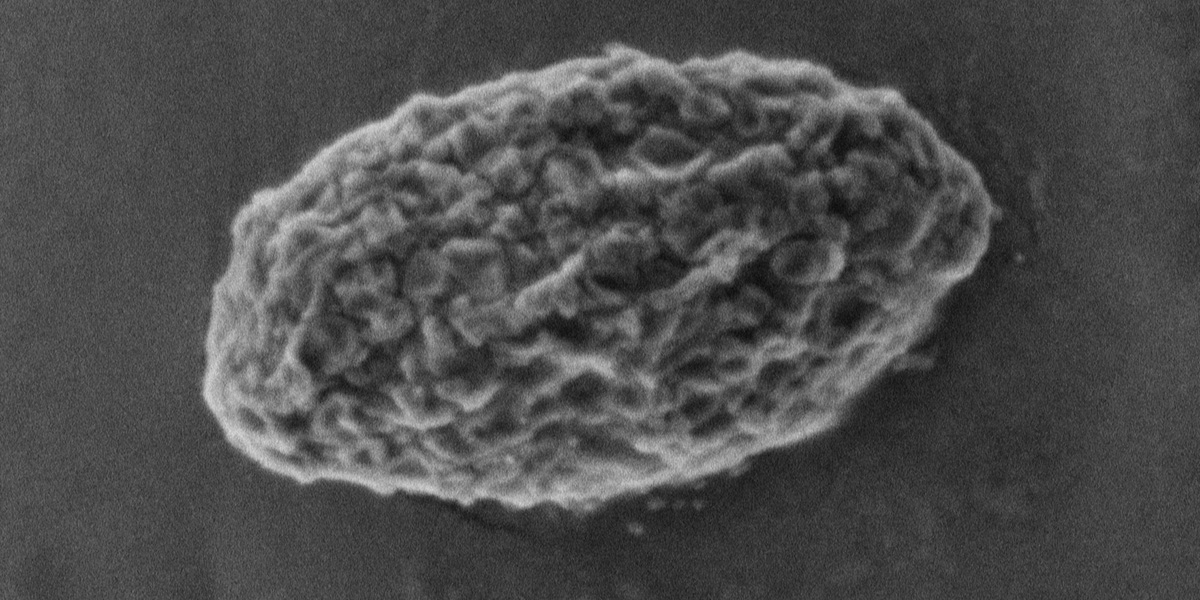
Lafora disease, or LD, is a rare but fatal neurodegenerative disorder in which aggregates of abnormal, hyperphosphorylated glycogen form inclusions called Lafora bodies. LD can be caused by mutations in the gene encoding the glycogen phosphatase laforin. In studies of LD, a catalytically inactive form of laforin called LCS is often used as a negative control, but unexpectedly, mice lacking laforin and expressing LCS exhibit almost no Lafora bodies. Therefore, it remained unclear whether the catalytic activity of laforin as a phosphatase is necessary to protect against LD.
M. Kathryn Brewer, University of Florida
Scanning electron micrograph of a Lafora body, an insoluble glycogen aggregate that can form in the brain, heart, skin and other peripheral tissues of patients with Lafora disease.
Kathryn Brewer, Katherine Donohue, Pankaj Singh and colleagues in the U.S. and Spain recently published a biophysical and physiological characterization of LCS in the Journal of Biological Chemistry. Although LCS lacks phosphatase activity, they found that LCS showed increased binding to laforin substrates, phosphate and long glucose chains, compared to normal laforin. In addition, using hydrogen-deuterium exchange mass spectrometry, they found that LCS exhibits decreased conformational dynamics, trapping glycogen in the closed conformation of the protein without completing dephosphorylation. Moreover, they saw that LCS interacts more robustly with laforin protein binding partners. The scientists then conducted targeted metabolomics in the brains of control mice, mice lacking laforin and mice expressing LCS to understand how the altered LCS dynamics impact physiology. They found that mice lacking laforin and mice expressing LCS both displayed altered metabolism, but mice expressing LCS showed a distinct metabolic profile. These results suggest that even though LCS expression prevents the formation of Lafora bodies, normal laforin phosphatase activity and proper regulation of glycogen phosphorylation are required for normal brain metabolism.