
WASHINGTON — The last thing the Phillies want is for a nagging issue to become a bigger one.
Don Mattingly spoke last week about Brad Keller, who could return soon, pitching through forearm discomfort before the right-hander landed on the injured list. Keller allowed three runs in Milwaukee before the roster move. Something did not look right, and something was not right.
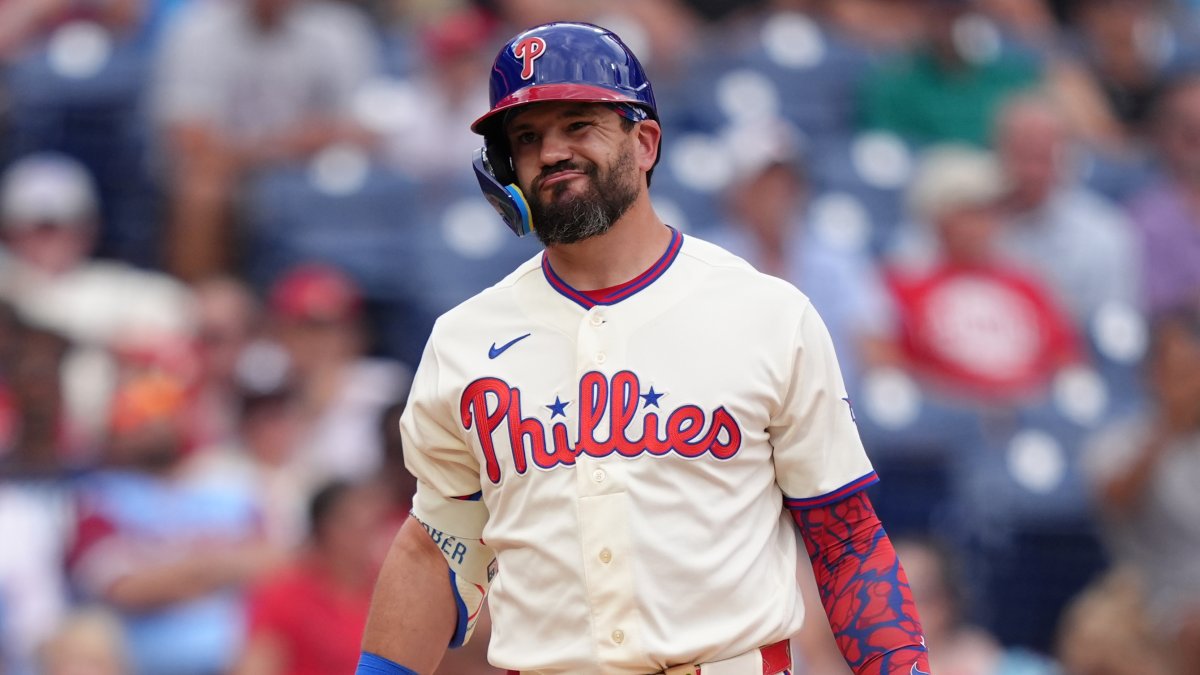
The Phillies are applying the same thinking to Kyle Schwarber.
Schwarber was scratched roughly seven minutes before Tuesday’s first pitch after his lower back tightened while he was trying to swing. The Phillies were already scrambling through a late lineup adjustment when the issue surfaced.
“Craziness started there,” Mattingly said. “It happened fast. It happened late.”
Schwarber felt better after treatment Tuesday night, and Mattingly said the 33-year-old was better again Wednesday. Still, the Phillies held him out of the lineup against Washington.
“We’re going to be a little cautious,” Mattingly said. “I think if it was a different time of year, he could do everything he could do, play today. He would, too, I think. But just to be a little cautious with him. We don’t want this to end up being two weeks or something.”
The Phillies do not need Schwarber to push through one June game if it risks losing him for a longer stretch. He has remained one of the central pieces of their offense, and the club has enough left-handed firepower in Bryce Harper, Brandon Marsh and Bryson Stott to give him a day.
Mattingly did not rule out Schwarber for an emergency situation Wednesday. The decision will depend on how the back responds throughout the day.
“That’s something we’ll find out,” Mattingly said. “I’d like him to be able to, maybe, or something. He got treatment last night, felt better, was better today. See as the day goes if it’s feeling better.”
The Phillies are hopeful Schwarber could return Thursday, but Mattingly avoided putting a firm timetable on it.
“Kind of, but I don’t want to put a timetable on it,” Mattingly said. “It takes another day. We’ve got guys who can play, so be cautious.”
Mattingly knows the stakes of a back issue better than most. He dealt with slipped discs throughout his playing career, which contributed to his retirement at 34.
For Schwarber, the longer view outweighs a milestone chase in June. He is pursuing his 400th career homer and has put himself in position to chase a 60-homer season (400 and 60 would come on the same roundtripper). But the Phillies need him healthy for the stretch run far more than they need to squeeze another game out of him this week.
NOLA’S NEW LOOK?
Aaron Nola takes the ball for the Phillies on Wednesday, making his 16th start of the season.
He has struggled through a 5.71 ERA, with the home run ball again at the center of the issue. Among the 40 starters with at least 50 starts over the last four seasons, Nola’s 1.42 homers allowed per nine innings rank fourth highest.
His last outing offered some encouragement. Nola allowed two runs over five innings, though both scored on home runs.
The four-seam fastball has been his biggest problem.
It entered Wednesday tied for the worst pitch in baseball by Statcast run value at minus-13. Opponents are hitting .406 and slugging .828 against it, the highest slugging percentage against any pitch in baseball. They have collected 13 extra-base hits, including six homers, against the pitch.
Nola has started mixing in a slider over his last two outings. He has thrown 10 of them, giving hitters another look beyond his knuckle curve, which opponents are hitting .207 against.
Mattingly confirmed the pitch is a true slider, not a misclassified knuckle curve.
“I think it’s a slider,” Mattingly said. “I think he’s been messing with it a little bit. I think it’s a good pitch for him.”
Nola has not used it much in the past, but Mattingly sees a path for it to become a useful addition.
“It’s probably not something totally comfortable with yet,” Mattingly said. “But there’s no reason it can’t become a good pitch.”
The slider could give Nola another option against right-handed hitters and another way to change eye levels against lefties. The larger task remains the same: limit the damage on the fastball and provide the Phillies with the length they need from the middle of their rotation.
OTHER NOTES
Adolis García underwent a successful procedure Wednesday in Chicago to repair his right lat. His expected recovery remains six to eight months.
Mattingly said García is in better spirits after making a difficult decision to undergo the procedure.
“He did the right thing, taking care of it right now and giving him the best chance to come back as a complete player,” Mattingly said.
García will rehab in Clearwater rather than remain around the club during the season. Mattingly said the outfielder will be missed beyond his production.
“He was very popular,” Mattingly said. “He was easy to be popular because he was a positive guy, played with a smile on his face. From a professional standpoint, being ready to play every day.”
García also leaves behind a clubhouse DJ vacancy.
Mattingly declined that job with a smile.
“I will not do that,” he said.
Cade Obermueller, the Phillies’ second-round pick in 2025, has looked strong through his first six professional starts.
The slender 6-foot, 170-pound left-hander owns a 2.81 ERA for Single-A Clearwater. In his most recent outing against Jupiter, Obermueller struck out eight over four scoreless innings without a walk.
The Iowa product works primarily with a low-90s fastball and sharp slider. He is not overpowering, but he has generated plenty of swing-and-miss early in his pro career.
The Phillies do not have many left-handed starters in the system with Obermueller’s early momentum. His father, also a former second-round pick, gives the 21-year-old another baseball connection worth noting as he works through his first full professional season.