
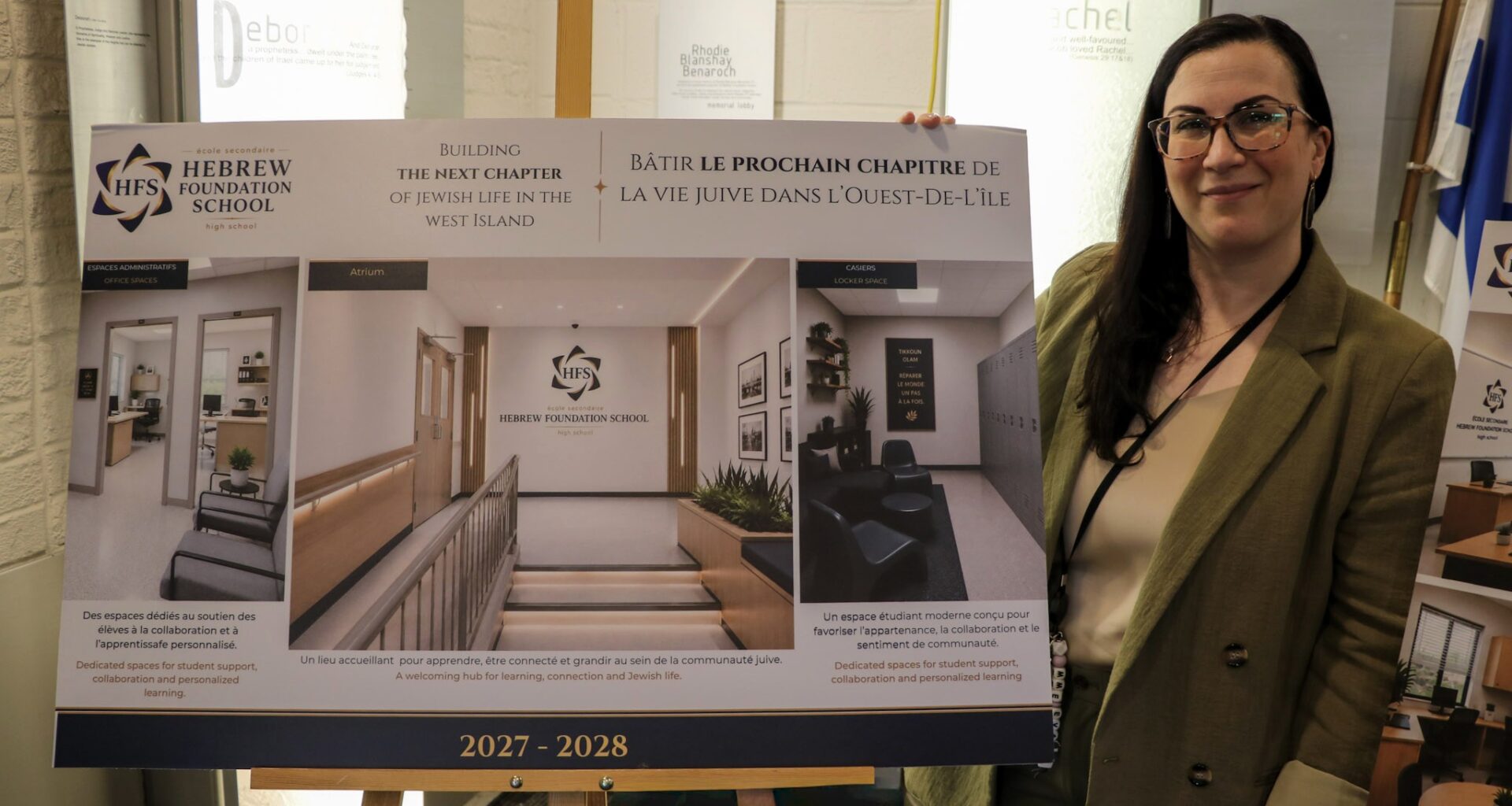
For many Grade 6 students at Hebrew Foundation School (HFS) in the West Island suburb of Dollard-des-Ormeaux (DDO), next year’s journey to high school may be longer than they like.
That’s because families seeking Jewish high school for their kids have only one option: shlep.
The West Island has no Jewish high school, leaving students to commute by carpool, or climb onto as many as six buses hauling Jewish teenagers from West Island boroughs and suburbs into the city daily to attend schools in Snowdon, Saint-Laurent and Côte Saint-Luc.
For students, it means roughly 200 kilometres of weekly bus travel, on top of an extended school day to accommodate Jewish studies. For some DDO families, it already means being on a bus at 6:45 a.m.
But that’s about to change.
HFS is launching a new Jewish high school with a Grade 7 cohort for the 2027-28 school year. Unlike previous efforts which never materialized, it is a measured plan already moving forward. “It’s go time,” head of school Eva Ohnouna told The CJN following two information sessions for prospective families.
The HFS community has discussed a high school for years, but previous plans faced major obstacles like costly construction proposals and concerns it would simply shrink existing Jewish day school populations rather than attract new students.
This time, Ohnouna says, circumstances are different. “For one, the school requires little in the way of major capital investment. Apart from some renovations, dividers and classroom modifications, the current building is more than adequate for the foreseeable future.”
HFS once accommodated nearly 500 students compared with its current 215. Students attending the day school – French immersion until Grade 4 before transitioning to bilingual – who transition to Montreal high schools like Herzliah or Bialik, often spend up to two hours a day commuting.
“That’s time that could be spent socializing, reviewing schoolwork, participating in athletics or being with family,” Ohnouna says. The commute also costs families about $2,000 per child annually. “That’s a cost that goes away, right away.”
According to the 2021 Census, Dollard-des-Ormeaux is home to roughly 8,000 Jews, about 16 per cent of residents and nearly 10 per cent of Montreal’s Jewish population. While the community has lost more than 2,700 people from its peak of 10,385 two decades ago, census data show Jewish populations elsewhere in the West Island increased 90 per cent over the last decade, with small pockets of Jewish families across the west end and off-island municipalities, creating a broader catchment area for a local Jewish high school.
Part of the past decline in HFS enrollment can be tied to overall growth and development of the region, and the quality of public English schools in and around the West Park neighbourhood where West Island Jewish life is centred.
Part of it also owes to simple family dynamics, says Yoni Petel, chairman of the HFS board and parent of five current and former HFS students. “It’s still a very vibrant young community with a lot of young families and a lot of school-age children” he told The CJN. “Unfortunately, there’s not a lot of housing for seniors who want to sell their homes and downsize, which diminishes turn over.” With no Jewish high school, says Petel, a DDO native and past-president of the Or Shalom Communauté Sépharade, “that makes two points in the life of a family when we lose people out of the West Island. It’s kind of a fork in the road.
“It’s simple: Anyone who knows the Jewish education system, if they were given a magic wand to do whatever they wanted, there’s no scenario that exists that doesn’t include a West Island high school.”
Fortunes are also changing at the school, founded in the early 1970s, says Ohnouna. “We have momentum,” pointing to rising enrolment, educational awards and recognition within Quebec’s education sector. “It’s also school-driven this time. We really did this from here. It’s realistic, it’s planned, budgeted, staffed and forecasted. The plan is based on confirmed community needs rather than a top-down organizational effort.”
The school already emphasizes student support services, and the high school will provide continuity for students with learning difficulties, with literacy development a particular focus. Ohnouna says HFS is distinguished by its ability to monitor student progress, “and identify challenges early, intervening before students begin to fail.”
The school plans to offer French and English streams, expecting an inaugural class of at least 30 students. The current Grade 5 group of 36 students represents the core target cohort.
Language matters
Hebrew Foundation High School, unlike the elementary, will be fully private with no provincial subsidies, which total about $6,000 per student annually. While hiking costs, it offers an upside for many families: no subsidy means no eligibility requirements.
Government-funded schools must follow Quebec’s English eligibility rules. Only children of Canadian citizens who did most of their elementary schooling in English in Canada, or of those eligible to do so, can attend English school.
That’s a generations-old linguistic chokehold on Quebec’s English education system, particularly in Montreal where virtually all immigrants – with few exceptions – are funnelled into French schools, many bursting at the seams, while numerous English schools remain under-capacity and face uncertain futures. This also applies to private schools, so American, Argentinian, Russian, Israeli, French and other families from abroad haven’t had the option of an English education in a Jewish school.
Until now.
With tuition of $14,500 a year, Hebrew Foundation High School will be competitive with other schools which typically charge around $18,000. The new school is relying on a mix of tuition and donor support, says Ohnouna, and the school is launching an endowment fund this year. “That’s already in the works for the sustainability of the school at large, the long-term plan. In the short term, for the high school, philanthropy is a big aspect. We have people and families who really believe in the project, helping us start with something really affordable.” HFS families can also receive tuition caps and assistance through Federation CJA programs.
Costs will be contained by using existing facilities and infrastructure. Part-time staff can be engaged for high school, security costs remain unchanged, and only modest renovations are needed to separate elementary and high school spaces. Shared building areas with the adjacent Beth Tikvah synagogue will also help reduce costs while maintaining separate institutions. “We share some doors with them, we are neighbours and we work really well together,” says Ohnouna. “It’s a natural step.”
With a grade added each year, the first student cohort will progress as new grades are introduced for a full secondary program. “We are really thinking long-term, and that’s why this will succeed” says Ohnouna, calling the project something everyone should support, “because providing a local Jewish secondary education option helps families remain connected. Without a school, you can’t have a community.”
West Island native Pascale Gozlan and her husband, who hails from Israel, have two children at HFS whom they hope to send to the high school, with the possibility of transitioning their two older children into higher grades as they become available. “We feel that the HFS high school model has the potential to meet the needs of all of our children, which is one of the reasons we are so excited about the project.”
HFS serves, and will serve, families from a broad range of religious backgrounds, from highly observant to secular, anglophone and francophone, Sephardi and Ashkenazi. “We’re talking also about the mesh of cultures: an Ashkenazi like me, Polish immigrant descendant,” says communications coordinator Amanda Meltzer, “and my daughter, God willing, is going to have a henna when she turns 12, which is such a beautiful testament.”
Curriculum will include Quebec Education Program requirements alongside Hebrew, Jewish studies, Israel education and advocacy. “We are definitely Zionist,” says Meltzer, “that’s something that we teach, and it’s going to be part of the high school curriculum.”
English access may boost enrollment, but HFS has also embraced more French since Ohnouna’s arrival, when the school reflected a more traditionally Anglo West Island culture. “When I started, I knew we needed to do things differently because we had two schools, one French, one English, and we can’t just be anglophone. The team was amazing: the shift in communications, culture, everything three years ago, and we have amazing French teachers. We’re in Quebec and with all the new laws, we must be next-level, not just the administration, but for the students.”
Ohnouna has heard from Montreal parents considering non-Jewish high schools because of concerns about French instruction and was shocked. “You put your kid in a Jewish school in elementary, and then send them, even if it’s private, to a non-Jewish environment for French?”
That French component is key, notes Meltzer, an HFS graduate whose own daughter in Grade 2, “is an incredibly fluent French speaker. My little one in kindergarten, who’s just learning, can speak and read French, which is beyond incredible.
“You can either be afraid to stay in Quebec, or you can teach your children.”
Fully private schools are also exempt from the latest provisions of Quebec’s secularism laws. Anyone, including those hired after November 2025, can wear religious symbols, food offered can be kosher-only, and schools can control admissions and hiring, says Ohnouna. “You can wear your necklace, your chai, your cross, I don’t care. Employees can look the way that they want.”
It’s also an incentive for congregations looking for rabbis, she says, noting a chronic Montreal challenge, with many U.S. rabbis deterred by language restrictions, while some recruited from France cannot lead English-speaking congregations.
Director-general of the Association of Jewish Day Schools (AJDS) Sidney Benudiz says Ohnouna’s leadership has definitely factored into the HFS trajectory. “Unfortunately for a number of years there was a lot of turn over,” he told The CJN. “There’s been much better stability with Eva and her team. She brought more professionalism to the school and has had quite an impact.”
Petel agrees. “Eva brought all that energy, renewing the school’s fortunes, and the enrolment has gone up every year. There was a period of ups and downs, but since she came three years ago, we’ve won awards and have been getting recognition for our innovations, and we put on our first student play, which drew 400 people. We also have good relationships with Beth Tikvah and Or Shalom and the Chabad network.”
There are some 4,000 students registered in Montreal’s Jewish French and English day schools, plus an estimated 1,500-2,000 in the ultra-Orthodox network. The project, says Petel, is not about drawing students from the six mainstream high schools. “Not at all, it’s about attracting Jewish kids in the west island and around us.”
Benudiz was initially unsure how other Jewish high schools would react, “but we saw a very positive reaction from other school presidents and directors-general. There’s excitement about this, and I’m personally very excited to help the school achieve this.” He notes mainstream Jewish high schools are already close to capacity, “so some students graduating from Hebrew Foundation do not always find a spot available. I don’t think it’s going to be a big difference in terms of enrolment.”
Some students will hail from public schools without the Jewish studies or Hebrew background, so the high school will offer parallel programs for them. Meltzer says high school information sessions have attracted interest from about 200 people so far, including queries from as far as Ottawa.
Students will also gain an extra eight to 10 hours a week for extracurricular activities by eliminating lengthy travel. “There are so many talented kids in academics, sports, arts and other fields,” says Petel, “who don’t have the opportunity because of time spent commuting each day. There are so many of them that we can offer a Jewish high school experience.”
Gozlan says another attraction is “the calmer, greener environment” of the West Island, and proximity to her home. “As a family that homeschooled our children, we value having more time at home, less commuting, less stress, and a lifestyle that supports family connections.” She also values continuity and familiarity of HFS. “Our children have developed meaningful relationships with both staff and peers, and the school feels like family.” And given the rise in antisemitism in Montreal, “it is especially important for our family that our children attend a Jewish school.”
HFS will begin receiving applications this summer, hold an open house in early October, and finalize admissions in the new year.
Joel has spent his entire adult life scribbling. For two decades, he freelanced for more than a dozen North American and European trade publications, writing on home decor, HR, agriculture, defense technologies and more. Having lived at 14 addresses in and around Greater Montreal, for 17 years he worked as reporter for a local community newspaper, covering the education, political and municipal beats in seven cities and boroughs. He loves to bike, swim, watch NBA and kvetch about politics.