
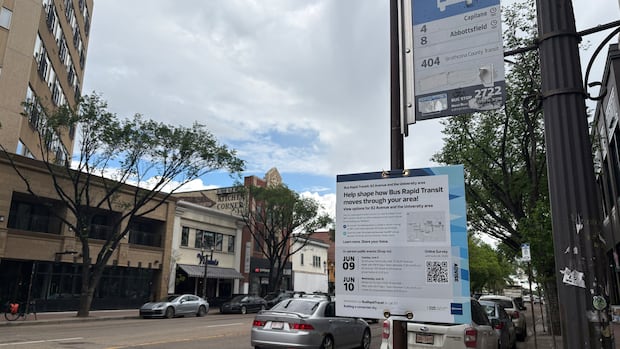
For the last decade in Edmonton, conversations about building out mass transit have been centred around LRT (light rail transit) — the cost, construction and opportunity.
Now, the city could be going full steam ahead on another way of moving large groups of people around: bus rapid transit or BRT. If advanced by council, the system will come with its own host of challenges and benefits.
With Edmonton potentially joining the ranks of other Canadian cities investing in BRT, CBC News examined how the system works and why it might be edging out LRT as the future of mass transit.
What is BRT?
“We’re talking about effectively an LRT system, but on rubber tires,” former city councillor and BRT enthusiast Tim Cartmell said in an interview.
City of Edmonton communication materials say the idea is to have buses travel in dedicated lanes, arriving at frequent intervals to larger stations and serving a high number of riders. These buses also typically get priority at intersections and have fewer stops, a city survey says.
The city says all of this would be designed to efficiently move people at high speeds.
David Cooper, a transit expert at consulting firm Leading Mobility, said BRT systems are more scalable and flexible than LRT, which has made it popular in cities like Vancouver, Winnipeg and Halifax.
“If we want to be nimble and build out our networks and have that access to service, which is usually the thing that people want the most is frequent service that they can rely on, bus-based rapid transit is the way that Canadian cities are going,” Cooper said.
What’s being proposed?
There are two BRT routes being proposed by city officials in Edmonton. One would run north-south from Castle Downs to Century Park. The other would go east-west from West Edmonton Mall to Bonnie Doon, passing through Old Strathcona and the University of Alberta.
The routes are currently in the planning stage, with feedback sought by an online city survey on the configuration of the university and Whyte Avenue portion of the plan. The bus lane could either run along the middle of the road or along the outside curb of the street.
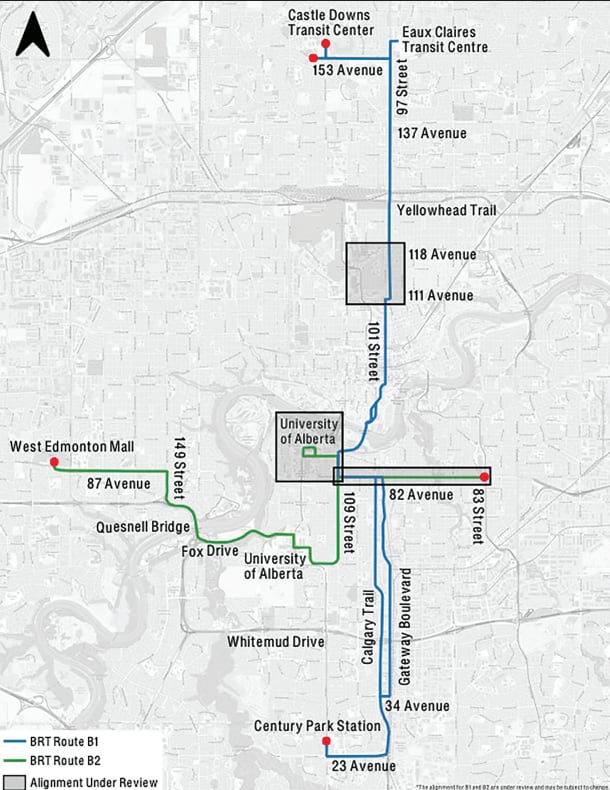 There are two planned BRT routes so far in Edmonton. One would run north-south from Castle Downs to Century Park and another east-west from West Edmonton Mall to Bonnie Doon. (City of Edmonton)
The draft concept plans online show both options mean on-street parking would be eliminated for much of Whyte Avenue.
City councillors will decide during budget discussions later this year whether the routes will get funding to move forward.
Why now?
Discussions around BRT date back to the early 2000s in Edmonton, with a 2015 advisory board report noting it had taken a back seat to the city focusing on building out its LRT network.
Outside of LRT extensions that are currently underway, the city has no further LRT projects planned for the next 10 years. Councillors have frequently discussed over the last year how rising costs, the city’s existing debt load and a lack of outside funding leave very limited room for big capital projects.
Factors like that have left Coun. Erin Rutherford wondering if a planned LRT to the city’s northwest would be better replaced with BRT for the time being, calling the LRT extension “a pipe dream” earlier this year.
All that rings a bell for Cartmell, who was pushing for BRT to replace the Valley Line West back in 2018.
“There’s no money left for any of the big projects because we’ve spent all of this money on LRT,” he said. “So I think there’s a bit of regret there. The question is, what do you do now?”
Cartmell said if the city goes all in on BRT, it can start to build ridership over time. That can create a business case for turning bus lanes into LRT further down the line.
Is it really cheaper?
Cooper noted that a big appeal of BRT is the more manageable upfront costs and shorter lead times for systems to come online. But he acknowledged when you factor in higher life-cycle costs for buses, things are less clear cut.
Council’s 2018 discussion found that BRT can actually cost 20 to 30 per cent more in the long run.
A report from that time said that’s because an LRT holds more people, the cars last longer and they require fewer drivers.
That report and Cooper noted that, historically, LRT has also had more success attracting investment and development around it.
WATCH | Could bus rapid transit be Edmonton’s next LRT?:
Bus Rapid Transit could be coming to Edmonton. Here’s why
The city might be going all in on Bus Rapid Transit. CBC’s Emily Williams explains how the system works and why it might be edging out LRT as the future of mass transit.
Whether that math still rings true is up for debate. City administration is currently preparing a BRT-LRT comparison for the city’s northwest Metro Line extension, to assist councillors in understanding the pros and cons.
There’s also considerations around expanding the bus fleet and building garages needed to service these rapid lines. City council has been working to set aside money to update the current aging fleet and address a lack of bus storage.
What do people think?
“There’s an eloquent dance that needs to happen,” Cooper said about putting BRT onto a road like Whyte Avenue.
He said the city will need to balance commercial needs like deliveries and parking and the desire to have high-quality service to encourage people to take transit instead of their vehicles.
Another obstacle noted by Cooper: people just tend to like trains more.
“The train is more reliable,” transit rider Brenda Ramirez told CBC News at a Whyte Avenue bus stop last week. “The buses say they will come at a certain hour and they don’t.”
Ramirez said she thinks BRT is a good idea overall, but wondered if it could make things worse on the already congested main road through Old Strathcona.
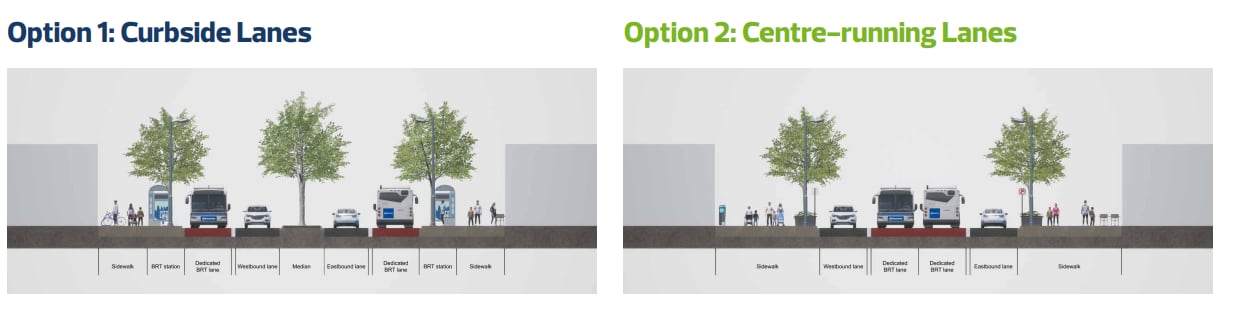 Edmontonians in a survey that closed June 24 could select if they would prefer curbside or centre-running lanes. (City of Edmonton)
Justin Theissen said he’d be more likely to take the bus if there was BRT, but added he believes the bus does have a perception problem for some Edmontonians.
“There’s kind of a thing people have in their heads about taking trains: they’re more exciting,” he said.
“There’s a little bit of a negative connotation with bus riding. You get different types of people on the bus and some people might be a little apprehensive.”
Cooper said putting in a BRT line can be disruptive in very similar ways to rail projects, but he believes it tends to be worth it in the end.
“When these projects come in and people see how they look and feel and they get to experience it, usually the public is happy with it after.”