
A new report on chronic absenteeism in Winnipeg schools is recommending including students more in policy decisions, strengthening ties between schools and community organizations and doing more outreach in and out of the classroom for those at highest risk.
A theme from a recent summit on truancy in the Winnipeg School Division was how the challenges facing chronically absent students are better understood as an “indicator of unmet need rather than disengagement or non-compliance,” the ensuing report says.
“A key reflection from the summit is that attendance cannot be meaningfully addressed through isolated interventions,” the Student Absenteeism Summit Report states.
“Chronic absenteeism is often the result of interconnected social, relational, and systemic factors which require coordinated and sustained responses.”
About nine per cent — 2,908 — of the nearly 31,000 students in the division were considered chronically absent in the 2024-25 school year, roughly the same percentage as the prior year.
The division defines severe chronic absenteeism in elementary school as a student absent 20 per cent or more of the time. In high school, students that miss 20 classes or more in math and language arts courses through the school year are considered chronically absent.
The recent summit brought together people from across the school division, and community and cultural organizations.
The related report suggests the “strongest protective factor” against absenteeism is solid relationships with adults and peers.

Community activist Sel Burrows says there needs to be more culturally appropriate supports outside the school system devoted to getting kids to school. (Holly Caruk/CBC)
The report underscores the need for more culturally appropriate inclusive environments and curricula amid disproportionate barriers and systemic inequities facing Indigenous students.
Among other recommendations, the report suggests creating more formal structures for engaging youth on policy, school design and program development.
The report recommends addressing systemic barriers related to housing, transportation, food security and intergenerational trauma because they’re among the “central drivers” of truancy.
“Sustained progress will require coordinated action across sectors, a commitment to flexibility and responsiveness, and a continued focus on building trust and connection,” the report says.
Inner-city community activist Sel Burrows participated in a panel at the summit.
Burrows agrees with a part of the report that suggests absenteeism can’t be considered as an isolated issue for the school community to solve on its own.
“The problem is larger,” he said.
Many students counted as chronically absent have been apprehended by the child welfare system, are in foster care or living with adults on social assistance, Burrows said.
“They’re all the same kids, and we need to focus on getting hope and help into those families so those children aren’t destined for a life of poverty,” he said.
“We can’t just talk generalities about relationships. We need to get help into those homes.”
Burrows hoped for more concrete recommendations in the report.
“If a child has a learning disability and is in school, we hire a teacher’s aide to work, help with the teacher,” he said.
“If a child is not attending school, we need to hire culturally appropriate staff who will go into the home and will help the [parents] get those kids off to school …. Otherwise, Manitoba will continue to have the highest poverty rate in Canada.”
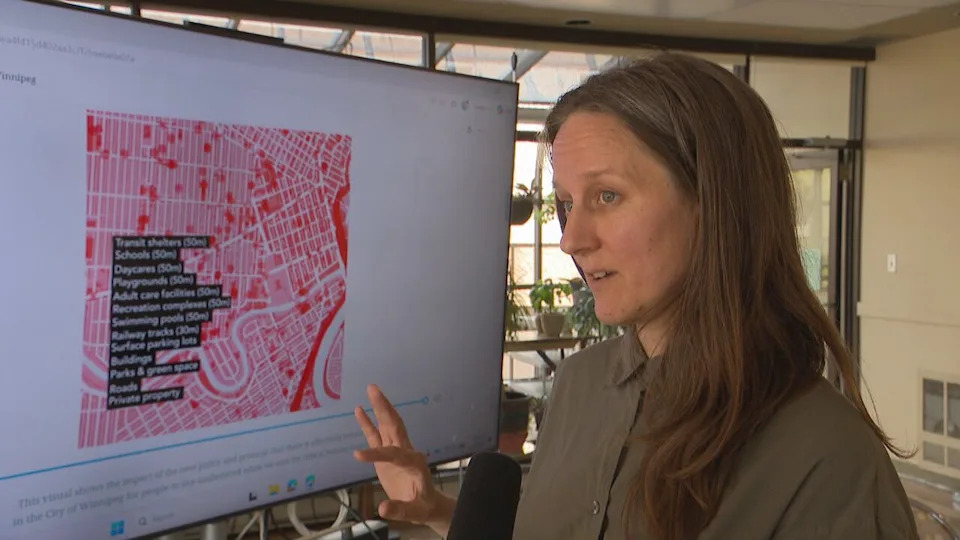
Kate Sjoberg, executive director of Resource Assistance for Youth, helped produce a similar report for another city school division in 2019. (CBC)
Kate Sjoberg, executive director at Resource Assistance for Youth, suggested many of the insights surfaced in the report, while valid, aren’t new.
Sjoberg and University of Winnipeg Prof. emeritus Jim Silver produced a report for Louis Riel School Division in 2019, when it was looking for ways to improve educational outcomes for students living in neighbourhoods experiencing poverty.
Like the new report, the 2019 analysis found strengthening connections between schools and community organizations led to better educational outcomes.
“So, yeah, good idea,” Sjoberg said. “We know that’s a good idea.”
Seven years after Louis Riel School Division’s report, she said the federal Winnipeg Centre riding continues to post the highest urban child poverty rate in Canada. The social challenges associated with that poverty aren’t something stronger ties between schools and community organizations can fix on their own, Sjoberg said.
“In my work at LRSD, we saw how issues like hunger, issues like violence having occurred in the home or in the community in the night before the the kid comes to school, how that … ability to learn, ability to be engaged in the school environment would impact anyone’s life,” she said.
“As we’ve seen the poverty crisis get worse, of course, we’re seeing matters like absenteeism get worse.”
Manitoba’s NDP government has been trying to address barriers to education through a universal school nutrition program, pledging to make transit free for youth later this year and ongoing efforts to add more educators to the system “to ensure students receive more individualized attention and stronger connections with their teachers,” Education Minister Tracy Schmidt said.
She said in a statement that attendance is a top priority and she knows “schools cannot address absenteeism alone.”
Schmidt suggested the NDP is taking steps to break down barriers, in part through building relationships with partners “to ensure students are present, engaged, and set up for success.”
CBC News sought comment on the report from the Winnipeg School Division but didn’t receive one ahead of publication.