
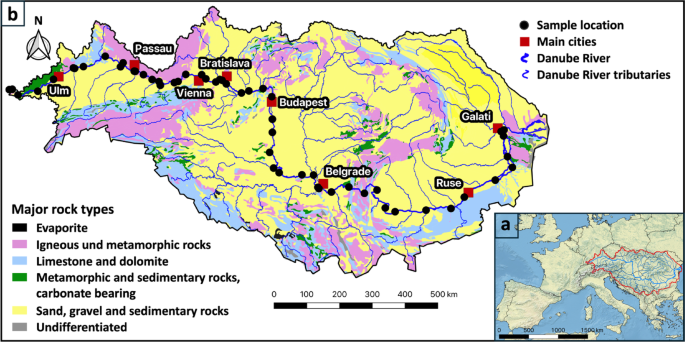
Spatial variations in DIC concentrations along the Danube River reflect the interplay between bedrock weathering, subsequent groundwater input, and hydrological mixing along the river continuum. Upstream of the Inn confluence (∼2,225 km from the mouth), DIC systematically increased across all seasons (Fig. 2a–d) and marked the transition from silicate-dominated headwaters of the Black Forest to the carbonate-rich upper Danube region49 . A particularly steep increase to ∼5.3 mmol L− 1 occurred within the karstic section near Immendingen and Fridingen (river km ∼2,740 to ∼2,720), where enhanced interaction with carbonate aquifers led to elevated concentrations of weathering-derived DIC30, 50. This karst-mediated groundwater recharge likely accounted for much of the pronounced DIC increase between the headwaters and river km ∼2,600 and coincided with the dominant role of carbonate bedrock in supplying geological DIC to ground and surface waters in karst terrains51, 52, 53 . Parallel increases in HCO3− and Ca2+ concentrations further confirm the strong carbonate-weathering control on DIC dynamics in the upper river (Supplementary Information II Figs. S1, S2): This trend also coincides with characteristic geochemical signals of carbonate dissolution observed in other river systems worldwide41, 54.
Downstream of this karst-dominated section, DIC concentrations gradually declined toward the confluence of the Inn River, primarily after confluences of tributaries Lech and Isar, both of which transport substantially lower DIC waters (4.4 ± 0.1 mmol L-1 and 4.6 ± 0.1 mmol L-1, respectively; Fig. 1; 31, 32, 33). The confluence of the Inn caused further decreases of DIC concentrations. Although the Inn River mostly drains carbonate terrains, its catchment is also influenced by glacial meltwater and rapid runoff from the Alps. These characteristics limit carbonate dissolution and result in comparatively low DIC concentrations (2.6 ± 0.4 mmol L− 1 DIC). Given that the discharge of the Inn is comparable to that of the Danube, this inflow exerts a pronounced dilution effect across all seasons (Supplementary Information II Fig. S3).
Downstream of the Inn, the DIC variability sharply decreased, and concentrations remained nearly uniform towards the river mouth. This homogenization reflects large-scale hydrological integration and the progressive admixture by groundwater and tributary inputs from an increasingly complex geological basin (Supplementary Information II Fig. S3; 30, 36). With increasing catchment size, lithologically diverse subbasins contribute to an average DIC signal that is stabilized by a large, groundwater-sustained pool with weathering of carbonates and silicates. This homogenized input effectively buffers DIC concentrations against local geochemical variabilities. Superimposed on this basin-scale DIC trend, minor deviations occur at major tributary confluences. For example, the Tisa River introduces low DIC water that transposes into a slight decrease in DIC in the middle of the Danube. In contrast, the Sava River drains carbonate-rich terrains and contributes higher-DIC waters. This input in turn leads to a measurable increase in DIC downstream of the Tisa confluence (Figs. 1 and 2; 30).
Moderate seasonal variations were superimposed on this longitudinal pattern. For example, DIC concentrations were lowest in summer and late summer (Fig. 2). These decreases could have been caused by DIC removal via photosynthesis. In contrast, fall and winter exhibited nearly identical DIC levels despite pronounced differences in discharge (Supplementary Information II Fig. S3). This similarity likely indicates a stable, basin-wide mixed groundwater and tributary signal with weathering-derived DIC along the river continuum.
Overall, the longitudinal DIC profile primarily reflects the control of a mixture of carbonate and silicate weathering together with progressive hydrological mixing. The downstream stabilization of DIC highlights the increasing dominance of hydrogeological integration and buffering by groundwater with its weathering products. This process dampens the expression of local and regional geochemical DIC variabilities in this large river system.
In contrast to the uniform DIC concentrations, δ13CDIC provided a more sensitive tracer of carbon sources, sinks and turnover along the Danube (Fig. 3a–d). Across all seasons, the δ13CDIC values increased from source to mouth. This trend coincides with progressive loss of 12C-enriched CO2 during degassing, but similar δSUPERSCRIPT 13 13CDIC values may also arise from carbonate weathering under open-system conditions involving soil CO2. To interpret this longitudinal enrichment, δ13CDIC values must be evaluated relative to the isotope value of soil-derived CO2 and its progression into groundwater. In temperate catchments dominated by C3 vegetation, soil-respired CO2 assumes the value of the original biomass 55. In the Danube catchment we found δ13CDOC values between -28 and -29‰ that reflect the organic matter also in soils. During diffusive transport within the soil pore space, the freshly produced CO2 becomes enriched in 13C by approx. +4.4‰ due to kinetic fractionation. This process yields residual soil CO2 values between -24.6 and -23.6‰ 44. Subsequent equilibration of this diffusively enriched soil CO2 causes an additional temperature- and pH-dependent equilibrium fractionation of about + 8.5‰ between gaseous CO2 and DIC at typical groundwater temperatures of 12 °C in the Danube Basin. Here individual fractionations between CO2(g) and each DIC species (CO₂(aq), HCO₃⁻, and CO₃²⁻) have to be considered.
Under these conditions, δ13CDIC values between -15.1 and -16.1‰ are expected for this equilibrium (gray bar in Fig.3: 43, 56). These values were calculated as the weighted average of the pH- and T-dependent distribution of DIC species (CO2(aq)*, HCO3− and CO32−), each associated with its respective equilibrium isotope fractionations (ε), following Myrttinen et al. 45. Accordingly, δ¹³CDIC represents a bulk signal that integrates species-specific fractionation and their relative abundances under given physicochemical conditions. The absence of such typical groundwater values in the Danube indicates rapid overprinting by CO2 degassing, once groundwater enters the river and dissolved CO2 becomes exposed to open-channel gas exchange. In addition to degassing, photosynthetic uptake of 12CO2 can further enrich δ13CDIC in 13C 57.
The above interpretation assumes that groundwater derived DIC can be approximated by isotope equilibration between soil CO₂ and DIC. This conceptual framework is expected to be the most applicable where sufficient contact times permit extensive equilibration along groundwater flow paths. However, the degree of equilibration likely varies across the heterogeneous hydrogeological settings of the Danube Basin. In particular, rapid infiltration and flow though karst systems may limit equilibration and preserve a stronger impact of weathering derived carbon sources. Furthermore, the relative contributions of groundwater sources with different residence times, flow paths, and lithological settings are expected to vary under different hydrological conditions. Consequently, the equilibrium range presented here should be regarded as a first-order reference endmember rather than a universally applicable groundwater signature. In the absence of basin-scale groundwater isotope data, this approximation nevertheless provides a useful framework for evaluating the downstream evolution of riverine δ13CDIC.
The spring δ13CDIC values revealed a broadly similar downstream enrichment pattern to that of winter but featured two pronounced anomalies (Fig. 3c). At the Inn confluence (black arrow), the δ13CDIC increased sharply by ∼1.5‰ to a value of -9.9‰. This increase reflects the input of low-alkalinity, low-DIC, and alpine glacially derived waters that must have been subjected to CO2 outgassing during steep, turbulent flow (Supplementary Information II Fig. S1). During spring melt, high discharge of the Inn River often exceeds that of the Danube main stem (Supplementary Information II Fig. S3c) and allows the Inn´s isotope signal to dominate downstream of the confluence. Comparable patterns have been reported for other large rivers; for instance, Striegl et al. 58 observed that DIC concentration and δ13CDIC in the Yukon River were strongly affected by dissolution of suspended carbonates in glacial meltwaters. Further downstream, the Sava introduces DIC-concentrated water that is more enriched in 12C (Supplementary Information II Fig. S1; Fig. 2). This input must have caused δ13CDIC values that are closer to those of winter (black arrow in Fig. 3c). Despite draining limestone-rich uplands, the Sava´s chemically buffered, low-turbulence water underwent little CO2 degassing and thus likely retained low δ13CDIC values59, 60 . The fact that the Sava contributes up to ∼25% of total Danube discharge30 , its inflow rapidly dilutes and suppresses the upstream signal. Moreover, influences of photosynthesis likely remained modest during spring because of the relatively low temperatures and limited availability of light. Nonetheless, minor increases in the middle and lower reaches of the river (red arrows) indicate early onsets of biological activities by photosynthesis61 .
During summer, δ13CDIC exhibited the strongest deviations from those of winter, with pronounced maxima in the upper, middle, and lower Danube (Fig. 3a). In the upper reach, δ13CDIC increased again at the Inn confluence, and reached a value of -9.4‰. This enrichment reflects a combination of intensified photosynthetic 12CO2 uptake under warm, light-intensive conditions and the continued input of 13C-enriched meltwater from the Inn River (black and red arrows in Fig. 3a). Despite the persistence of alpine contributions, the relative discharge of the Inn is considerably lower than that of the Danube compared to spring and likely reduced its hydrological dominance and preserved a detectable isotope imprint. The reduced magnitude of the summer δ13CDIC shift therefore likely reflects smaller tributary influence rather than a less enriched source62 . Downstream of the Inn-Enns section, δ13CDIC gradually declined toward winter baseline values as groundwater-derived DIC became more prominent under generally low summer discharge. Further downstream, renewed δ13CDIC increases in the middle and lower Danube indicate localized in-stream photosynthetic enrichment (red arrows), as also observed in other studies of large rivers where metabolism and land use influence carbon isotope composition63 . These sections coincide with reaches that were previously identified as areas of elevated primary productivity (e.g., 20, 64, 65). These biologically driven isotope maxima were sharply interrupted downstream of the Sava confluence, where the inflow of high DIC, and low turbulence water induced isotope dilution, driving δ13CDIC values below the winter baseline (black arrow). This effect was particularly pronounced in summer, when reduced Danube discharge allowed the carbon dynamics of major tributaries to exert a stronger influence. Comparable processes have been observed in other large rivers, where tributary inflows interact with carbonate-rich sediments, leading to dissolution and modification along the river continuum66 . Similar influences by groundwater are also possible but cannot be separated from tributary inputs with the current dataset.
During late summer and fall, δ13CDIC broadly followed the winter baseline as biological enrichment weakened with decreasing temperature and light availability. Reduced discharge and longer water residence times likely promoted continued but slow CO2 outgassing, thus leading to slight but persistent 13C enrichment in the remaining DIC pool during both seasons. These hydrologically stable, low turbulence conditions favor carbonate system buffering and gas exchange over biological turnover and mark the seasonal transition from biologically driven isotope variability towards a predominantly groundwater- carbonate controlled carbon regime of the river with subsequent degassing.
While these processes consistently explain the overall downstream enrichment of δ13CDIC, the relative contribution of different carbon sources remains less well constrained. A potential additional contribution may arise from C4 vegetation (-12.5‰) 43, which has regionally expanded in parts of eastern Europe and may increase C4-derived carbon inputs to soils and groundwater towards the lower Danube67.
To evaluate this effect, we applied a Miller-Tans plot (Fig. 5), where the slopes of seasonal regressions the input δ13CDIC signal and corresponds to the δ13CDIC as it originally entered the river from its groundwater source48, 53 . The derived δ13CDIC source values (-11.2 to -15.4‰) deviate from the expected equilibrium range for purely C3-derived soil CO₂ in the Danube (-15.1 to -16.1‰), particularly during summer, indicating an additional heavier carbon source. Using a two-endmember mixing model based on C3- and C4-derived DIC inputs (Eq. 4), we estimate that C4 contributions may reach up to ~ 27% during summer, while remaining substantially lower during fall, winter, spring and late summer (Table 1). The applied endmembers assume idealized equilibrium conditions and do not explicitly account for spatial variability in land use, groundwater flow paths, or overlapping in-stream processes such as CO₂ degassing and photosynthesis.
Fig. 5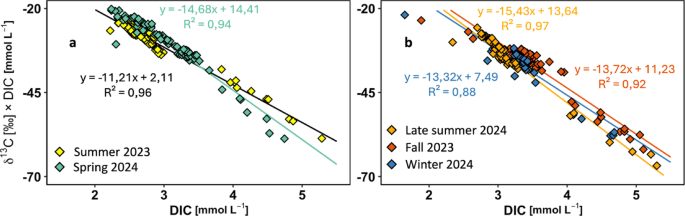
Miller-Tans plots of DIC versus δ¹³CDIC for each season (a) spring and summer, and (b) late summer, fall, and winter. The slope of each dataset represents the δ¹³CDIC signature of groundwater inputs.
Table 1 Estimated relative contributions of groundwater influenced by C3 and C4 vegetation, calculated using the two-endmember mixing model (Eq. 4).
Seasonal patterns indicate the highest C4 contributions during summer, with substantially lower values during the remaining seasons. Minor inconsistencies between campaigns likely reflect uncertainties in the mixing approach as well as temporal variability in groundwater flow paths and source contributions.
Despite this detectable influence, C3-derived carbon clearly dominates at the basin scale. This is supported both by consistently low δ¹³CDOC values (-28 to -29‰), reflecting the prevailing organic matter composition of the catchment, and by seasonal C3 contributions, which consistently exceed 70% (Table 1).
The above considerations rely on a simplified two-endmember mixing model that distinguishes between DIC ultimately derived from C3 or C4-dominated vegetation. Consequently, the estimated contributions should be interpreted as indicative and as an upper-bound approximation rather than strictly quantitative source apportionments. A more comprehensive source framework could additionally distinguish between carbonate- and silicate-weathering contributions associated with both vegetation types. Such an approach would require independent constraints on groundwater endmembers, lithology-specific isotope signatures, and temporally variable groundwater flow paths. However, these parameters are not available for the present basin-scale dataset. Therefore, the two-endmember model should be viewed as a first-order approximation that provides insight into the potential influence of C4-derived carbon on the Danube DIC budget rather than a unique source apportionment. Future groundwater-focused studies would be required to quantify the relative contributions of more complex source combinations and their variability under changing hydrological conditions.
Overall, δ13CDIC integrates the cumulative effects of groundwater-derived carbon inputs that are rapidly overprinted by CO2 degassing. Additional influences include photosynthetic 12CO2 uptake and the admixture of major tributaries along the Danube continuum. The progressively more positive δ13CDIC primarily reflect efficient CO2 degassing, whereas sustained groundwater inputs and carbonate system buffering offer a basin-scale counterbalance to these processes. Superimposed spatial anomalies at major confluences and influences by C4 plants highlight the hydrochemical heterogeneity of this large fluvial system. Other studies have observed similar enrichments in δ13CDIC, though at smaller scales and in headwater regions, emphasizing that such patterns are common feature of large river systems68, 69, 70 .
The consistently elevated pCO2(aq) values along the Danube River confirm that CO2 degassing is a basin-wide and persistent process (Fig. 4a–d). Across all seasons, most pCO2(aq) values exceeded atmospheric equilibrium value of 421 µatm. However, degassing intensities varied seasonally and during fall and winter, pCO2(aq) values remained uniformly high along the river continuum and reflected efficient CO2 degassing under colder, enhanced turbulence, and limited biological conditions. In contrast, during spring, summer and late summer, several river sections even fell below atmospheric equilibrium (red arrows) and indicated localized and transient CO2 drawdown. These pCO2(aq) anomalies spatially coincided with δ13CDIC maxima in the middle and lower Danube and occurred in reaches characterized by reduced flow velocities and a lower river gradient. This river regulation by damming enhanced the sedimentation of suspended matter and led to reduced turbidity and increased light penetration. Together with sustained nutrient inputs from agricultural land use, these conditions likely favored phytoplankton development and elevated photosynthetic activity, which locally reduce pCO2(aq). Comparable summer CO2 undersaturation has been reported for other large rivers, including the upper Mississippi River, where damming and nutrient inputs promote phytoplankton production15 , and the St. Lawrence River, where lake regulation and strong seasonal photosynthesis lead to undersaturated reaches during summer and fall14 .
Independent evidence for enhanced biological activity in these middle and lower Danube reaches with low pCO2(aq) has been previously reported based on dissolved oxygen (DO) and its 18O/16O ratios20. While oxygen data are not re-evaluated here, their documented spatial patterns provide contextual support for the interpretation that photosynthetic activity contributes to localized CO2 uptake during favorable hydrological and thermal conditions. Notably, the magnitude and spatial expression of pCO2(aq) variability differ fundamentally from those of oxygen-based indicators because of the contrasting pool sizes and buffering mechanisms of the underlying dissolved constituents. DO responds rapidly to short-term changes in photosynthesis, respiration, and degassing, owing to its relatively small reactive pool. In contrast, the DIC pool is one to two orders of magnitude larger and is strongly buffered by carbonate equilibrium, weathering with subsequent groundwater inflow, and continuous CO2 exchange with the atmosphere.
Consequently, pCO2(aq) variability integrates biological CO2 uptake with physicochemical control, such as temperature-dependent solubility and carbonate-system buffering. This buffering explains why pronounced seasonal pCO2(aq) fluctuations of up to ∼2,000 µatm can occur even when total DIC concentrations remain stable. Calculated fluxes of CO2 closely follow the seasonal pCO2(aq) patterns. Higher fluxes in fall and late summer correspond to elevated pCO₂(aq) along the river, while lower fluxes in spring and winter reflect periods of reduced or more uniform pCO2₂(aq) (Supplementary Information I). These fluxes provide a basin-wide measure of CO₂ outgassing that integrates the combined effects of degassing and localized biological activity, highlighting the Danube’s role as a persistent CO₂ source to the atmosphere.