

Thanks for reading the Her Hoop Stats newsletter. We’re excited to announce a new partnership with Hudl. Hudl’s industry-leading tools – Sportscode, Instat, and Fastmodel – elevate the preparation, performance, and player development of WNBA and NCAA teams. We appreciate their support and look forward to working with them to help bring more insight about the women’s game to you.
You can find me on Bluesky and Twitter and you can find HHS on Bluesky, Twitter, YouTube, Facebook, and Instagram.
Haven’t subscribed to the Her Hoop Stats Newsletter yet?
For the second time in two years, the WNBA is going to expand the schedule.
The league announced earlier in June that the league would increase the 44 games this season to 50 next year, just a year after the league jumped from 40 games. There were two new expansion teams this season – Toronto and Portland – but the next expansion club will be Cleveland in 2028, so there are no new teams next season.
The increase for this season happened just months after the league announced a new media rights deal worth more than $3 billion in value.
There are a lot of questions that need to be resolved about transitioning to a 50 game schedule. Will there be more time in the season? Will the league footprint extend backwards, into the college basketball season, or forward, into the NBA season when arenas are booked?
More importantly for those in the league, how will the league account for adding more workload onto the players?
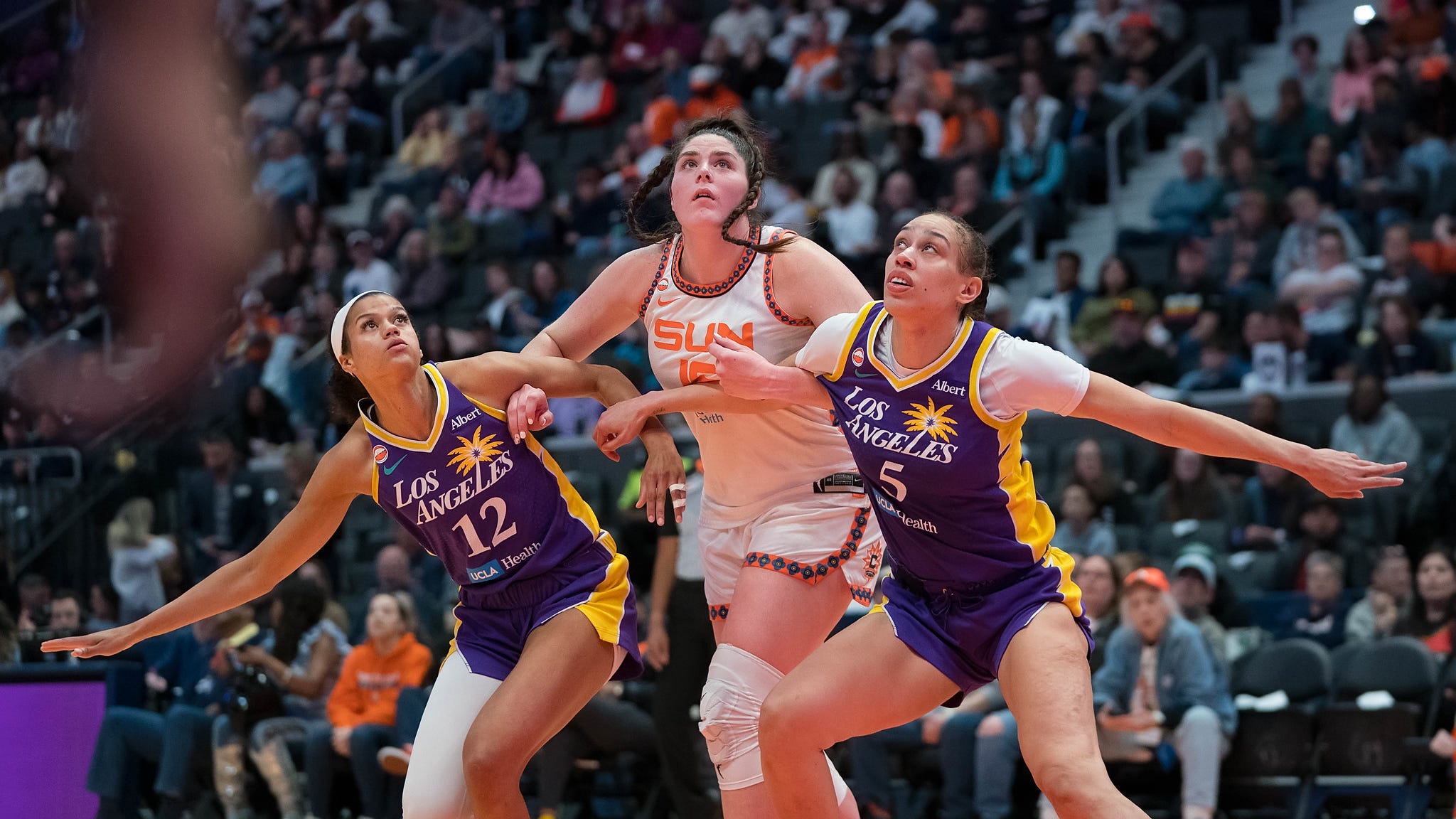 during the WNBA game between the Los Angeles Sparks and the Connecticut Sun at People’s Bank Arena, Hartford, Connecticut, USA on May 30, 2026. Photo Credit: Chris Poss
“I think it needs to be more than 12 (spots),” said Las Vegas Aces coach Becky Hammon. “I don’t know what the language is in the CBA, or how they’re going to negotiate that. I’m sure they’ll take a look at it, you know. At the end of the day, we always want to protect the players, and that should be the number one.”
The new collective bargaining agreement signed this March states that the regular season cannot exceed over 44 games in 2026, cannot exceed 50 games in both 2027 and 2028 and cannot go above 52 regular season games in 2029.
For much of the WNBA’s history, players have primarily played overseas in the offseason. Leagues in Europe and Asia often offer higher salaries than the WNBA has previously, but that’s different this year for the first time ever. The WNBA’s new CBA raised salaries significantly, with a maximum of $1.4 million and a minimum of $270,000 annually.
Per the CBA, the season can begin as soon as April 1 and extend to November 21. There are no stoppages in next year’s season, unlike this September’s FIBA tournament and 2028’s Olympics, which should give a trial run for what a bigger footprint looks like.
But how can the schedule be safe for players, and does it really come down to just adding more roster spots?
“We just need to make sure that we protect the players in that,” Los Angeles Sparks head coach Lynne Roberts said earlier this week. “If it’s kept in the same window that we have now, how is that going to look? We just bounced after the Minnesota game was our fourth game in seven days. Those are hard on players.”
Meanwhile, stateside offseason leagues like Unrivaled and Athletes Unlimited have given players options to stay in the U.S. in the offseason already. Unrivaled especially has been financially lucrative for players, but exists in the first place as a stopgap for players.
“50 games is a lot,” said Atlanta Dream guard Jordin Canada. “But I’m just trying to focus on this season.”
In an ideal world, players could take a full offseason off and be rested. But until then – or, even if the schedule is too compressed – 50 games is a huge ask.
“I think adding the development players and making sure that we always have 12 on the roster has already been huge,” said Valkyries forward Gabby Williams. “That was a big thing that we fought for. I’m just trying to get through this season. It’s hard to think about the 50 next season, but I think we’re already taking steps in the right direction.”
Williams, who represents France internationally, has played overseas in the offseason for her entire career but recently signed a three-year deal with Unrivaled. That’s a big step for her to stay fresh into the WNBA season, since Unrivaled is a far shorter, less intense season than playing overseas.
“More games means more viewership,” said Valkyries head coach Natalie Nakase. “It means more opportunity for us to showcase all the talent in the W. So, obviously, really exciting. Just hope everyone stays healthy.”
The league added two developmental spots for this season, which allows teams to play up to 14 players in a game. The developmental players, though, can play a maximum of 12 games and teams can lose a developmental player to a team willing to put them on the regular roster, such as the Los Angeles Sparks poaching Kiana Williams from Phoenix recently.
Nakase called for more roster spots in addition to the developmental spots earlier this season. Developmental players also make significantly less salary than even a league-minimum player, in addition to leading to a ton of roster math around making moves to fit everyone.
If the WNBA expects a healthy season, they might need to increase those spots for safety’s sake. Injuries are slightly up this season with the addition of games and two more teams. It’s too soon to consider that a trend.
The CBA says teams must carry 12 players and their developmental players don’t count against the cap. But there is room for roster expansion, somewhere, though it doesn’t seem likely in the next couple of years.
“Take care of the players and take care of their health,” Hammon said. “Number one, as you’re trying to form out a plan, that should be number one priority.”
Thanks for reading the Her Hoop Stats Newsletter. If you like our work, be sure to check out our stats site, our podcast, and our social media accounts on Twitter, YouTube, Facebook, and Instagram.