
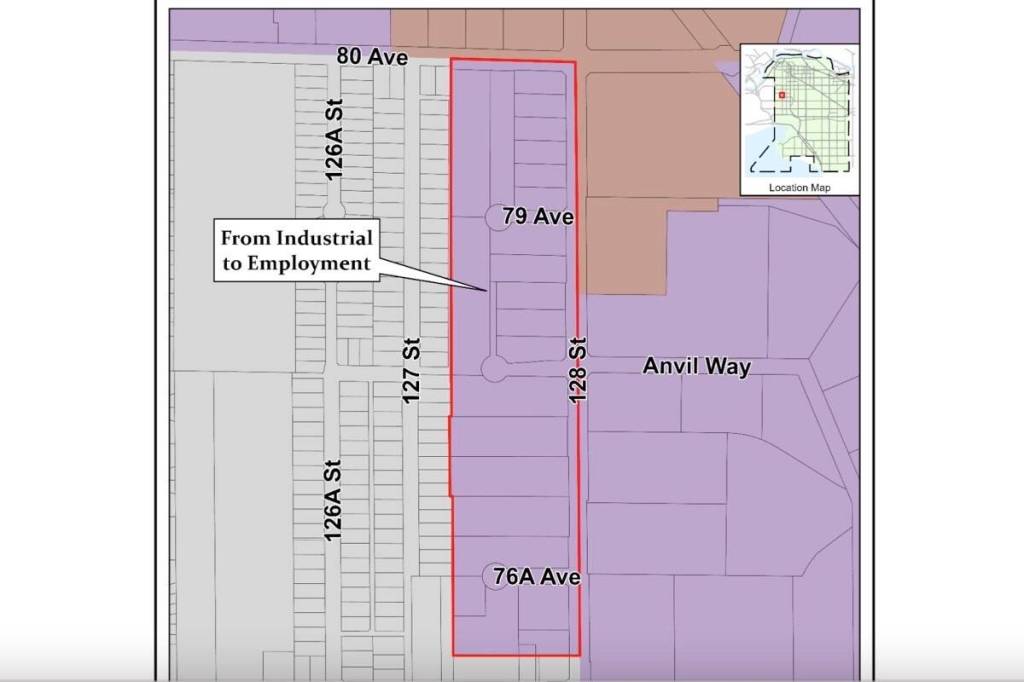
Surrey council to consider changing land in Central Newton Industrial Study Area to ‘employment’ from ‘industrial’
Published 12:15 pm Friday, June 26, 2026
Surrey council will vote on bylaw amendments being brought forward by city staff to re-designate land within the Central Newton Industrial Study Area to “employment” from “industrial” and if passed, it will got to a public hearing.
On May 11 city staff provided council with a status report concerning the area bound by 128 Street to the east, residential lots on the west, 80 Avenue to the north and 76 Avenue to the south. The study area contains 24 lots ranging from 1,800 square metres to 9,500 square metres with the majority zoned for light impact industrial or comprehensive development, permitting uses such as warehousing, office, automotive uses, recycling depots and recreation facilities as well as accessory uses such as coffee shops, community uses and childcare centres.
It’s also immediately south of south of Surrey’s Newton Cultural District – Canada’s largest South Asian shopping district – covering 40 acres “centred on” the intersection of 80 Avenue and 128 Street.
Ron Gill, Surrey’s manager of planning and development, in a corporate report coming before council on June 29 notes that the proposed re-designation is in response to market demand related to the Newton Cultural District and addresses “compatibility issues with adjacent residential uses that were not anticipated when the industrial designation and buffer requirements were established prior to the small-scale multi-unit housing legislation, as well as the need for flexible employment land designations in an area with good transit service.”
The study area directly abuts residential properties.
Gill noted in May that while industrial uses next to housing “can create compatibility issues, these are typically managed through requirements such as landscaped buffers and minimum building setbacks from residential lots.”
City staff sent a survey to property owners in the area on May 19. Gill summarized the response as 14 per cent indicated support for the proposed redesignation, three per cent opposed, that only five per cent of the mailouts were returned, and that 78 per cent of the property owners “received the mailout but have not indicated their position.”