

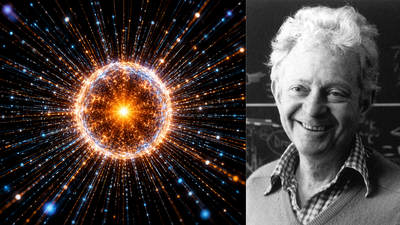
 Image(s): Left/AI Generated/Right/Wikipedia For decades, physicists searched for a missing piece of nature’s puzzle, an elusive particle believed to explain why matter has mass. Nicknamed the “God particle”, the Higgs boson became one of the most sought-after discoveries in modern science. On July 4, 2012, researchers from the European Organisation for Nuclear Research, or CERN, announced their discovery of a new subatomic particle consistent with the Higgs boson, a particle theorised to have existed for almost half a century. This discovery has made the final piece of the puzzle regarding the Standard Model of particle physics. However, despite the exciting name, the Higgs boson is not the particle that built the universe; it explains how the universe we know could exist at all.
What is the Higgs boson and why is it called the God particle
The Higgs boson is a subatomic particle linked to the Higgs field, which is an invisible energy field presumed to be everywhere in the universe. In accordance with the Standard Model of particle physics, particles gain mass through interaction with this field, and the more they interact, the heavier they get.If there were no Higgs field, then particles would move at the speed of light and never join to make up atoms, molecules, planets, or life forms.The expression “God particle” did not originate from physicists. According to the Nobel Lectures, Physics, it became popular after Nobel Prize-winning physicist Leon Lederman’s 1993 book The God Particle. Lederman later explained that the title was chosen by publishers because it was more commercially appealing than his preferred title, “The Goddamn Particle”, reflecting the immense difficulty of detecting it.As CERN explains:”The Higgs field is thought to permeate all space, and particles acquire mass through their interaction with the field.”The Higgs boson itself is not the source of mass but the observable quantum excitation of the Higgs field, providing experimental evidence that the field exists.
How was the Higgs boson discovered at CERN?
Finding the Higgs boson required building the world’s largest and most powerful particle accelerator.Located beneath the France-Switzerland border, CERN’s Large Hadron Collider (LHC) accelerates protons to velocities approaching the speed of light before smashing them together. These collisions recreate conditions similar to those that existed fractions of a second after the Big Bang.The Higgs boson exists for only an incredibly brief instant, around one sextillionth of a second, before decaying into other particles. Rather than observing it directly, scientists identify it by analysing the distinctive combinations of particles left behind after its decay.On 4 July 2012, researchers working on the ATLAS and CMS experiments independently announced the discovery of a new particle with a mass of approximately 125 gigaelectronvolts (GeV), matching the predicted properties of the Higgs boson.CERN described the announcement as:”The discovery of a particle consistent with the Higgs boson opens the way to more detailed studies.”The discovery completed the Standard Model, one of the most successful theories ever developed in physics, and earned François Englert and Peter Higgs the 2013 Nobel Prize in Physics for their theoretical work predicting the mechanism decades earlier.
What does the Higgs boson reveal about the origins of the universe?
While commonly attributed to the Big Bang, the Higgs boson was not responsible for the birth of the universe.On the contrary, experts suggest that about one trillionth of a second after the Big Bang, the temperature of the universe dropped to levels where the Higgs field would turn on due to a phenomenon called spontaneous symmetry breaking.Prior to the phase transition, the behaviour of elementary particles was identical to that of massless particles. The Higgs field turned on, filling up space, giving rise to the mass of the particles interacting with it; subsequently, atoms were formed hundreds of thousands of years later and, in time, gravitational forces pulled matter into planets, stars, galaxies, etc.In conclusion, the Higgs boson is essential evidence in understanding how our universe came to exist in the manner we know it from its initial highly dense and hot state.Nevertheless, the discovery has thrown light on some fundamental questions that science still fails to answer.Namely, the Standard Model does not provide any explanation for the existence of dark matter, which seems to make up the bulk of the matter in the universe and for the existence of dark energy, causing its accelerated expansion.Physicists are also investigating whether the Higgs field could help explain cosmic inflation, the matter-antimatter imbalance and entirely new forms of physics beyond the Standard Model.More than a decade after its discovery, the Higgs boson continues to be studied with increasing precision at CERN. Every new measurement tests whether this remarkable particle behaves exactly as predicted or whether it offers the first clues towards an even deeper understanding of the universe.