
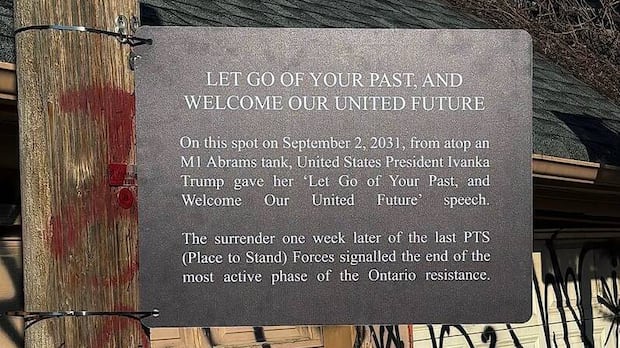
It’s an unusual mission, but Dara Vandor is up for the task. Early next week, the Toronto-based artist will cross the U.S. border and advance toward Boston. Her destination: the Massachusetts State House. Her directive: unleash an immersive art exhibition on the capitol building. But don’t alert the authorities; none of this is top secret.
Vandor’s show opens Tuesday and it marks a new chapter in her series, Pax Americana. The work is set in the near future, and on this alternate timeline, the U.S. has conquered Canada and a fascist dynasty reigns. For the first time ever, Vandor has written how the saga will transpire south of the 49th parallel.
When threats of annexation were suddenly coming out of the White House in early 2025, Vandor began to develop the project. What would happen if Donald Trump snatched up our country like a sack of Big Macs?
Would Canadians fight back, Vandor wondered? “I wanted to create a series that imagined this alternate reality and confronted people,” she told us in March. “This is what life in Trump’s 51st State could look like.”
And so, the artist adopted a new favourite medium: the etched aluminum plate. She took to the streets of Toronto, erecting heritage markers from a possible tomorrow. Before the spring was over, the project had achieved a degree of local notoriety. One plaque, installed on Spadina Ave., became a talking point on Reddit. A tribute to “The Hot Dog Stand” sniper’s nest and the American liberation effort of 2035, the sign’s mysterious origins provoked confusion and delight. Was it satirical? Pro-American propaganda? Theories flew in the thread.
This March, Vandor took Pax Americana beyond the street and opened an exhibition in London, Ont., at Western University’s D.B. Weldon Library. That show, which was extended an extra month, had the feel of a scavenger hunt. Plaques were displayed throughout the building as though they’d always been there.
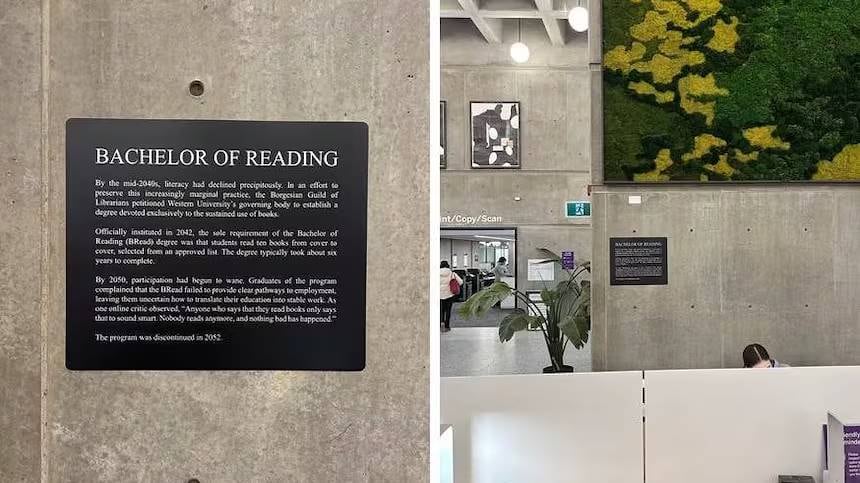 Installation view of Pax Americana at the D.B. Weldon Library at Western University. This sign commemorates a short-lived degree program, the Bachelor of Reading. “Officially instituted in 2042, the sole requirement of the Bachelor of Reading (BRead) degree was that students read ten books from front to back, selected from an approved list. The degree typically took about six years to complete.” (Dara Vandor)
One was a tribute to a “flag-waving rock musical” starring Ryan Reynolds as “America’s favourite ICE Agent — a future blockbuster filmed on the site. Another heralded the library’s “repository for Canadian culture.” Opened post-annexation, it contained an “assortment of hockey erotica and 10 issues of Chatelaine.”
The show attracted media attention (including this feature in CBC Arts), and when the headlines reached Mark Sternman in Boston, he was immediately intrigued. He travelled to London just to see it.
Staking new territory for Pax Americana
Sternman is the chief of staff for State Senator John F. Keenan. Organizing art shows is not in his job description — nor has the Massachusetts State House presented an exhibition from an out-of-state artist, never mind one based in Canada. Still, Sternman believed the show belonged there.
In Pax Americana he saw a reflection of his civic values. “A lot of the work we do here professionally is trying to ensure that the rights of residents of Massachusetts are protected even though they’re often under assault from our federal government,” he says. And though the project’s tone is darkly comic, Vandor’s message couldn’t be more serious.
Hallowed institutions can be hobbled; rights can be taken away; democracy itself is no guaranteed thing. Says Sternman: “As I’m sure you know, we have those issues here in the United States, probably more so than in Canada.”
 Toronto-based artist Dara Vandor is the creator of the speculative art project Pax Americana. (Dara Vandor)
After visiting the show at Western University, Sternman was determined to bring Pax Americana to Boston. Perhaps it would be a wake up call to those who saw it: legislators, staff and tourists alike.
Before he left Ontario, he reached out to Vandor. It was a plot twist she never saw coming.
At the time, Vandor felt like her creative well was dry. She wasn’t planning to continue Pax Americana, and she was perplexed by Sternman’s interest in taking the project Stateside.
“It got a lot of Canadians mad, you know, why would you want to put this into your orbit?” she laughs. Still, she was excited by his pitch. “I think we all have that Canadian insecurity that you’re only successful if Americans are paying attention,” she jokes.
How would the saga play out south of the Canadian border?
Until now, the project has only appeared in Canada for a Canadian audience. “There’s so many references in there that are so niche to Canadians,” she says. “You know, I wasn’t sure it would have a wider resonance. It wasn’t designed to have a wider resonance.” And besides, how many Americans have even heard the phrase “Elbows Up?”
To channel the American mindset, Vandor called on friends in the States. What did they know about Canada? “After the usual cliches about how we’re nice and polite, you know maybe a bit goofy and naive … many of these friends of mine admitted that they don’t really think about us,” she says. Her suspicions were confirmed, but she could work with that.
Canadian anxieties are American anxieties too. Pax Americana could reveal that common ground, and there’s a unique experience both countries are going through right now, she says: “we share a front-row seat to the erosion of one of the greatest cross-border relationships in human history.”
How the Canadian (art) invasion will unfold
For the show at the Massachusetts State House, Vandor has produced 16 new works which will appear in the halls of the capital building. A guide to the plaques’ locations will be made available to visitors, but folks will be encouraged to wander the corridors.
Vandor has also shared the new chapters of Pax Americana online, including the history of The Bacon Hill Maple Tree Massacre. (Post-annexation, migrants from north of the 49th parallel head south. and Boston’s Beacon Hill neighbourhood becomes home to many of these “New Americans.” As a result, the locals derisively rebrand the area — a reference to Canadians’ “ancestral breakfast meat.”)
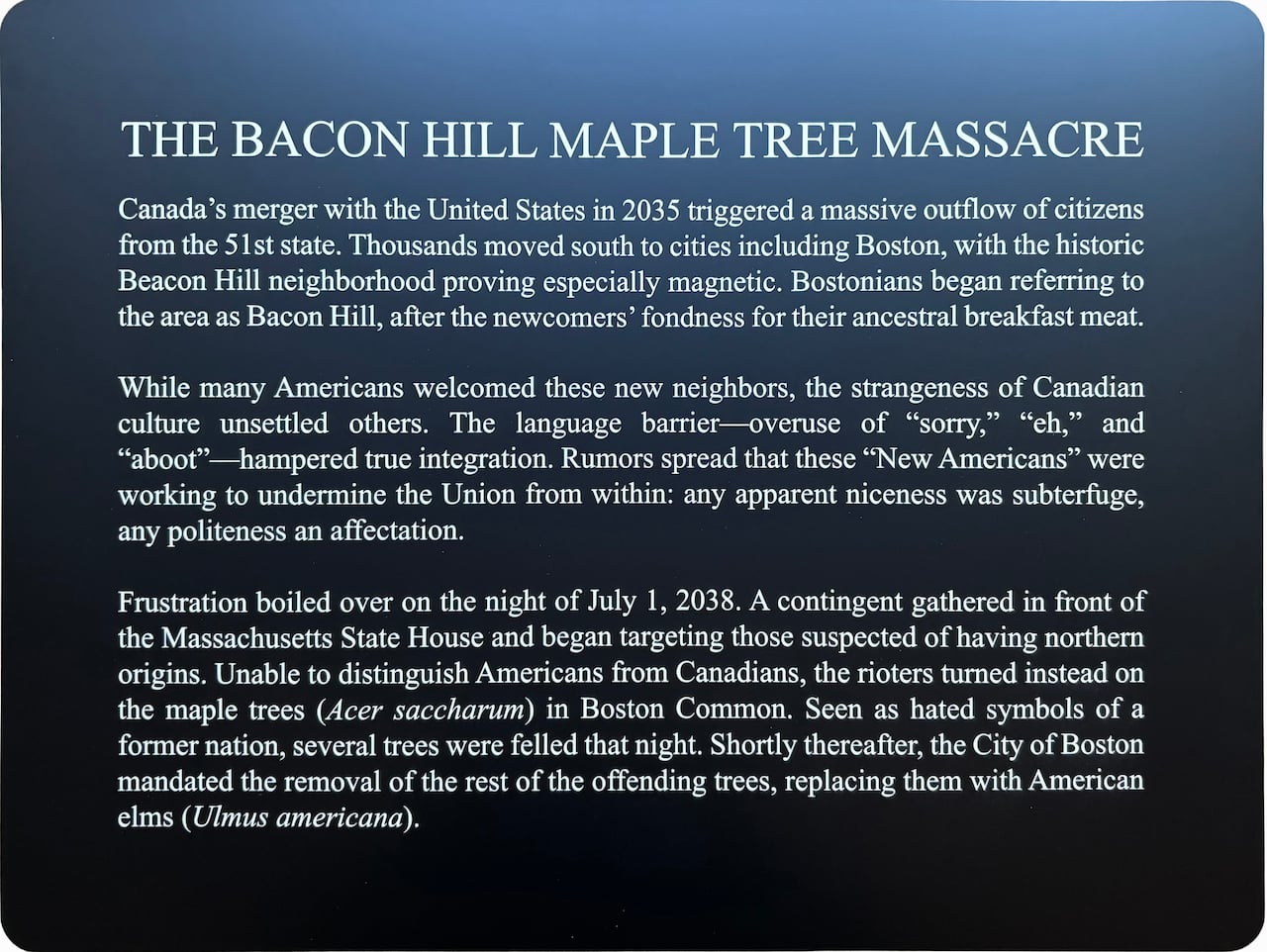 From Dara Vandor’s Pax Americana (Massachusetts State House), The Bacon Hill Maple Tree Massacre. “Canada’s merger with the United States in 2035 triggered a massive outflow of citizens from the 51st state. Thousands moved south to cities including Boston, with the historic Beacon Hill neighborhood proving especially magnetic. Bostonians began referring to the area as Bacon Hill, after the newcomers’ fondness for their ancestral breakfast meat. While many Americans welcomed these new neighbors, the strangeness of Canadian culture unsettled others. The language barrier — overuse of “sorry,” “eh,” and “aboot” — hampered true integration. Rumors spread that these “New Americans” were working to undermine the Union from within: any apparent niceness was subterfuge, any politeness an affectation. Frustration boiled over on the night of July 1, 2038. A contingent gathered in front of the Massachusetts State House and began targeting those suspected of having northern origins. Unable to distinguish Americans from Canadians, the rioters turned instead on the maple trees (Acer saccharum) in Boston Common. Seen as hated symbols of a former nation, several trees were felled that night. Shortly thereafter, the City of Boston mandated the removal of the rest of the offending trees, replacing them with American elms (Ulmus americana).” (Dara Vandor)
Sternman is fond of any entry that mentions hockey, but he’s especially affected by a marker for Harvard Community College. A short-lived institution, it was established in 2041 after its Ivy League namesake was “financially crippled by skirmishes with the fourth Trump administration.”
“On a personal note, Canada’s the best friend the United States has ever had. So to see Washington attack and take for granted that relationship, I’m doing everything I can,” says Sternman. “This is a relationship that we need to protect and strengthen and cherish, not throw away.” He hopes the exhibit will inspire action.
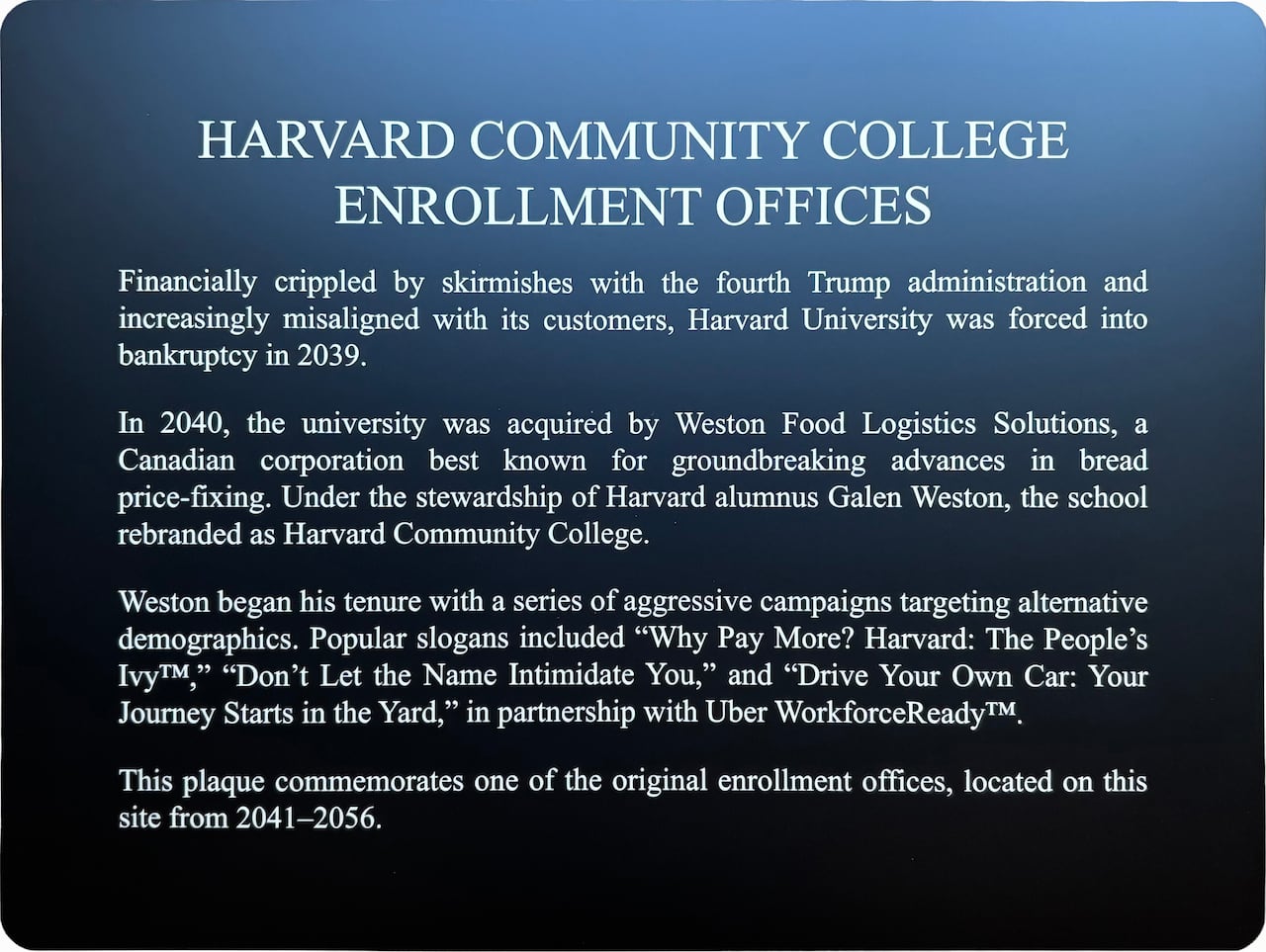 From Dara Vandor’s Pax Americana (Massachusetts State House), Harvard Community College Enrollment Offices. “Financially crippled by skirmishes with the fourth Trump administration and increasingly misaligned with its customers, Harvard University was forced into bankruptcy in 2039. In 2040, the university was acquired by Weston Food Logistics Solutions, a Canadian corporation best known for groundbreaking advances in bread price-fixing. Under the stewardship of Harvard alumnus Galen Weston, the school rebranded as Harvard Community College. Weston began his tenure with a series of aggressive campaigns targeting alternative demographics. Popular slogans included ‘Why Pay More? Harvard: The People’s Ivy™,’ ‘Don’t Let the Name Intimidate You,’ and ‘Drive Your Own Car: Your Journey Starts in the Yard,’ in partnership with Uber WorkforceReady™. This plaque commemorates one of the original enrollment offices, located on this site from 2041-2056.” (Dara Vandor)
“I’m very interested in who’s going to see it,” he says. The Massachusetts State House is open to the public every weekday, Sternman explains. “Anyone can, and believe me, everybody does come in here.” Many of the plaques will hang outside the offices of state senators and representatives, he says — meeting grounds for constituents, lobbyists and staff.
Both he and Vandor are curious to see how the exhibit is received. “Some of the plaques are not flattering,” says Vandor. “Like all the others, there’s a degree of discomfort.”
“I think Dara’s art is kind of making good trouble, as John Lewis, the U.S. Civil Rights leader said. And the fact that it makes some people uncomfortable made me comfortable with the fact that it was worth doing,” says Sternman.
Pax Americana will be at the Massachusetts State House through Aug. 3.
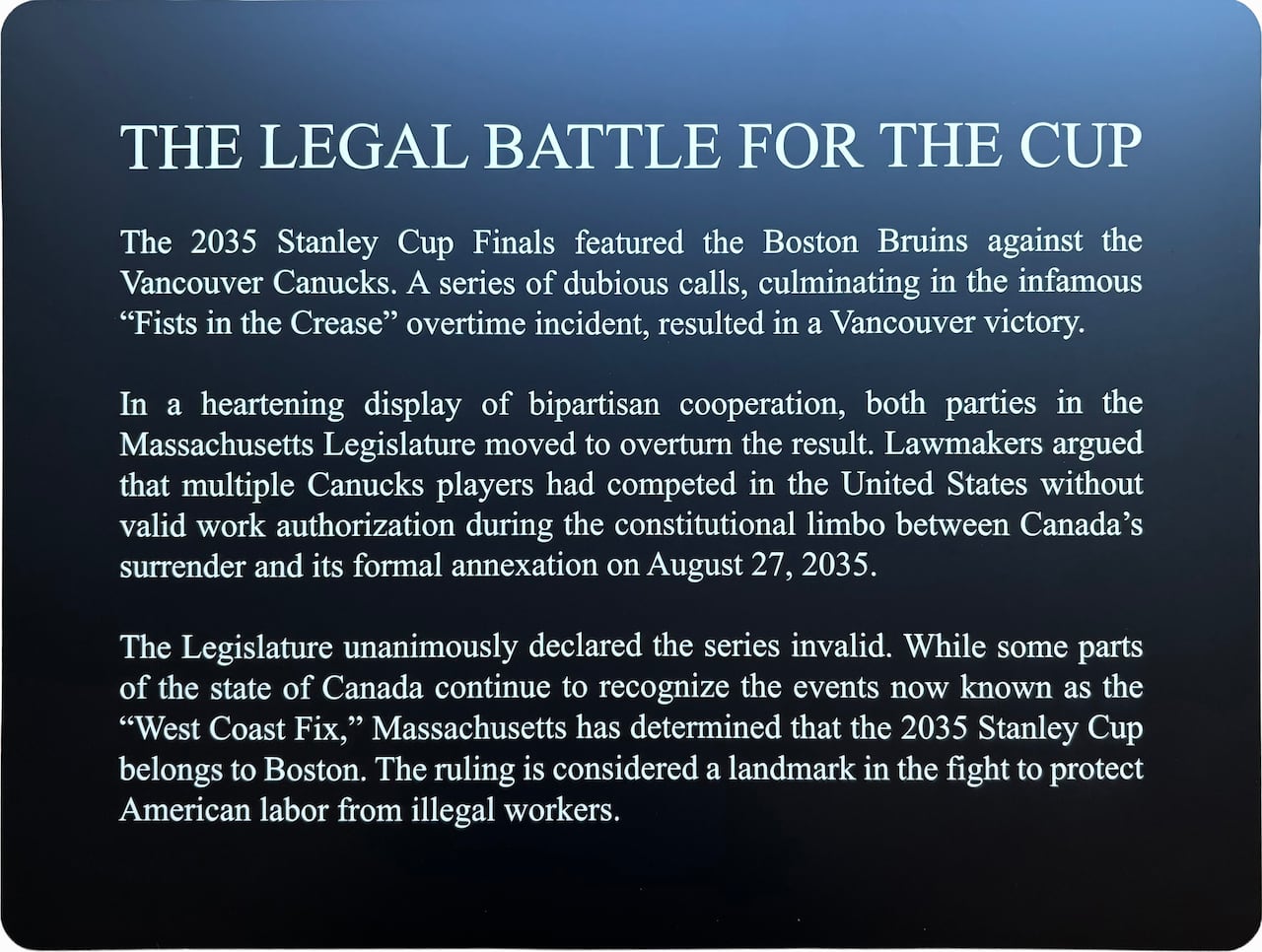 From Dara Vandor’s Pax Americana (Massachusetts State House), The Legal Battle for the Cup. “The 2035 Stanley Cup Finals featured the Boston Bruins against the Vancouver Canucks. A series of dubious calls, culminating in the infamous ‘Fists in the Crease’ overtime incident, resulted in a Vancouver victory. In a heartening display of bipartisan cooperation, both parties in the Massachusetts Legislature moved to overturn the result. Lawmakers argued that multiple Canucks players had competed in the United States without valid work authorization during the constitutional limbo between Canada’s surrender and its formal annexation on August 27, 2035. The Legislature unanimously declared the series invalid. While some parts of the state of Canada continue to recognize the events now known as the ‘West Coast Fix,’ Massachusetts has determined that the 2035 Stanley Cup belongs to Boston. The ruling is considered a landmark in the fight to protect American labor from illegal workers.” (Dara Vandor)