
SEATTLE — Amid the crowds, the loneliest people were the preachers: They bellowed of sin and salvation, of the devil and Jesus Christ, but fans of Egypt, Iran, the World Cup or gay rights weren’t quite the right audience. Friday was Iran-Egypt night in Seattle, on Pride weekend in Seattle, and thanks to FIFA’s cosmic pinball, these two visions of humanity met.
For everyone involved, it was an important match. Egypt recently won its first World Cup game in some 5,000 years, while Iran was trying to get out of the group stage for the first time in three millennia, give or take. Egypt needed a win to top the group; Iran needed a draw, at least, to escape it. But really, a win.
But before the match started, the crowds had to arrive. All of them.
As diplomacy goes, FIFA doesn’t seem to understand humans beyond parties, football, and contractual agreements, but even FIFA is not so cartoonish as to shoehorn gay rights and conservative Muslim countries to see if it clicks. That said, Seattle’s first annual celebration of gay pride came in 1974, and the date wasn’t going to move, so Seattle’s FIFA organizers decided the two could coexist. Then FIFA popped Iran and Egypt into the slot, which was awkward; homosexuality is either absolutely or effectively illegal in both countries.
Both nations lobbied FIFA to remove any visible support of gay rights from the stadium. And FIFA, which largely bowed to Qatar at the 2022 World Cup, effectively said: What do you think this is, Qatar? So rainbows in the stadium were allowed.
So before the match, the streets were full of flags: pre-Revolution Iranian flags, post-colonialism Egyptian flags and post-Stonewall rainbow Pride flags for all occasions. There were protests against the current Iranian regime. And, of course, the preachers, the hawkers, the media, the right-wing streamers — they, too, looked lonely, except for one another’s rancid company — and the occasional provocateur. All walks of life, and all that.
Demonstrators took to the streets of Seattle on Friday amid the World Cup match between Egypt and Iran. It was just a coincidence that the city’s “Pride Match” ended up as a high-stakes matchup between Iran and Egypt — ultimately a 1-1 draw — and it came with plenty of pushback from both countries. (June 27, 2026)
AP Video
On one sidewalk, a middle-aged woman in a custom rainbow shirt was smoking with a young man who was here to accompany a friend who was cheering for Iran. He smiled, finished his smoke, and left. She lit up again.
“I appreciate different cultures, different people, but we all have a pride in our countries,” she said. “I mean, I’m from the U.S., and I do not support our current government, but at the same time, you could still appreciate people.”
Sounds like the Iranians, I said. She nodded. In Seattle, there’s a concept called The Freeze, which refers to the standoffish nature of people in the city; Vancouver has a similar vibe. It can be hard to make friends there.
“I know even in Seattle, people say, ‘Oh, The Freeze,’” she said. “Yes, we are generally people who keep to ourselves. But I think this allows us the opportunity to be more outward, open and welcoming. Together.”
Then she apologized and ran off into the crowd to hug a pink-haired friend before I could ask her name.
Iranians booed the anthem, and the match began with almost pure chaos. Egypt scored on a scramble in the 5th minute; Iran was stopped on a penalty in the 10th minute; Iran tied the score off their own chaotic scramble in the 13th minute. A few minutes later, an Iranian used a bicycle kick to clear the box. Delightful.
There were some rainbow flags in the stadium, or rainbow shirts, but in the mass of the crowd, they were swallowed up; they were dwarfed by the Iran jerseys, or the Egypt jerseys, or the people in pharaoh costumes. But they were there, under the rainbow flags overlooking the stadium, and they were brave.
Iran has been treated badly at this tournament. The United States government imposed singular, punitive measures on the team as part of the war that America is currently losing to Iran. Several visas for staff and media were denied, the training camp had to be moved from Arizona to Tijuana, Mexico, and the Iranians were given narrow entry and exit visas so they could only come in one day before a match, rather than two for other teams, until this one. And they had to return to Mexico right after a match instead of staying in the same city.
Iran’s government is a blight, but then, so is America’s, at the moment. When the hydration break arrived, everyone booed together. It was 1-1 at the half.
Outside before the match, a bespectacled bearded man wore a T-shirt with the lion and sun that graces Iran’s pre-Revolution flag, but in rainbow colours. Ram Joubin’s family came to Canada from Iran in 1996; he is now an immigration lawyer in Vancouver specializing in the cases of people fleeing countries over homophobia. Many, though not all, are Iranian.
“That regime is trying to make people intolerant, and it’s trying to make the culture intolerant, and Iran has a history of tolerance,” Joubin said. “Tolerance is intuitive. We believe in intuitive freedom, civil liberties, and equality, and that’s just cultural.” He looked around, and there were no fights, no confrontations. Almost everyone was just going to a football match.
“I mean, this is a tolerant city,” said Joubin. “I think people have accepted that, so you know we got the upper hand for once.”
The second half settled into an evening of fierce, sometimes desperate-feeling football. Egypt pushed hard for long stretches in the second half, but Iran held, and then pushed back. Desperation, maybe. Egypt was through with a draw, and even a loss: Iran needed a win to be sure.
Egypt soccer fans celebrated from Seattle to Cairo and in the camps of the Gaza Strip as the Pharaohs kept Iran to a 1-1 draw in their final Group B game in the World Cup advancing Egypt past the group stage at the World Cup for the first time. (June 27, 2026)
AP Video
It became Sisyphean. Iran nearly scored off a corner in the 88th minute, but Mehdi Taremi’s blind backwards header bounced off the bar. Iran drew a free kick in the 93rd minute, and it eventually deflected to Iran’s Shoja Khalilzadeh, who smashed it in.
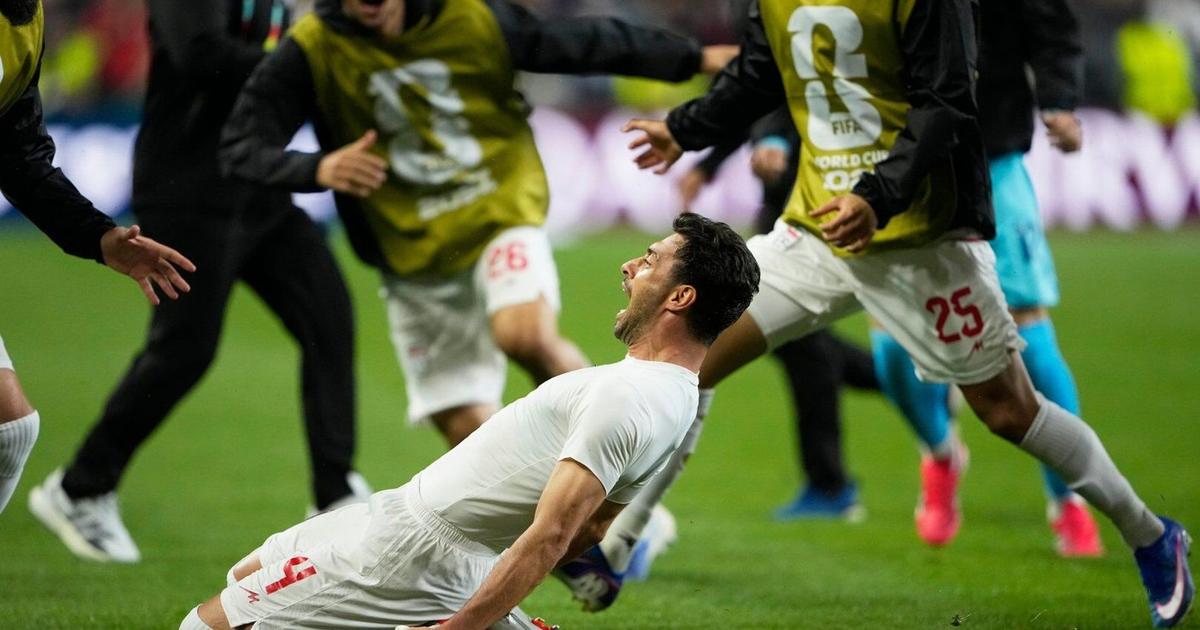
At least half the stadium went mad. A man ran onto the field and was tackled by security. Khalilzadeh stripped off his jersey and put on a pair of Internet-popularized “Deal With It” glasses. Iran was in a position to finish second in the group.
The goal was called back over the barest, smallest offside. Iran kept storming: They had shots in the box blocked, and headed another ball off the crossbar six minutes into extra time.
It ended 1-1. Ramin Rezaeian, who scored the Iranian goal, appeared to be fighting back tears. Taremi, the team’s captain, lay on the ground for a full three minutes, eyes sometimes closed. The Iranian fans had booed Iran’s anthem, which represents the regime. But oh, how they cheered the players.
Before the match, a 36-year-old brewer from Mexico City named Alejandro Cortes was watching the crowd. He works for a hops company in Yakima, in Eastern Washington, and this was the only World Cup ticket he could get. He watched the flags go by: red, white, green and gold; black, white red and gold; all the colours of the rainbow.
“Yeah, I mean, this is the way things should be, right?” said Cortes. “We just get together, and we just want to celebrate unity and being human. And there’s even, like, some Christian preachers in the middle of the crowd, just speaking to their beliefs, and no one’s fighting. I mean, at the end, they are also entitled to their beliefs. So I really enjoy this atmosphere.”
Iran can still advance — and could play a knockout game in Vancouver — but they need some help.
Young supporters celebrated in Tehran early on Saturday after Iran drew 1-1 against Egypt in the World Cup tournament as Team Melli will have to wait a day to find out if they will make it to the next round of the soccer tournament after the Iranians scored a potential late winning goal, but an offside call meant it was disallowed. (June 27, 2026)
Saeed Sarmadi/AP Video
“I’m tired, really,” said Rezaeian, who was still emotional. “I don’t know what’s going wrong with our football, because I can’t see any luck to my team, because we deserve to win the game. At the end, we apologize to my people in Iran, because … they deserve more than everything. They deserve more happiness. They deserve everything.”
Taremi, too, was devastated. He spoke about how FIFA president Gianni Infantino had promised to fix the problems in a meeting with the Iranian team after their first match, but almost nothing had been done. He took responsibility for missing Iran’s early penalty. And he confirmed Iran had to travel back to Tijuana directly after the match.
“It’s a disaster World Cup,” he said. “We do our best. Always do our best. We play for our people. We want them to be happy. We want to bring the joy. We want to send the message: Peace for the people in Iran, outside of Iran, for the FIFA, for everyone. But there is no peace about the others to us. Who (will) solve this problem for us? Who, FIFA? I don’t know, USA? I don’t know.”
Taremi was asked what it meant that this was a Pride match. He plays for Iran, remember.
“In our religion, our religion doesn’t accept that,” Taremi said, “but we respect all of the LGBT people. That’s their own idea. It’s not about us; we are here to play football. We respect all of those guys.”
Those words won’t affect government policy in Iran, or anywhere else. But it’s nice, in these difficult times, to remember you can still be pleasantly surprised.
The World Cup in the United States in 2026 may be a disaster of sorts, but it’s also proof of concept of certain fundamental truths: People want to be together, having fun, and they can do it with people who don’t look like they do. The current American backlash against equality is vicious, yes. It’s a repellent vision of the human future.
But sports really do bring people together in a way that can give you this strange, beautiful hope. That the vision will fail.
Opinion articles are based on the author’s interpretations and judgments of facts, data and events. More details