
When people think of the Calgary Stampede, they probably picture rodeos, chuckwagon races, the famous parade, or perhaps deep-fried Mars bars on the midway. But how about kosher pancake breakfasts, Israeli tech entrepreneurs, and the Jewish businessman who created Calgary’s iconic white cowboy hat in 1949?
For more than a century, Calgary’s Jewish community has woven its own traditions into Alberta’s “Greatest Outdoor Show on Earth.” What began with Jewish homesteaders, ranchers and merchants has evolved into one of the busiest weeks on the Jewish community’s calendar.
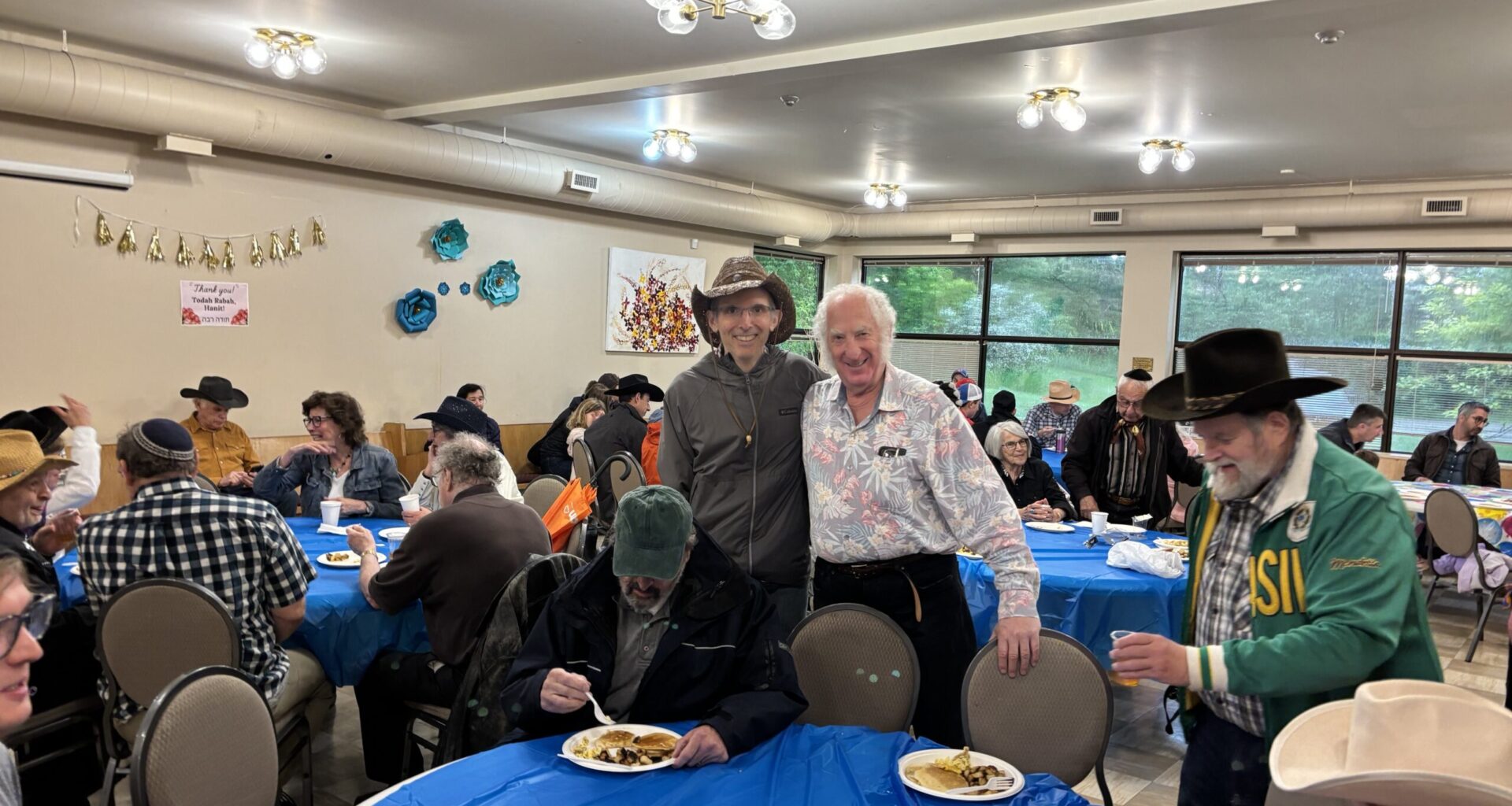
Even before the 114th Calgary Stampede officially begins on July 3, the Jewish community has already hosted two kosher pancake breakfasts: the Calgary Jewish Academy’s Mishpacha & Maple Syrup celebration June 14, while the House of Jacob-Mikveh Israel’s annual community pancake breakfast went ahead on June 27 in the rain, but despite the weather, stll attracted hundreds for flapjacks and pony rides. It’s co-sponsored by the Calgary Jewish Federation and the city’s Paperny Family JCC.
Still to come later this week are the annual “Spuds & Suds” gathering, co-hosted by the Centre for Israel and Jewish Affairs (CIJA) and Canadian Jewish Political Affairs Committee (CJPAC), where Jewish leaders and elected officials mingle over kosher latkes; and the Israeli Embassy’s ShukTech showcase at the Stampede is also set to highlight Israeli innovation and entrepreneurship.
On today’s episode of The CJN’s North Star podcast, host Ellin Bessner is joined by historian Saundra Lipton, president of the Jewish Historical Society of Southern Alberta, and by David Silver, president of the House of Jacob-Mikveh Israel synagogue, who moved to Calgary from Toronto nine years ago, to discuss how Jewish Calgarians have been part of one of Alberta’s defining civic traditions for over a century.
Related stories:
Transcript:
Arena announcer
Ellin Bessner
Every summer since 1912, Calgary comes alive with the sound of the Calgary Stampede. The chuck wagon races, the rodeo, the live country music shows, the parade, and all of the wacky food concoctions sold at the Midway. “The greatest outdoor show on earth”, they call it. A million and a half people visit the Stampede every year, including many from Alberta’s Jewish community, for whom the 10-day Western festival has been a significant part of their own history in the province, dating back to the Stampede’s earliest years.
It began with the first Jewish homesteaders, ranchers, and merchants a century ago who settled the West before the First World War. Today, Jews from all over Alberta come to celebrate Stampede Week in their own way: with free kosher pancake breakfasts, a political networking event called “Spuds and Suds” where premiers, cabinet ministers, and civic leaders gather over kosher latkes, and most recently, “Shuk Tech”, where Israeli entrepreneurs showcase innovation and look for investment.
And that iconic white cowboy hat, the worldwide symbol of the Calgary Stampede?
That’s Jewish too. Created in 1946 by the Calgary company owned by a Russian Jewish immigrant, Morris Shumiatcher.
In previous years, there have been Jewish community floats in the Stampede parade, and Jewish performers have appeared in the Grandstand show. And for a week, the city’s accepted dress code includes cowboy hats and western shirts. Even Calgary’s Jewish Academy students give themselves cowboy names during their school’s pre-stampede pancake fundraiser known as “Mishpacha and Maple syrup.”
A better-known pancake breakfast– for more than four decades – is hosted by members of Alberta’s oldest Jewish organization, the modern Orthodox House of Jacob-Mikveh Israel Synagogue. They serve up free kosher pancakes to hundreds of visitors on the first Sunday before the Stampede starts July 3rd.
David Silver
It’s an honour in some ways to be able to be part of “The Greatest Outdoor Show on Earth
and to do it like not in a place of fear or concern about antisemitism. We can remind us that we’re part of this larger community, too.”
Ellin Bessner
I’m Ellin Besner, and this is what Jewish Canada sounds like for Monday, June 29th, 2026. Welcome to North Star, the flagship podcast of The Canadian Jewish News, made possible thanks to the Ira Gluskin and Maxine Granovsky Gluskin Charitable Foundation.
The House of Jacob’s Kosher Pancake Breakfast may be one of Calgary’s best-known Jewish Stampede traditions. even though this Sunday, June 28th, they had to move it inside the synagogue social hall because it was pouring rain.
But the Jewish connection to Alberta’s biggest celebration goes back much further than pancakes. To tell that story, I sat down with David Silver, a transplanted Torontonian who now makes Calgary his home and is president of the House of Jacob-Mikveh Israel Synagogue, or HOJMI as they call it, and also with the historian, Professor Saundra Lipton. She’s president of the Jewish Historical Society of Southern Alberta.
I guess we can call you the Pancake King.
Welcome to The Canadian Jewish News’s North Star Podcast, both of you.
Saundra Lipton
Thank you. Happy to be here.
David Silver
Well, pleasure to be here and greetings from Calgary.
Ellin Bessner
Well, it’s great to speak to you. So our audience may or may not have ever experienced a Stampede. But we want to talk about it from the Jewish perspective. Historically, the connections to the Jewish community and also what’s currently happening. Before we do like, a bigger picture, David, can you give us a lowdown on the preparations and the reason behind having a kosher pancake breakfast in Calgary?
David Silver
Well, in the midst of Stampede week, the city really comes alive with breakfast being hosted by many organizations, a lot of companies, a lot of nonprofits. But with a lot of these breakfasts, the traditional fare includes, let’s say, bacon, or foods that Jews typically do not eat. So we took on as a HOJMI a number of years ago, just, well, let’s make a kosher stampede breakfast. Let’s make something available to those who want to partake and enjoy and not be concerned about issues relating to Kashrut. So that was, I think, a big impetus of putting this together. And it makes us stand out amongst all the other, again, wonderful activities and initiatives that organizations are putting together to just welcome the community in general. People, just your neighbours and strangers you don’t know to come together, but this is our angle, our way to bring Jews together and also non-Jews who want to just take part in a festivity and feed their curiosity as to what a kosher breakfast is like.
Ellin Bessner
And how far back, you said recent, but I mean, we’re talking, it’s like what, 40 years almost?
David Silver
To my knowledge, it’d be around 40 years. So. There was a revival in some ways of our congregation. It became through an influx of people to our city and youthful energy, sort of in the mid-80s, that really bring a boost to our congregation.
Ellin Bessner
What do you served and how many meals do you serve? Let’s get some numbers.
David Silver
We’ve had from, we have just around 500 to 600 people. But two years ago, maybe for a variety of reasons, political and otherwise, we had over 1,000, I estimated. So picture a lineup going outside of our parking lot, maybe. People waiting half an hour, if not more, to obtain their food.
Ellin Bessner
David, why is it important for the House of Jacob-Mikveh Israel to participate in the Stampede tradition?
David Silver
I think, so we’re not only, not only just part of the Jewish community, we see what goes on around us. We like the Stampede spirit and it’s a way to bring it closer to home. It creates accessibility in some ways. It is a great sort of promotion for the synagogue itself and Federation. So people can come to our property and see, have a closer look at our building, what we do inside, and just get an understanding of who we are and who we are as their neighbours. The relationships we create with the broader immediate community is just I think immeasurable. So we take great pride in that.
Ellin Bessner
Now, Saundra, we just said, David mentioned, it goes back about 40 years, but when did Jews start participating in the civic tradition of Alberta?
Saundra Lipton
Well, I mean, Jews first arrived here in the late 1890s and almost from the beginning were participating in the broader community. But in terms of sort of the goal of the Stampede to celebrate Alberta’s ranching and agricultural roots, the early Jewish settlers, many of them were involved in agriculture and ranching.
The whole essence of the Stampede is not new to the Jewish community.
In fact, they were very, very involved in it, in that kind of enterprise in the early part of the 1900s. And in fact, in 1910, there were more Jews living in rural areas than there were in the cities. Huge numbers that were involved in homesteading and working in the cattle industry.
Ellin Bessner
There’s a famous picture, I think you wrote about it, of the inaugural Stampede parade. with Jewish-owned businesses and stores operated by the Diamond and Joffe families and others in the Stampede back in 1912. Were Jews marching, were they the merchants, or were they even organizing?
Saundra Lipton
In the very early days, I don’t know how much they were involved in the organization of it, but various Jewish businesses had floats in the parade. And later on, there were people very active in the Stampede Association, the organization itself. Harold Milavsky served on the Stampede Board. The founding president of the Jewish Historical Society, Jay Joffe, sat on the Stampede Historical Committee, and he participated in a number of parades with himself and his family and other Jewish members of our community.
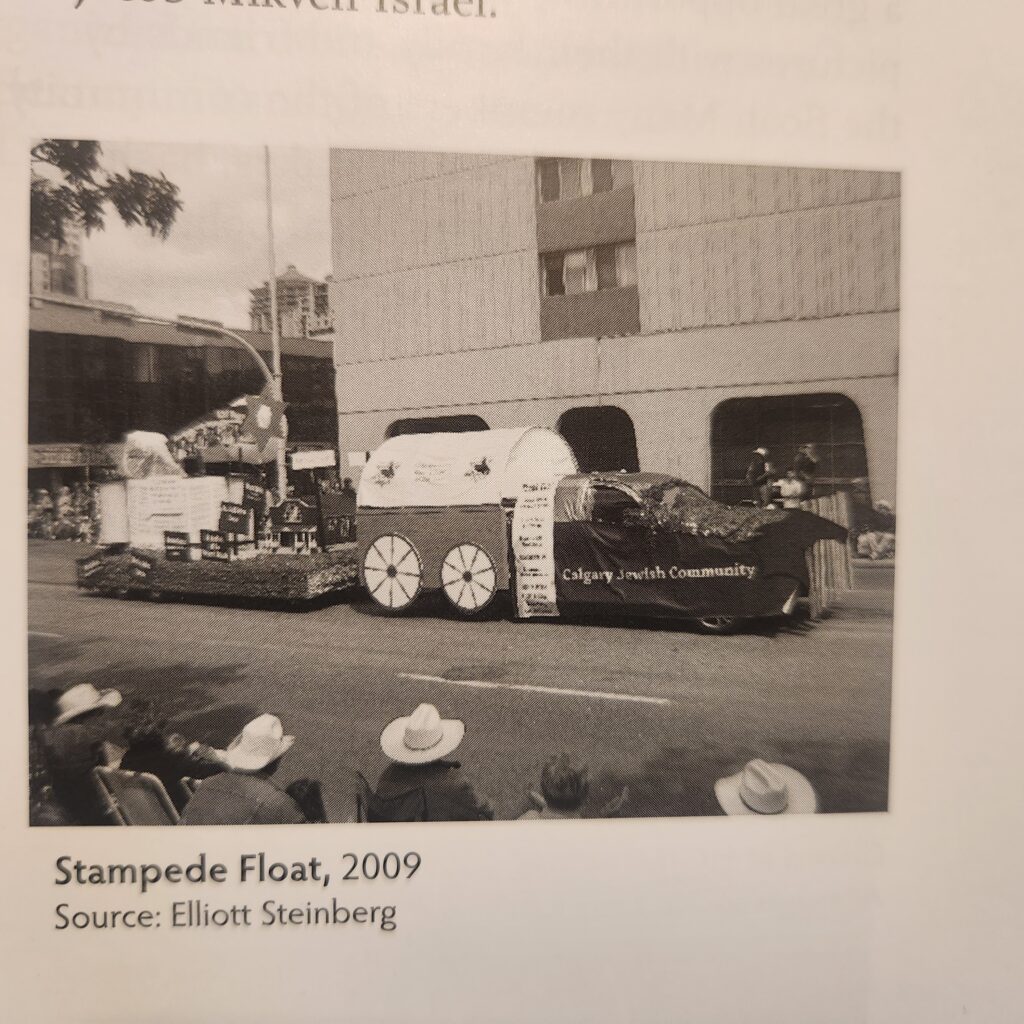
We also were participants in the parade, and in 2009, the House of Jacob-Mikvah Israel had a float, in the Stampede Parade. And that was done to honour the 100 years of the synagogue in Calgary and 120 years of Jewish presence in Calgary and the opening of the Little Synagogue at Heritage Park. So they had this really incredible float that was in that parade.
Ellin Bessner
What was the parade float? Can you describe what they have on it?
Saundra Lipton
The rear of the float design featured a biblical Torah scroll lying against the backdrop of the Rocky Mountains. And it’s open to Leviticus 19:18 with a text bubble translating the phrase, “And you shall love your neighbour as yourself”. And they had an arch projecting from it. And then they had signs identifying various peoples and activities and programs and institutes that showcase the Jewish community’s contributions to Calgary. The front of the float featured a model of the original House of Jacob.
Ellin Bessner
Many provinces and Jewish communities experienced antisemitism, so they weren’t allowed to be part of the merchant guilds or the stock exchanges or the clubs. What was the experience for Calgary’s Jews becoming accepted into such a tradition? Was there antisemitism?
Saundra Lipton
I haven’t done a lot of specific research in this area, but whatever I have done in that period, I have not seen a lot of antisemitism that people seem to be accepted into the communities. And I know when various Jews went out to homestead and they often didn’t have a lot of knowledge about what they were supposed to do, the non-Jewish neighbours in the area would help them.
Ellin Bessner
Do you know anything about how difficult it was to get a pancake breakfast or Jewish participation in the whole tradition?
David Silver
I don’t get the sense that it was a struggle per se to put this together. I don’t think there was any sort of resistance from the larger community. I suspect that it was probably, in some ways, innovative for its time. It, again, brought a different angle of that kosher stamp on there as being something different. And it originally started just as a synagogue activity. It was to serve the membership. And then I guess the leadership at the time, in conjunction with Federation, thought this could be bigger. Like, why not? Why just limit it to the synagogue, especially when geographically we’re next to each other and they’re the, The Federation has greater ties to the larger community. And it was an idea back then to just say, well, let’s work together and increase the numbers, make it an even bigger event. And there’s a lot of buy-in. And thankfully, that seems to have continued till today.
Saundra Lipton
I think that for many, many years, Jewish community has been very active in many different ways with the Stampede, not just with the parade itself, but also being a vendor at the Stampede. There have been families there that have sold jewelry. A jeweler here, the Segals, went onto the site and sold jewelry. There were people that opened food booths. And in fact, Hadassah women, apparently one year had a kosher food booth at the Stampede. The Grandstand Show has had numerous Jewish children participating as Young Canadians over the years. It’s song and dance performing part of the Grand Stand show.
Ellin Bessner
Are there Jewish cowboys and rodeo people and ranch people that go out there do we know?
Saundra Lipton
I don’t I was wondering about that I don’t know of anyone that has participated maybe in the early early years when there were Jews out on the homestead dealing with cows and whatnot.
Ellin Bessner
We have to say which is a very important Jewish symbol of the Calgary Stampede and nobody really knows about the history of the White Stetson. So let’s tell everybody. You’ve got to show us one if you have one.
Saundra Lipton
That is the most visible and long-lasting Jewish connection. Well, I actually have a Smith Built hat, but it’s not white. It was my Dad’s and it’s black.
So Morris Shumiatcher, who actually was a former homesteader near the Rumsey community, he bought a hat company in Calgary, the Calgary Hat Works in 1919. He changed his name to Smith and called his company Smithbuilt Hats. And it remained in his family, this business, until 2002. So it was a long-standing business. In 1946, oilman Bill Heron commissioned Smith to create a white cowboy hat to wear in the 1946 Stampede Parade. Then in 1948, hundreds of Calgarians wore the white hat to the Grey Cup in Toronto, where the Calgary Stampeders won the Grey Cup. And that kind of, I think, just set the hat on its trajectory to becoming what it is today. And in 1950, the mayor of Calgary, Don McKay, established a tradition to present the Smithbuilt white hat to visiting dignitaries. So it’s a continuing tradition today in Calgary to white hat visitors to Calgary.
Ellin Bessner
I’ve seen pictures of, well, now the Duke, but Prince, Prince William and Kate, when they were visiting, they were wearing, you know, the checkered shirt and the, and the Stetson. And I think, I guess it was Prime Minister Stephen Harper was with them at the time on their official visit. So that’s a pretty iconic picture that made all the, you know, British tabloids and everything, right? Yeah.
Saundra Lipton
And the Jewish community also white hats various people that come to participate in activities for us.
Ellin Bessner
So, David, you have a Stetson handy?
David Silver
It’s this sort of straw hat bought at a Western store. I thought soon it’d be fine. So I’ll be wearing this. It’ll be on throughout. So it really has really caught on. And I caught on to the fever moving here nine years ago, and it’s one of the highlights. So I get to be a cowboy for a week.
Ellin Bessner
A Jewish cowboy, and you mentioned earlier that it’s near the JCC and it’s sort of a broader outreach. This has also become a political schmooze fest how Jewish political activists and lobbyists and mingle with politicians. Is that right? Federation presidents in their striped shirts or whatever are schmoozing with politicians. Is that not at your pancake breakfast, but at some other place, but part of the Stampede?
David Silver
Well, it happens, I think, two different places. One, I think it first starts at our Stampede Breakfast, with being tied with Federation, who have these incredible contacts and ways of nurturing ties with local members of parliament, members of the provincial legislature, all of them within our surrounding area of the Shul usually arrive and say hello.
And our mayor, Jeremy Farkas, during his campaign last year to become mayor, dropped by and made a point to be there.
And then in a Federation-sponsored event we call the “Spuds and Suds” event right after the parade, there have been premiers, prime ministers, and all up the political chain that have made a point to drop in and say hello and be part of a sometimes a very well attended and very energetic social event downtown. So on multiple fronts, you could say the ties with political leadership have been nurtured and been kept quite strong.
Ellin Bessner
Coming up, why David Silver feels safe wearing his kosher cowboy pin during the Stampede.
Look, I want to ask you from a personal perspective, what does it mean to be a Jewish Calgarian during the Stampede? this year.
David Silver
It’s an honour in some ways to be able to be part of the greatest outdoor show on earth and to do it like not in a place of fear or concern about antisemitism. It’s we can remind just that we’re part of this larger community too and something to be proud of and just the opportunities it provides to have some fun and to see the city come alive in ways it doesn’t for other times of the year. It’s great and we can proudly say we’re Jewish and have no reservations about that. So it’s a reflection just personally that given the broader times that we’re in, there’s some refuge here that we can live peacefully and have some fun at the same time.
Ellin Bessner
But it’s not an issue for you where it would be in Toronto or Montreal where you have a Jewish event. You would have to have massive security and not tell people where it is and stuff.
David Silver
Yeah, I think maybe it helps inviting the fire department and the police department to just showcase their wares on site. So people seeing their presence there may maybe think twice about God forbid causing trouble, but it hasn’t been really top of mind to create any special added measures to in concern about trouble happening that thankfully we have not seen before. And God willing won’t happen this year either.
Ellin Bessner
Thank you. Saundra, did you want to weigh in for yourself personally
Saundra Lipton
I want to say that it’s a way of celebrating our Western heritage, which we are, as a Jewish community, are also a part of, and, you know, to showcase our history as well as the general community, and to be a part, to interact with the community as a whole, you know, and be friends and neighbours. I have to just mention that when I was a little kid, I was in Calgary visiting my grandparents and…
Ellin Bessner
Oh, you weren’t born there.
Saundra Lipton
No, I wasn’t born there. My parents were both born here, but I wasn’t. And I remember they lived on Seventh Avenue, which was the parade route. And at that point, we just went to the end of their property on Seventh Avenue and watched the parade, which now it’s a production to watch the parade. Yeah. You have to get there really early, maybe buy tickets for a stand. You know, it’s, it’s a big “to do”. And we just walked out of the house and watched the parade, which was.
Ellin Bessner
That’s a beautiful memory. Is there a Jewish float this year at all? Do we know?
David Silver
No, there won’t be one. It was a huge effort back in 2009 to do it. Like, and it was a special anniversary, as Saundra was saying, it was at the right time to invest the energy and the wherewithal to do it. I’d love to see it again, but it’s not on the immediate horizon.
Saundra Lipton
I also wanted to point out that in the early days of the Stampede, a number of Jewish families lived in Victoria Park, which is now a part of the Stampede grounds, and they would rent out homes to people coming in to the Stampede. And according to one person’s recollections, one of the local hotels would actually call her Mom up when they were running short of space and direct people to their house. And they would just rent out like every ounce of space in their house to these visitors coming in to the town.
Ellin Bessner
Jewish Air B n B.
Saundra Lipton
Yeah, exactly, before Air B n B. And then they would Air b n b their backyard for parking.
Ellin Bessner
Look, you know, before we go, for people who don’t know, I mean, I have family roots who came from Romania and farmsteaded in Alberta. But how did Jews get to come in Alberta? What was the history of them arriving and who sent them there?
Saundra Lipton
Well, that’s always the big question I have for my family. Like, why did you choose Calgary? They came in the 1910s and the 1920s. And why Calgary? But it appears that it was someone from that community came first and then sent word back. And then other people came. I know the Jewish Colonization Society was encouraging people to come to Canada also. And so some of that movement could have been, initial movement could have been directly because of efforts on the part of the Jewish Colonization Society.
Ellin Bessner
Well, they would get free land. I mean, moving people out of Eastern Europe to populate neighbouring provinces too in this world.
Saundra Lipton
But they would get loans from the Jewish Colonization Society, so my great-grandparents got loans to help assist on their homestead. Many of them also were shopkeepers too. They were working in these small, tiny communities in the grocery store, the only general purpose store in town. It was tough. They got, you could apply for the land with a very small fee to apply for the land. And then if you worked it for three years, it became yours. So it was one way for them at that point to sell it and then get money to move back into the city. If they could handle sticking it out, because it was rough, very rough, very difficult times for them on the homesteads. Some of the communities like Rumsey and Trochu were very successful.
Ellin Bessner
That’s where my family came from, Trochu.
Saundra Lipton
Oh, they came from Trochu, eh?
Ellin Bessner
My uncle, well, from Romania. Then they went to Trochu and then they’re like, “This sucks. We’re moving to Montreal.” And after a couple of years because the land was no good.
Saundra Lipton
Yeah, some of the land was, which is not great. But some people carried on, you know, up to the forties. There were some diehards there that continued farming and actually had generations of farmers. So their kids carried on for them, but it, after a while, just ended.
Ellin Bessner
We’re gonna wrap up. Is there, before we ask our listeners to write to us and tell us their Stampede memories, is there anything that you think you would like to share that we didn’t already cover?
David Silver
Oh, it’s a great opportunity to be in Calgary. There’s opportunity to live a great Jewish life here. And so it may be seen as distant and not close to major centres, but there, all the essentials are here. It’s got synagogues, you got kosher food, great community federation.
And now there’s no better time than now, if there was not to travel here, to move here and just see what it’s like and you get to enjoy the Stampede.
Ellin Bessner
Why did you move?
David Silver
My wife to be at the time was living here and in the oil and gas industry, which is an Alberta thing. And I kid, there’s more oil in Alberta than there is in Ontario, where I’m from. So I decided to make the move and haven’t looked back.
Saundra Lipton
I don’t think we mentioned about the Hadassah Bazaar because that took place. It’s not part of the Stampede week, but it took place on the Stampede grounds. And for just over 20 years, it was taking place in the Big Four building. So it was a big connection of the Jewish community to the Stampede grounds outside of the Stampede period. Yeah.
Ellin Bessner
That’s interesting. Listen, guys, it’s been so great. I wish I was coming. I know lots of people are. Thank you so, so much for sharing these really interesting historical and present stories. And good luck with the crowds.
Thanks for joining The CJN’s North Star. And that’s what Jewish Canada sounded like for this episode of North Star, made possible thanks to the Ira Gluskin and Maxine Granovsky Gluskin Charitable Foundation.
We’ll be off for Canada Day, July 1st, but we’ll be back with a fresh show on Friday all about the Nakba exhibit with our producer, Izzy Helenchild, who was there on the ground and will report back on what she saw.
North Star is produced by Zachary Judah Kauffman and Izzy Helenchilde. Our executive producer is Michael Fraiman, and Alicia Richler is The CJN’s editorial director.
Do you have memories of the Stampede? Write to us at info at thecjn.ca.
Thanks for listening.
Credits
Host and writer: Ellin Bessner (@ebessner )Production team: Zachary Kauffman (senior producer), Izzie Helenchilde (producer), Michael Fraiman (executive producer), Alicia Richler (editorial director)Music: Bret Higgins
Support our show