
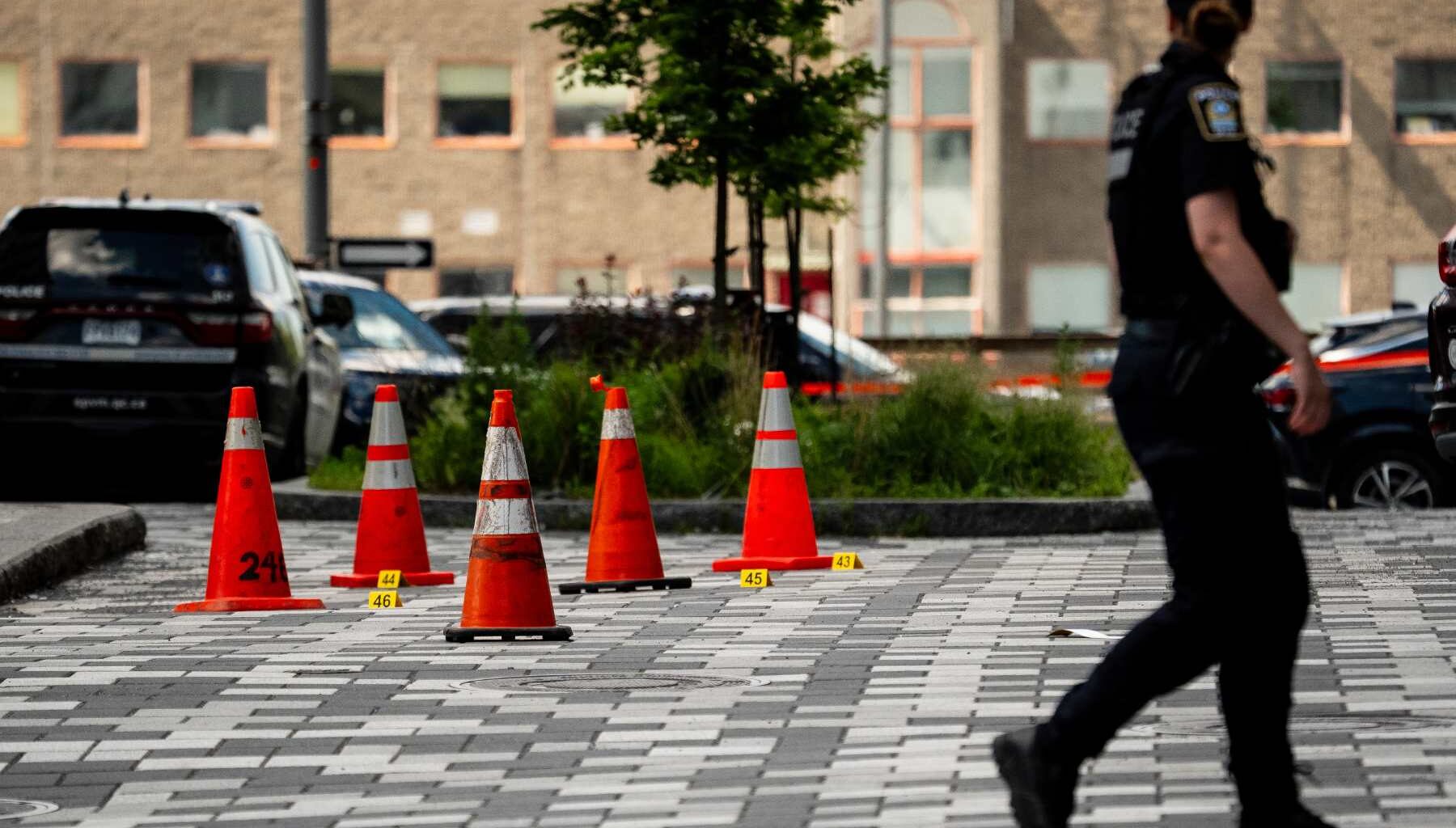
It took mere hours after the June 22 shooting in Montreal for some users in a global incel forum to claim the shooter as one of their own and place him among his supposed peers.
Key points
Scholars say the shooting in Montreal on June 22, and the online reaction to it, wasn’t surprising
The key to preventing incel-perpetrated acts of violence is understanding how the movement is changing
CSIS recommends making the terrorist-listing process more adaptable given the rise in online hate groups
That morning, a man carrying a long gun and outfitted in military camouflage was seen in the Côte-des-Neige neighbourhood in Montreal. Police arrived, and a shootout resulted in three deaths, which included thirty-four-year-old police officer Mohamed Lamine Benredouane, civilian Michel Mizrahi, and the twenty-five-year-old shooter, identified as Seth Hatfield of Alberta.
“He may as well be the Reincarnation of Marc Lepine. 37 years later, he returns to Canada to continue his mission,” reads one post in the forum.
“New Canadian hero who shall sit among Lépine and Alek,” another user posted in the same thread.
Those names, Marc Lépine and Alek Minassian, are frequently evoked in this forum, which boasts more than 40,000 members as self-proclaimed incels and contains more than 23 million posts. (The forum was created in 2017, launched after the Reddit community r/incels was banned.) Lépine and Minassian are often described as though they are luminaries, seminal figures lionized for carrying out two of the worst mass killings in Canada’s history.
Lépine shot and killed fourteen people, all women, at l’École Polytechnique in Montreal on December 6, 1989. In 2018, Minassian plowed through Toronto pedestrians, killing ten and injuring another sixteen. Prior to the attack, Minassian declared his allegiance to the incel cause on Facebook.
Scholars who study incel communities say the Montreal shooting, the ideologies seemingly behind it, and the online celebration afterward are not surprising; they also warn Canada will see more of such attacks. Key to preventing them is to understand how the incel movement itself is changing.
The Toronto van attack in 2018 raised widespread awareness of incel ideology and the forums that fuel it. At the time, media outlets depicted incels as fringe, anomalous, and incongruent with the population’s general beliefs.
Scholars have since broadly found that the expansion of online hate networks in the wake of the pandemic and a deepening unaffordability crisis have laid the groundwork for more ideologically driven violence.
Far-right media outlet Rebel News posted a 104-page manifesto, supposedly authored by the shooter; CBC News later independently verified it. (The Walrus has not independently verified the manifesto.)
The manifesto blames feminism for the “social degradation” of men and also points to capitalism as a supposed tool for women’s liberation that has resulted in men’s apparent harm. The document also lists banks, politicians, “the influence of Zionist Jews,” and various corporations as targets for destruction, including pornography companies.
Kayla Preston, a Toronto-based sociologist who studies extremism and gender-based violence, said that while the jumbled messaging in the latest manifesto can make it more challenging to unravel Hatfield’s ideologies, the language in it ultimately advocates for violence against women. Often, that’s by “harking back to very hardline gender rules wherein women are forced to marry and forced to have children,” she said.
Though incel-fuelled violence has been seen globally in the past few years—including an attack on a massage parlour in Atlanta and a shooting in Plymouth, England, in 2021—it is unusual to see a mix of ideological messages alongside misogyny, said Barbara Perry, a professor at Ontario Tech University and director of the school’s Centre on Hate, Bias and Extremism.
“We are seeing this kind of blending, primarily because of the sorts of things that people are exposed to in online spaces . . . they’re not just getting incel messaging, they are getting anti-authority messaging, they’re getting white supremacist and white nationalist narratives,” she said.
Given its critiques of capitalism, the manifesto looks to denounce structures in our society, she said. That is slightly different, she explains, than views expressed by many past attackers, including Minassian and a man who stabbed and killed a woman at a Toronto massage parlour in 2020; in the latter case, the attacker was ultimately indicted on terrorism charges based on his ties to the incel movement. In both murder cases, the perpetrators primarily expressed motivations rooted in wanting to harm women, rather than myriad beliefs.
How the attacker’s motivation is categorized will affect how law enforcement officials address it. At a press conference the evening following the shooting, Quebec’s minister of domestic security, Ian Lafrenière, said the shooting would not be classified as terrorism. He said the Royal Canadian Mounted Police was consulted prior to making that determination.
Perry said it should be, assuming the manifesto accurately reflects the shooter’s mentality. “I would be very disappointed if it wasn’t pursued,” she said.
Canada moved to include incel violence in its national security framework for the first time in May 2020. In 2021, the Canadian Security Intelligence Service announced that it would move away from describing terrorism as something mainly perpetrated by religious extremists or those firmly on the political spectrum by widening the definition to include ideologically motivated acts of violence. Incel extremism is included in the latter category and can intersect with other forms, including violence motivated by xenophobia or anti-government beliefs.
In this vein, the federal Standing Committee on Public Safety and National Security issued a report in 2022 in which it noted that CSIS is on high alert about a rise in extremism in Canada fuelled by anti-government rhetoric rooted in conspiracy theories that were solidified and expanded upon due to the pandemic. The threat is rooted in a “new breed” of violent extremism that may appear to be perpetrated by a lone actor but that is actually driven by a network and connections to an ideological movement. The report recommended a series of policies, including calling for the criminal code terrorist-listing process to be made more adaptable given the rapid growth of online hate groups, for social media platforms to be compelled to address hate speech, and for law enforcement to be given better tools to track online hate.
There is debate among scholars on whether the terrorism designation for incel-motivated violence is helpful. Academics Reem Bahdi and Fahad Ahmad, from the University of Windsor and Carleton University, respectively, argued in a 2020 piece in The Conversation that the categorization could worsen the already obfuscatory nature of Canada’s intelligence agencies. Placing this form of violence under their purview could give agencies too much power that could be abused, they argue.
Esli Chan, a PhD student at McGill University who has conducted extensive research on incels and the terror threat they may pose in Canada, said that despite efforts from CSIS, violence driven by misogyny continues to be viewed in Canada as a private act, and too often a normalized element, rather than a national terror threat. “This thinking has shifted more in recent years . . . there is more understanding of misogyny and gender-based violence as a public safety issue,” she said.
But, she said, “more needs to be invested in understanding these dynamics, particularly in the online environment.” She said it’s difficult to gain insight into how public safety agencies, including police and intelligence officials, have changed their approaches to online subcultures given shifting definitions of terrorism.
If Montreal shows us anything, she said, it’s the need for more mental health interventions for young men and boys. Preston similarly advocates for a public school curriculum that directly addresses these issues. “That’s really important, especially as the online space is here . . . our young folks are going to be interacting with this for the rest of their lives,” she said.
