
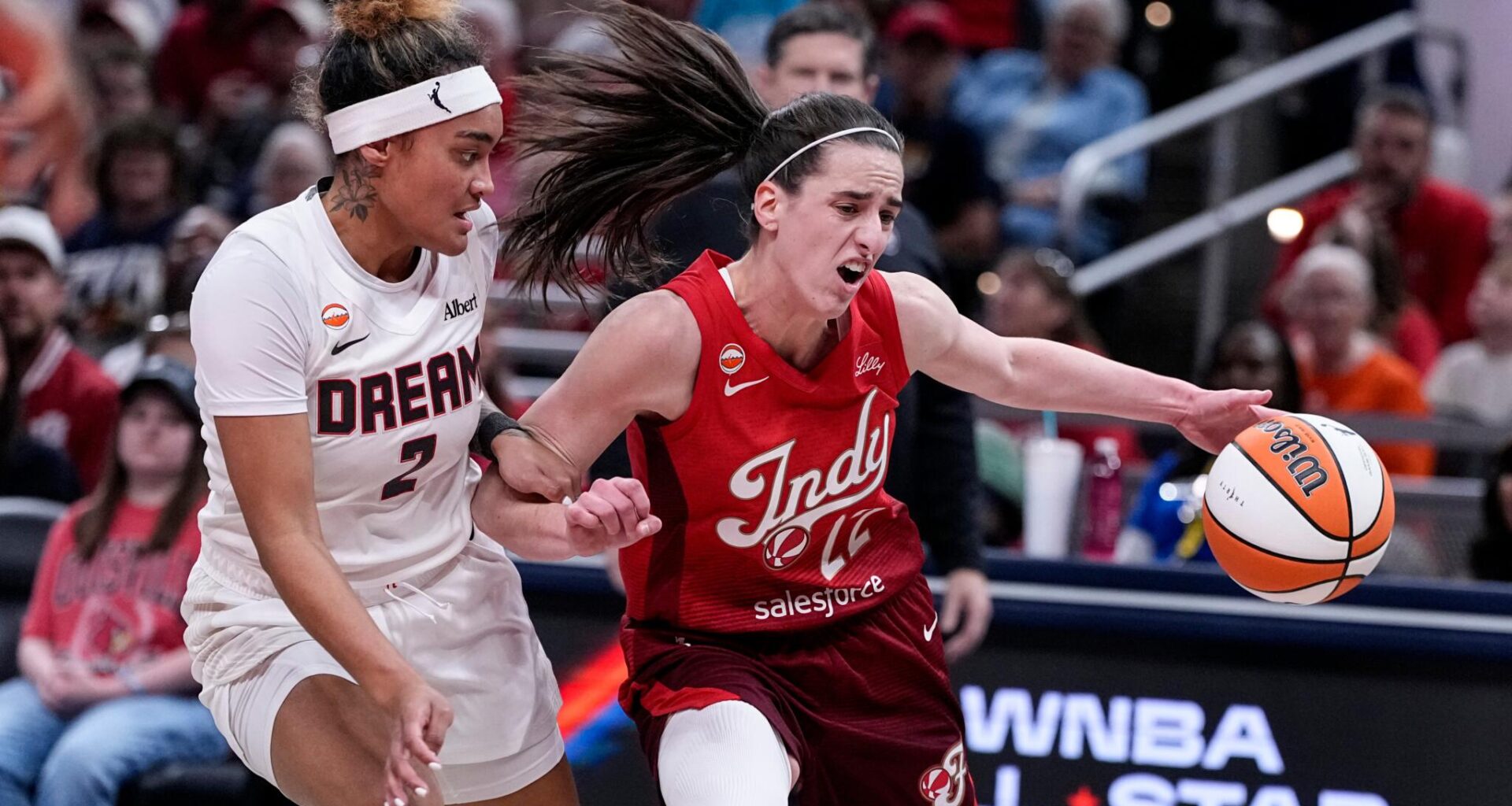
All-time tennis great Billie Jean King couldn’t have been more correct when she called sports a microcosm of society. We try to pretend otherwise — that it’s only entertainment, meaningless pursuits and distractions from the real issues in the world. Every time we do that, sport proves us wrong.
The latest saga with Caitlin Clark, the biggest name in women’s basketball, is a perfect example.
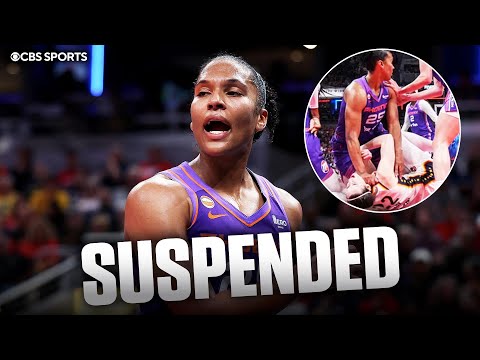
Clark recently had a run-in with Phoenix Mercury star Alyssa Thomas while they fought for a loose ball on the floor. As Thomas used Clark’s body to push herself off the ground, her closed fist momentarily pressed down on Clark’s throat before she got up, stepped around Clark, and continued to play. No foul was called at the time. Play wasn’t stopped. The game went on.
 Load YouTube video
But when a slow-motion replay made the rounds on the internet, outrage and calls for punishment for Thomas flooded social media. Journalists called for Thomas to be suspended and decried the WNBA’s lack of action to protect Clark on the court. National news outlets like PBS and ABC picked up the story.
The WNBA responded by assessing Thomas with a Flagrant 2 foul (which would have resulted in an ejection during the game), a $1,000 fine and a one-game suspension for the unnecessary contact. But that wasn’t the end.
One sports radio personality, former NFL quarterback Boomer Esiason of New York’s WFAN, said the quiet part aloud. After musing that Clark should take her talents overseas, leaving the WNBA out to dry, he said the following: “She’s a straight, white basketball player. And she is not being treated with any sort of respect.”
Naturally, those remarks created their own firestorm of reaction, though it’s also not the first time someone has made similar claims about why Clark is “hated” by other players.
But let’s back up for a second here and talk about why people are saying this.
The Caitlin Clark phenomenon
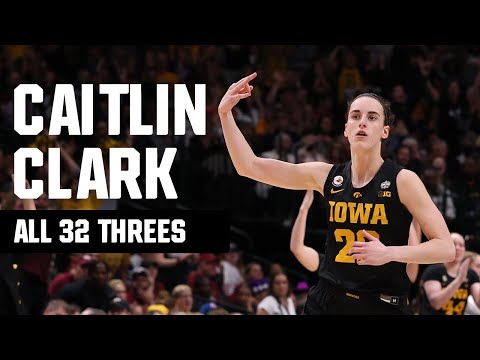
Dating back to her junior season with the Iowa Hawkeyes, the Des Moines native, whose penchant for launching three-pointers from half-court and fiery attitude launched her and Iowa on a Cinderella run in the 2023 NCAA tournament, has become a one-woman box office the likes of which women’s basketball has never seen.
Since she went No. 1 overall in the 2024 WNBA Draft to Indiana, other teams have moved their games to larger venues when they play the Fever because she sells out stadiums. That includes a regular-season game against the Washington Mystics that drew 20,711 fans to Capital One Arena, setting a new record for the highest single-game attendance in WNBA regular-season history.
 Load YouTube video
The WNBA makes sure every single one of her games is on national television —something they’ve never done for any other player. The numbers back up why: ESPN saw a 170% increase in WNBA viewership in Clark’s rookie year, per Nielsen, while the 2024 WNBA All-Star Game drew 3.4 million viewers on ABC, the most-watched All-Star event in league history and nearly triple the previous record.
And the WNBA has benefited massively from the eyes she’s brought to the game. In the three short years she’s been in the league, the WNBA signed a $2.2 billion TV deal with Disney and Comcast, agreed to a strong new collective bargaining agreement that finally allows players to earn more than $1 million on contracts, and has watched the valuations of several franchises jump close to $1 billion.
Plus, everywhere Clark goes, something happens — whether it’s a logo three-pointer, a spectacular pass, a heated conversation with a coach or referee, or what just happened with her and Thomas.
Everything she does — good, bad or indifferent — sets tongues wagging in every corner of digital space.
The new Larry Bird
As a Boston transplant, I’ve often found myself comparing Clark’s meteoric rise in the basketball world to someone fans around here remember well: Larry Bird, who helped propel the Celtics to a golden age in the 1980s.
That comparison isn’t just about their electric playing styles, either. Let me explain.
I grew up in Northwest Indiana in the 1990s, about 40 minutes from where Michael Jordan dominated the basketball world with the Chicago Bulls for 13 years, and about four hours from Bird’s hometown of French Lick near the Kentucky border.
The two places I called home — my grandparents’ house in Gary, a former steel town that is nearly all-Black these days, and the one I eventually moved to in suburban, predominantly white Hobart, about 15 minutes away — couldn’t have been more different.
Everyone I knew in Gary, even my generally sports-averse grandfather, loved basketball, especially Jordan and the Bulls. Gary even had its own semi-pro team when I was a kid, the Steelheads. The local basketball court on 4th Avenue was practically the only thing still standing at the dilapidated park by my grandparents’ house. (The fouls you took on that blacktop made what happened between Clark and Thomas look like a friendly high-five.)
In Hobart, when one family petitioned to add a basketball court to our neighborhood park, several neighbors revolted, claiming the court might attract “unwanted visitors” from Gary and nearby Merrillville who would “disturb the peace.” I’ll give you one guess as to what kinds of people they were referring to.
The idea that basketball automatically signified “Black” wasn’t a new concept.
Bird arrived on the basketball scene in the late 1970s, starring with the Indiana State Sycamores, before breaking out in the ‘80s with the Celtics. Like Clark, he entered a primarily Black league. Fans and basketball executives at the time openly complained the NBA was too Black. Journalists derisively called the league “African handball.” Ratings were down, and the NBA was on the brink of folding.
Bird’s arrival and his budding rivalry with Magic Johnson are credited with helping “save” the NBA.
Bird’s arrival and his budding rivalry with Magic Johnson are credited with helping “save” the NBA. Their 1979 NCAA title game matchup — Bird’s Indiana State against Magic’s Michigan State — is still the most-watched college basketball game ever broadcast, per Nielsen historical records. The increased intrigue around Bird and the Celtics also helped lead to the proliferation of live NBA broadcasts and a massive (for the time) TV deal, which led to exploding revenues in the ‘80s.
But Bird understood all too well that his phenomenon was not just his basketball skills. Don’t take my word for it: he said it himself, in response to a question from an ESPN reporter asking if the NBA needed more white superstars.
I think it’s good for a fan base because, as we all know, the majority of the fans are white America. And if you just had a couple of white guys in there, you might get them a little excited. But it is a Black man’s game, and it will be forever.
To be clear, Bird meant no disrespect toward Black players, whom he called “the greatest athletes in the world.” He openly rejected the “Great White Hope” label placed on him, fighting to prove he belonged on his own merit.
But he gave voice to something white America rarely has to acknowledge in any other space: It’s nice to see yourself reflected in the world around you once in a while.
Caitlin Clark is an avatar for ‘middle America’
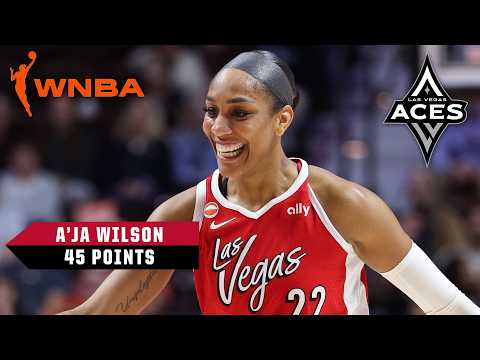
Ever since its inaugural season in 1997, the WNBA has been and continues to be a majority-Black league, with many players identifying as lesbian or queer. Most of its biggest stars, including A’ja Wilson of the Las Vegas Aces — arguably the greatest player in WNBA history — are Black.
Still, the WNBA has had and continues to have great white players. Multi-time champions like Dianna Taurasi and Brianna Stewart. Sharpshooter Marina Mabrey, who just tied the WNBA single-game scoring record with 53 points and is every bit as fiery as Clark on the court. Paige Bueckers, who went No. 1 overall in the draft last year, is already a fan favorite. And for the “straight, white” hate allegations, stars like Sabrina Ionescu and Kelsey Plum would like a word.
 Load YouTube video
What makes Clark the women’s basketball version of Bird isn’t that she’s white, passionate, or awesome at basketball. It’s that she’s all of those things and from Iowa. The others aren’t. (Bueckers is from Minnesota, but she’s lesbian and openly called out the media for not covering the WNBA’s Black stars equally.)
Clark’s the homegrown star from the “middle America” I grew up in. She’s an avatar for a place that frequently laments being “misunderstood and underappreciated,” while sometimes engaging in exactly the racist behavior it pretends doesn’t exist. Larry Bird, “the hick from French Lick,” was too.
The numbers bear this out. Nielsen data obtained by The Wall Street Journal showed that while every demographic group saw double-digit viewership increases during Clark’s rookie WNBA season, the biggest gains — including more than 301% on ESPN networks — came specifically among white viewers.
“There are basketball reasons [for the attention on Clark],” Victoria Jackson, a sports historian and clinical associate professor at Arizona State University, told the Associated Press in 2024, “but also there are racial reasons for why Clark has been able to kind of break off into a completely different stratosphere from players that came before her.”
Fans and media are quick to dismiss that idea, of course. Suggesting Clark’s popularity isn’t solely about her singular skill and charisma is an insult. Why can’t “delusional” people just accept that she’s better and more relevant than other players in women’s basketball, even the other white ones? Why can’t they understand that without her, no one would even care about the WNBA? Making her the undisputed center of the WNBA universe — and forcing her reluctant competitors to kiss the ring — is just good business, not politics.
This is about (much) more than basketball
But comments like Esiason’s give away the game. Because they show you exactly whom this Clark-centric world is meant to appeal to, and whom the challenges to her supremacy should anger the most.
That’s why Clark objectively being among the WNBA’s best players at this exact moment, a top-five scorer who’s also second in the “W” in assists, isn’t good enough.
That’s why putting her face on every national broadcast, promoting every highlight play and changing the rules to ease the physical play on her will never elevate her enough.
In their eyes, she’s the savior of women’s basketball, rescuing it from these unmarketable, undesirable and jealous queer Black women.
Because Clark can’t just be great to the people using her as a proxy — she has to dominate indisputably. The people and businesses invested in her preeminence don’t want her to “earn” it the way Bird had to in the men’s game, or Jerry West before him — fighting tooth and nail to win and earn respect. They just want Clark to have it. Because her success validates them.
In their eyes, she’s the savior of women’s basketball, rescuing it from these unmarketable, undesirable and jealous queer Black women. Which means you’d better not dare mention that fans might also care about Bueckers, Wilson, Angel Reese, or whoever.
If another player dares to outperform Clark on a given night, it doesn’t matter because no one’s there to watch them. Because they’re not The Chosen One.
And if anyone so much as suggests that the WNBA is about more than Clark alone, a whole host of journalists and talking heads will publish mountains of opinion pieces telling you how wrong you are.
Because this isn’t about basketball. It’s about us, and who holds power.
About who decides what’s valuable in a country that, for even longer than its 250 years of existence, has been defined by its disdain for anyone other than white, cis-het males.
It’s about a powerful sector of our culture saying it wants to keep “politics” out of sports, now trying to turn basketball into its latest colonization project. (Or else why is Fox News so invested in promoting all things Clark, and why is Republican Congressman Tim Burchett, who does not represent either Indiana or Iowa, saying Clark should take her talents to Europe?)
In the process, a whole lot of people who just want to play the game they grew up loving for a living, including Clark, have become pawns in a game they never wanted to play.
Clark has ceased to be a mere basketball player. She’s become a mirror of a divided country — one that can’t seem to see eye-to-eye even when we’re all watching the same thing.
Subscribe to Cog’s weekly newsletter. Essays on friendship, love, loss, parenting, politics and more, from Boston’s NPR.