
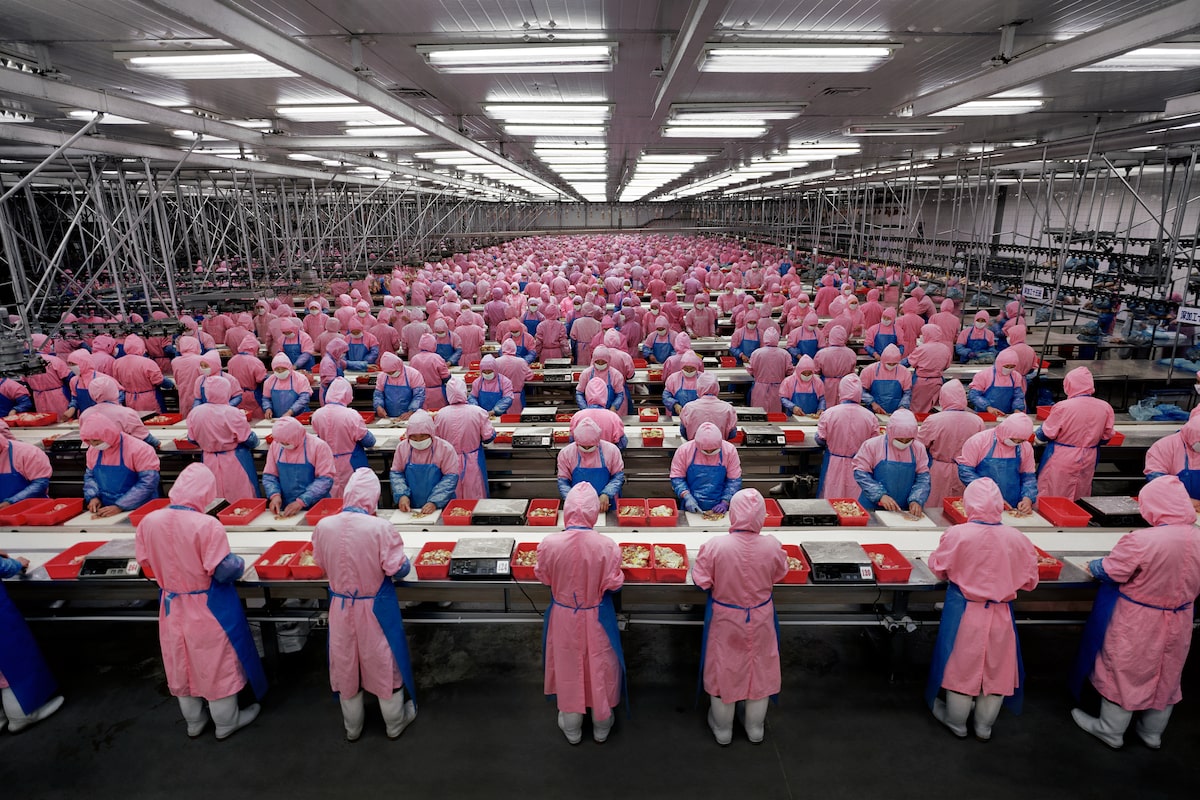
Edward Burtynsky, Manufacturing #17, Deda Chicken Processing Plant, Dehui City, Jilin Province, China, 2005.Sutherland House Books
With 10 biographies – mostly of artists – under his belt, author and McMaster University professor emeritus James King knows his way around an interview. But nothing prepared him for the “curious bond” he would develop with celebrated photographer Edward Burtynsky.
His admiration only would grow as he began to understand the photographer’s relentless determination to confront the destruction of nature. With images spanning desolate oil fields in Azerbaijan, to ghostly ship breaking yards in Bangladesh, to the eerie basement cells of Auschwitz, Burtynsky has spent four decades photographing landscapes transformed – and often devastated – by industry, extraction and mass consumption.
In Edward Burtynsky: The Biography released earlier this month by Sutherland House, King traces Burtynsky’s journey from his working-class upbringing in Ontario and early gigs in automotive manufacturing and gold mining, which ultimately shaped his approach to photography. Pairing journalistic rigour with a deep understanding of art history, King explores not only Burtynsky’s artistic process and influences, but also the philosophical, environmental and political questions his photographs ask of their viewers.
From his home in Hamilton, King spoke with The Globe and Mail about the relationship between photography and fine art, the role of bearing witness and his unique friendship with Burtynsky.
Nick Iwanyshyn/The Globe and Mail
What compelled you about Burtynksy’s work enough to want to write his biography?
I’m very interested in the intersection between so-called fine art and photography. Photography is like the poor sister to fine art, and it’s struggled to be recognized as such. I think Burtynsky is amazing in the way that he has very fearlessly trained his eye in many aspects of modernism, and I show those in the book.
As the reader goes along, they can see that his kind of image-making completely destroys the illusion that photography might not be considered fine art. It’s the way that he makes something which might be considered sinister into an object of beauty. The end result of the photograph is that it forces the viewer to really ponder, “What am I looking at?”
What was he like to chat with?
He’s a very friendly, very honest guy. He’s very easy to talk to, completely unpretentious. The other important thing is that he allowed me access to all his notebooks, and in the notebooks you often see this very private side of Ed Burtynsky being revealed to us.
James King at his home in Hamilton, Ont.Nick Iwanyshyn/The Globe and Mail
Did anything surprise you, either in your conversations with him, or about the things you read in those notebooks?
I think his origins, the story of his mother and father in the Ukraine and their immigration to Canada. That is not well known. Also not well known is his boyhood, his real grit as a boy and a young man. He’s very modest about that, but I think the book begins with a lot of information that has never been put together. We see the origins of his creativity: He’s angry. He knows that his artistry comes from his father, but he’s very angry at his father, so that creates a tension in his work from the very beginning.
Does any of his work have a personal resonance for you?
When I began the project, I did not know about his Holocaust photographs. They have a chapter to themselves and they really blew me away when I saw them. I like the tire burning photographs too. In the book you come to that moment after the tire burning: He doesn’t know exactly where he wants to go and then he finds out about shipbreaking, and of course the shipbreaking images are the breakthrough images in his career. That is what really established him as a major world photographer.
Edward Burtynsky, Colorado River Delta, near San Felipe, Baja, Mexico, 2012.Ed Burtynsky/Sutherland House Books
Is there anything you think about differently after having completed this project with Burtynsky?
When he became celebrated, he would often say that the images might have a teaching purpose, they might be warnings: “What we are doing to the planet is horrible.” Before that, even though he was communicating that through his images, he was reluctant to speak about it.
I think that’s an important turning point in the book, and in my relationship with him. At one point he told me that he thought a good title for his biography would be “The Evidence of Man,” and if you think about it, that’s really what he’s done in showing us all these fractured, broken landscapes.
This interview has been edited and condensed.