
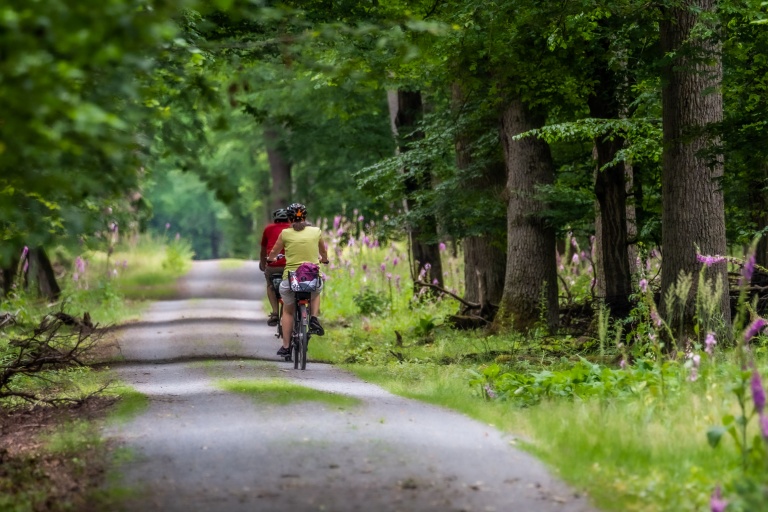
The EuroVelo 13 Iron Curtain cycle route, along with its accompanying map and story portal, follows the path of the former Iron Curtain and highlights local stories, villages, and culinary spots that have been virtually unknown until now, Turizmus.com reported. The project is complemented by a 6+1-part short film series that approaches the region from the perspective of slow cycling tourism: it shows where it is worth stopping, veering off the route, or incorporating a local experience so that the tour is truly about exploring the region.
The Iron Curtain once stretched across Hungary’s westernmost corner—one of the most heavily guarded borders in a Europe divided during the Cold War. In place of the barbed wire, minefields, and watchtowers, EuroVelo 13—the Iron Curtain Cycle Route—now runs along approximately 10,000 kilometers of the former East-West border, stretching from the Barents Sea all the way to the Black Sea.
Today, the former border zone functions as a “green corridor”—rich in natural beauty, historical monuments, and cultural heritage—where cyclists can experience the landscape, history, and local communities in a single journey.
This is the world showcased by the Inclusive Border Cycling project and its accompanying 7-part video series, which focuses on the border towns of Southern Zala and the Őrség region.
“Rediscovering and showcasing this landscape—which was once accessible only with special permission—is a unique experience. It is precisely this former isolation that has preserved numerous natural and cultural treasures in Southern Zala and the Lenti–Letenye region, which today offer cyclists a true adventure.
We are not just cycling through this region: we want to showcase the remnants of its oil-rich past, the wildlife, the historic sites, and the stories that make this landscape unique,”
said Balázs Szabó, head of the Zalai Tekergők Cycling Sports and Touring Association.
Inclusive Border Cycling is a large-scale European Union project initiated by Hungary, with 16 organizations from Austria, Hungary, Slovakia, Slovenia, Croatia, Serbia, and Romania participating.
Photo: Pexels
“The goal of this approximately two-and-a-half-year development project has been to treat cross-border cycling routes not merely as infrastructure, but as a comprehensive tool for social and economic development, a system that, by connecting local stories, products, and communities, is capable of giving new meaning to travel,” said Tibor Polgár, managing director of West-Pannon Nonprofit Kft.
The initiative connects several cycling routes, including the Iron Curtain Cycle Route (EuroVelo 13) and the nature-oriented “Amazon of Europe” cycling network along the Drava and Mura rivers.
As Tibor Polgár explained, international experience shows that in rural areas, tourism can account for as much as 30 percent of local producers’ revenue, ranging from the smallest to the largest players in the gastronomy sector. This raises the question of how local communities in border regions—in the former Iron Curtain region—can connect even more closely with tourism.
“In the program, we also paid special attention to ensuring that these producers—who do not necessarily have experience in tourism or communications—receive training. Building on Austrian best practices, knowledge transfer and the training of local stakeholders took place with the involvement of multiple partners.
One of the highlights of this was the “Iron Curtain” weekend tour organized as part of last year’s “Open Farm Day,” in which some 70 producers participated and more than 8,000 visitors attended the events over the course of a single weekend,”
said Tibor Polgár.
The initiative goes beyond storytelling by also encouraging community involvement in maintaining cycling routes. In less populated or resource-poor areas, by involving locals, the project is also exploring how communities can play an active role in the maintenance of cycling paths.
One of the project’s most important professional achievements was the development of a methodology that facilitated the authentic collection, organization, and concise, engaging presentation of local border histories for cycling tourists.
The essence of the concept is what is known as “experience design”: the region’s stories are presented not as comprehensive historical accounts, but as carefully curated, dramaturgically structured travel experiences. The goal is for cyclists not merely to pass through the countryside, but to also learn about its past, its communities, and its cultural heritage.
Photo: Pexels
The project also sought to determine how communities and local stakeholders living in the former Iron Curtain region could be involved in cycling tourism. The offerings include everything from honor-system kiosks and “grandma’s jam” to small-scale producers, wineries, and high-end gastronomic establishments. The goal was to develop a comprehensive, experience-based tourism offering that brings together the landscape, stories, local products, and human encounters.
A key element of the project is the Danube Story Portal, which connects the region’s major cycling routes—including EuroVelo 13, the Amazon of Europe Bike Trail, and EuroVelo 6—on a single digital platform.
What makes the platform unique is that it showcases not only the routes but also the local stories and producers associated with them, thus functioning as a comprehensive database that European and domestic professional organizations—including the European Cyclists’ Federation and Active Hungary—can utilize to develop cycling tourism.
Related article
Hungary’s First Public Building Constructed Entirely of Wood Unveiled
Via Turizmus.com; Featured photo: Pexels (Illustration)