
After The Gazette posted my opinion piece last week, something unexpected happened.
My inbox filled up.
That part was not surprising. Whenever you write about tragedy, fear, misinformation, social media, panic and the Jewish community all in one column, you expect a reaction. You brace yourself a little. Maybe more than a little.
But what surprised me was not the disagreement. It was the agreement.
Many of the messages I received were kind, thoughtful, generous and deeply appreciated. People thanked me for calling for calm. They appreciated the plea for truth, restraint and responsibility. They agreed that in a crisis, “I don’t know yet” may be one of the most honest and necessary sentences a person can say.
Some were Jewish. Many were not. But a strange theme appeared again and again:
“I’m not Jewish, and I’m sure we disagree on Middle East politics, but …”
“We probably disagree about Israel, religion, and almost everything else, but …”
“Chances are you and I have very different views, but I appreciated what you wrote …”
In case it’s not obvious, I was genuinely moved by these notes. In a tense time, it takes decency to reach out to someone outside your own circle and say, “Your words helped.” I do not take that lightly. I am grateful for every person who wrote.
Editor’s Picks
I also found myself wondering: How did we get here? How did we arrive at a place where people feel the need to preface agreement with assumed disagreement? How did strangers who have never spoken with me become so certain of all the things we must disagree about?
I understand, in a sense. I am a Chabad rabbi. I walk as a loud and proud visible Jew. Beard, black hat, Jewish name, public Jewish life. People see that and understandably make associations. Some are accurate. Some are not. Some are fair. Some are inherited from a culture that now sorts human beings faster than airport security.
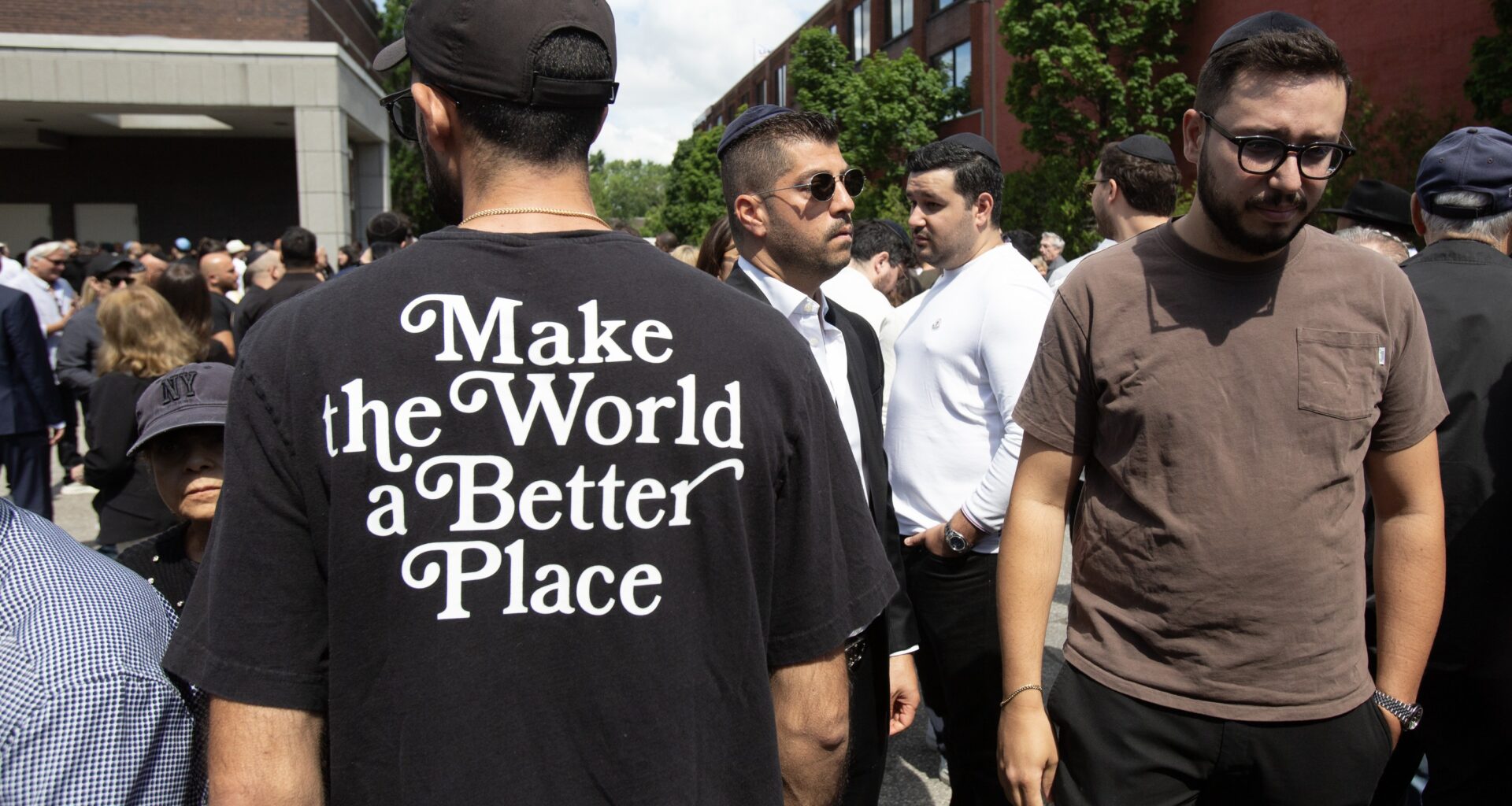
Perhaps we have become very good at identifying teams and very bad at meeting people. We see a title, a photo, a kippah, a flag, a bumper sticker, a headline, a single sentence online, and immediately we think we know the whole person. We know their politics. Their fears. Their loyalties. Their blind spots. Their moral failures. Their entire inner universe.
All before we have asked one question of them. There is something deeply sad about that.
You and I may disagree about many things — we also may not. We may disagree about religion. We may disagree about the Middle East. We may disagree about politics, policy, theology, history and whether dogs are better than cats, which is obviously a far more dangerous conversation than Middle East politics.
But we may also be in agreement about more than we think. We might agree that children should not have to inherit adult hatred. We might agree that grief should not be turned into content. We might agree that truth matters.
We might agree that people should stop spreading rumours before facts arrive. We might agree that families in mourning deserve compassion before commentary. We might agree that social media has trained us to react faster than our souls can process. We might agree that a calmer society would be a healthier society.
In a crisis, ‘I don’t know yet’ may be one of the most honest and necessary sentences a person can say.
And maybe, if we actually spoke, we would discover that even where we disagree, the disagreement is more human and more layered than we imagined.
This is not a small thing. One of the great tragedies of our time is not that we disagree. It is that we have become convinced that disagreement must mean distance: If I know one thing about you, I know everything about you. Before I hear your voice, I already know your villain category.
In Jewish thought, every person is created b’tzelem Elokim, in the image of G-d. For me, it means that before a person is an opinion, they are a soul. A soul cannot be reduced to a slogan. A soul cannot be understood by an algorithm. A soul cannot be fully known by the side of the debate you assume they are on.
My teacher and mentor, the Lubavitcher Rebbe, taught me how to see people. The Rebbe met individuals, not categories. He spoke to Jews and non-Jews, religious and secular, leaders and children, politicians and professors, skeptics and believers.
The Rebbe saw every human being as a unique light, sent into this world with a unique purpose. No one before you, no one after you, and no one alive today can fulfill the exact mission that belongs to you.
That is a lost art.
Perhaps we have become very good at identifying teams and very bad at meeting people.
Today, we do the opposite: We start with the category, and then try to squeeze the person into it. This has real consequences.
When we assume that we already know each other, we stop being curious. When we stop being curious, we stop listening. When we stop listening, we become easier to manipulate. And when we become easier to manipulate, the loudest voices in society get to decide who we are allowed to care about.
That is dangerous. It is dangerous for the Jewish community. It is dangerous for Montreal. It is dangerous for anyone who still believes that a city is more than a collection of tribes glaring at one another across comment sections.
Montreal is better than that. At least, it can be. We are a city of accents, histories, religions, languages, wounds, loyalties and memories. We do not all see the world the same way. We never will. The goal is not to pretend otherwise. The goal is to stop assuming that difference makes conversation impossible.
The people who wrote to me after my column reminded me of something hopeful. Underneath all the noise, many people are still hungry for sanity. They may be tired of the outrage machine. They may be tired of being told who they must hate before they even say hello. They may be tired of living in a world where every sentence becomes a loyalty test. I am tired of it too.
So perhaps the next step is this: Instead of saying, “We probably disagree about everything, but…” maybe we can say, “We may disagree about some things, and…”:
“We may disagree about some things, and I am willing to listen.”
“We may disagree about some things, and I still see your humanity.”
“We may disagree about some things, and I refuse to let the internet decide whether we are allowed to speak.”
That little word “and” may be one of the most important words we have left. The word “but” often cancels what came before it. “And” lets more than one truth live in the same room. You can be Jewish and care about non-Jewish grief. You can be deeply concerned about Jewish hatred and still insist on facts.
You can be right about something and still have more to learn. Both can be true. That was the message of my original column. It remains the message now. Truth matters. Restraint matters. Humanity matters. Not only in how we respond to tragedy, but in how we respond to one another.
To everyone who wrote to me, thank you. Truly. Your messages meant more than you know. And to those who began by assuming we disagree about almost everything, maybe you are right. Or maybe we should have coffee first. One fact at a time. One conversation at a time. One human being at a time.
Rabbi Yisroel Bernath is the spiritual director at Rohr Chabad NDG and the Jewish chaplain at Concordia University.