
ⓘ NASA – Unsplash
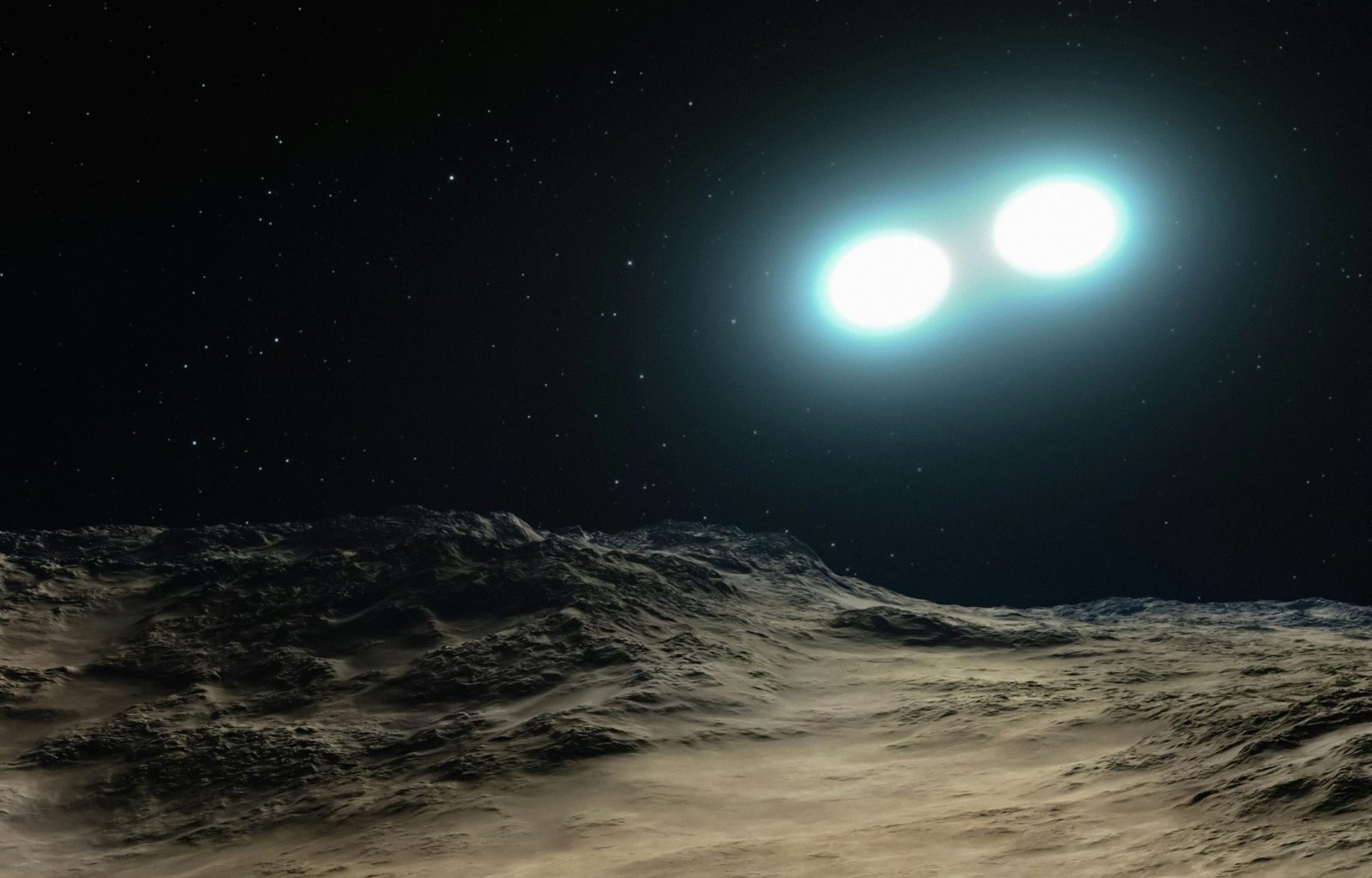
An artist’s illustration showing two neutron stars and a planet.
A team of astronomers has recently discovered a new millisecond pulsar located in our galaxy. But while this discovery is very interesting, researchers will have to conduct further observations to try to better understand it.
The universe contains many celestial objects that fascinate scientists. And recently, a team of astronomers has discovered a new pulsar in the Milky Way that rotates at high speed.
As a reminder, pulsars are neutron stars with a diameter of about 20 km and a mass about 1.5 times that of the Sun. Due to their extreme density, they spin at high speeds, such as PSR J1748-2446ad, which is located about 18,000 light-years from Earth and rotates 716 times per second.
However, this new pulsar, which has recently been discovered by astronomers, rotates more slowly. Indeed, named PSR J0125−5854, it was detected using the Murchison Widefield Array (MWA). According to Chia Min Tan of Curtin University in Bentley, Australia, and lead author of the study, this celestial object has a rotation period of 24.6 milliseconds.
ⓘ arXiv
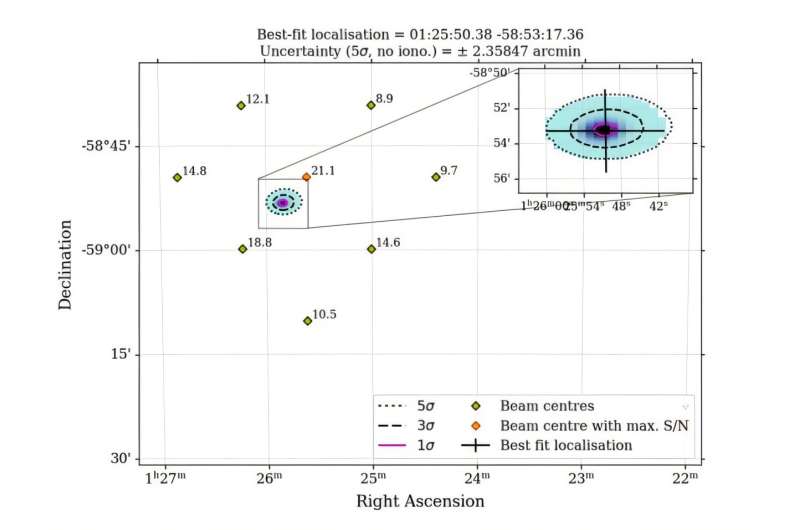
An image showing the location of PSR J0125−5854.
This pulsar is estimated to be between 1,600 and 3,200 light-years from Earth and is believed to be part of a binary system composed of a white dwarf with a mass equivalent to 0.41 times that of the Sun. However, although this pulsar is the first to have been discovered by the MWA, further studies will be needed to better understand its properties.
 Alexis Stegmann – Tech Writer – 676 articles published on Notebookcheck since 2025
I’ve been working in the field of web writing for several years, and I’m passionate about keeping readers up to date with the latest news on astronomy, technology, the world of video games and other exciting subjects. In particular, I’ve had the opportunity to work on a number of websites, which has enabled me to cover a wide range of subjects. In my personal life, I’m passionate about a wide range of subjects, including astronomy, video games, history and science. I’m also drawn to psychology, which is a subject that deserves greater documentation and recognition.