
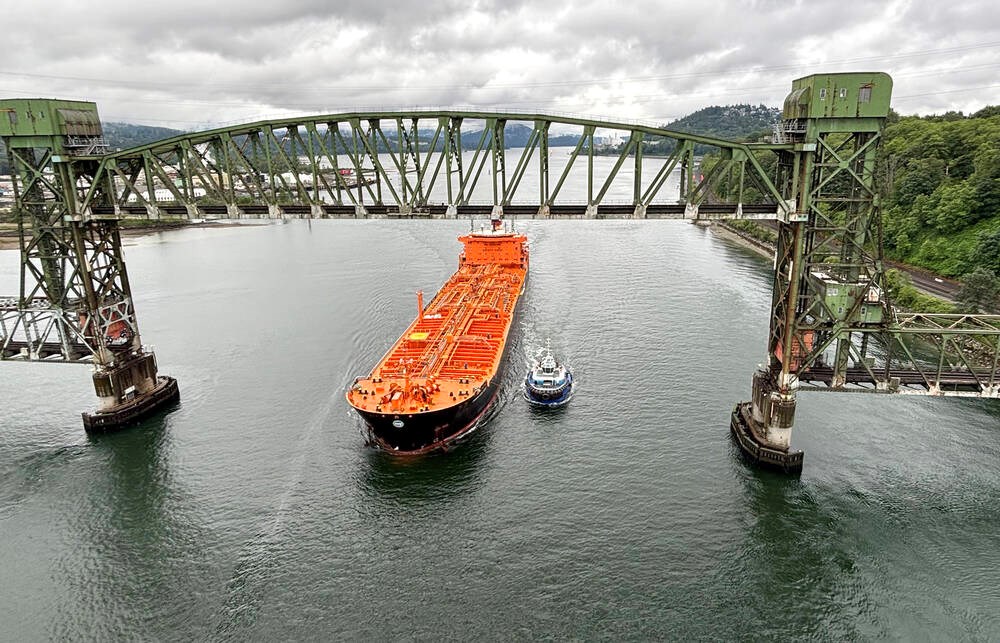
25,000 cubic metres of material will be removed from the channel between North Vancouver and Burnaby to allow for larger shipments of oil
Work will begin later this year by the Vancouver Fraser Port Authority to dredge 25,000 cubic metres of material from the Second Narrows, clearing the way for larger shipments of oil.
Currently, Aframax tankers calling at Trans Mountain’s Westridge Marine Terminal in Burnaby can only fill to about 75 per cent capacity. A fully laden ship’s draft wouldn’t have enough keel clearance to meet international navigation standards.
“Channels like this are heavily regulated, obviously,” said Charlotte Olson, the port’s director of infrastructure delivery. “We’ve received federal approval and our permits have over 150 conditions that we must comply with.”
Starting in September, when the fisheries window opens, contractors will use a scow-mounted crane with a clamshell dredge to scoop up 25 to 30 barge loads of material and ship it off for disposal at a facility licensed to accept the salty debris. The areas to be dredged run along the margins of the existing channel covering a surface area of about 17,000 square metres. In most areas, the dredges will remove 1.5 to two metres of material, although in some spots, it may be as much as six metres.
The project also includes the removal of old decommissioned Metro Vancouver water mains from the floor of the inlet and the installation of two new navigational lights.
Dredging projects have the potential to churn up toxins that have settled on the seabed and cause turbidity problems in the water, but the conditions of the Second Narrows make that less likely.
“You can imagine, the currents in this area are really quite strong, and so it’s quite coarse sands, gravel, and cobbles, and there’s not a lot of fine material,” Olson said.
The Canadian Impact Assessment Agency has also granted a permit after determining the project “is not likely to cause significant adverse environmental effects.”
As the work is carried out, there will be a dedicated environmental monitor checking on water quality and marine mammal impacts and ensuring the conditions are being followed.
“We’re confident that we can implement all of those conditions and deliver the work in a respectful way to the First Nations, to the environment, and safely, which is also really important,” Olson said.
The federal permits do come with requirements for the port to carry out habitat restoration projects to offset the changes being made to the natural environment. Olson said the details of that haven’t been finalized yet, but it will likely involve planting new kelp beds.
Costs for the dredging won’t be known until the port has finished its procurement process for contractors, but Olson said they will be paid by the port from its own revenues and some contribution from Trans Mountain.
Ultimately, the port has a mandate to facilitate Canada’s trade. Dredging the inlet will make shipping more efficient and increase the port’s overall capacity, Olson said.
“Works like this really are vital,” she said. “You’ve probably heard Canada’s goal to double exports to non-U.S. markets over the next decade, and certainly the Port of Vancouver plays an outsized role.”