Those ultra-low mortgages wrecked the housing market, but homeowners had nevertheless been paying them off steadily – until now.
By Wolf Richter for WOLF STREET.
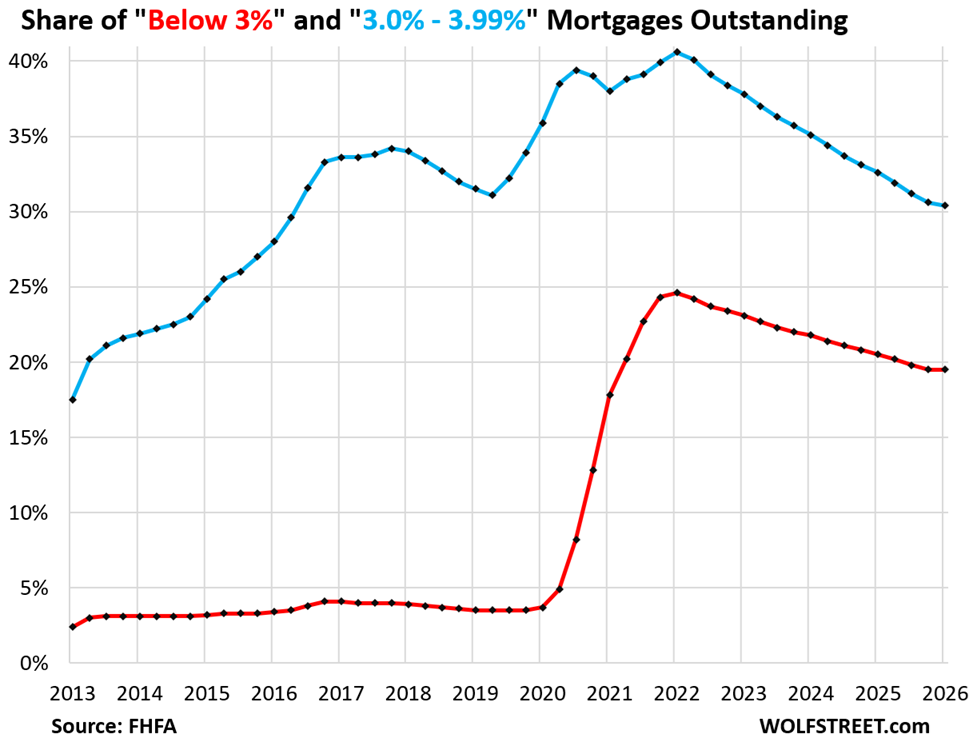
Progress in resolving the “lock-in effect” has suddenly stalled: The share of below-3% mortgages outstanding, by number of mortgages, remained unchanged at 19.5% of all mortgages outstanding in Q1, after declining steadily since the peak in Q1 2021 of 24.6% (red in the chart).
The share of 3% to 3.99% mortgages edged down by just 20 basis points in Q1 from Q4, the smallest quarter-to-quarter decline since their share started to decline in 2022, to a share of 30.4% of all mortgages (blue), according to data by the Federal Housing Finance Agency (FHFA).
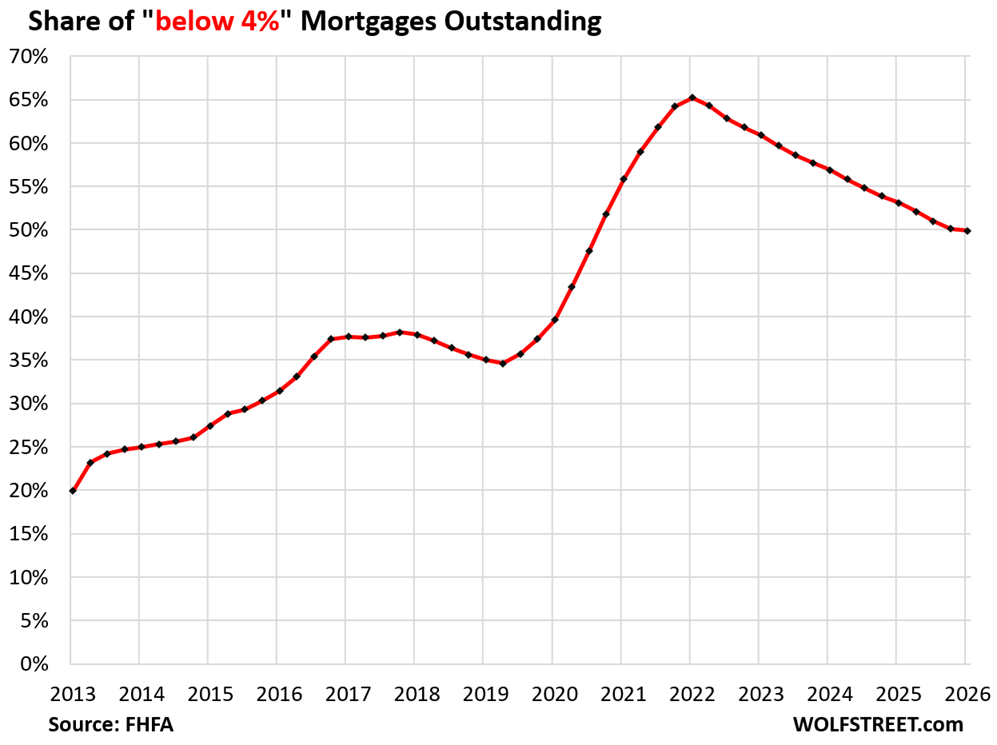
Combined, the share of below 4%-mortgages edged down only 20 basis points in Q1 from Q4, by far the smallest quarter-to-quarter decline since the share began to decline in 2022.
The combined share in Q1 of 49.9% of all mortgages outstanding marks the first time since Q3 2020 that the share of these ultralow-rate mortgages accounted for less than half of all mortgages outstanding, down from over 65% at the peak in Q1 2022.
From early 2020 through Q1 2022, the Fed’s interest rate repression via 0% policy rates and trillions of dollars of asset purchases, including mortgage-backed securities (MBS), had pushed mortgage rates to historic lows, which had created a tsunami of homeowners refinancing their homes into mortgages with these new ultra-low interest rates. And those low-rate mortgages have since then frozen up the housing market.
The share of these ultra-low mortgages declined since early 2022 because homeowners had to deal with changes in life that pushed them to give up those ultra-low-rate mortgages, either by selling the home or refinancing the mortgage: a new job in a different city, divorce, growing family, bad neighbors, death, financial issues, etc.
But now this trend has stalled. The stall of that decline in Q1 could be a blip, or it could turn into a larger trend of the housing market remaining frozen for even longer:
All types of mortgages are included here, such as 30-year fixed-rate mortgages, 15-year fixed-rate mortgages, and Adjustable-Rate Mortgages.
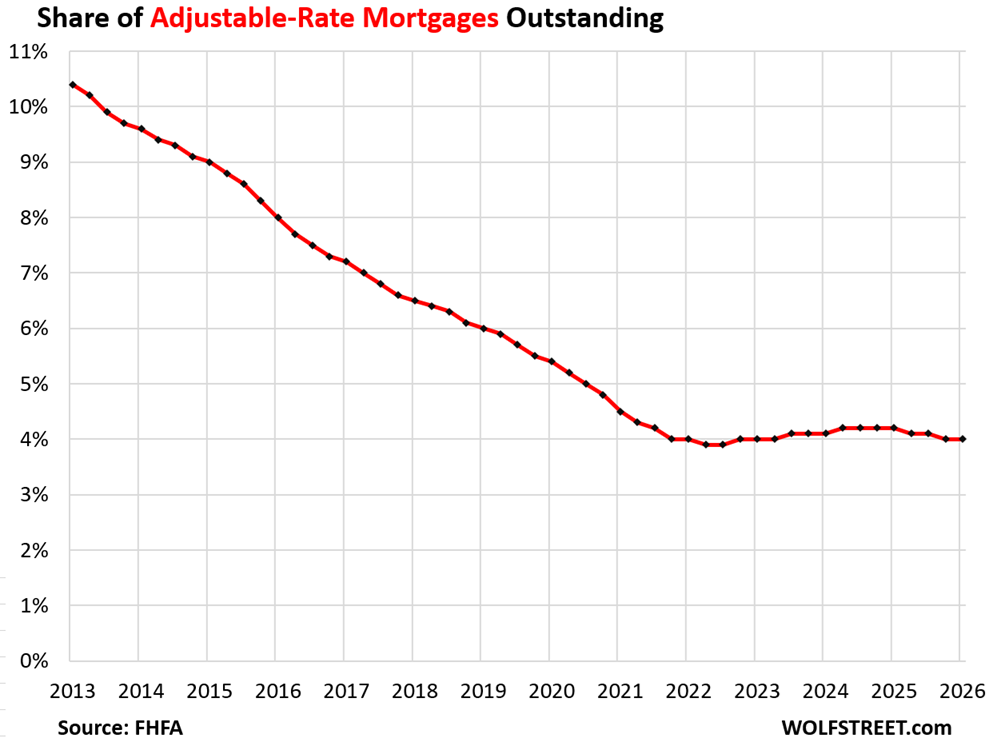
The share of Adjustable-Rate Mortgages remained unchanged in Q1 at 4.0% of all mortgages outstanding, and has hovered at these low levels since 2021, down from over 10% in 2013, the extent of the FHFA data.
Some ARMs had rates below 3% even before 2020, which is one of the reasons the share of below-3% mortgages was above zero even before 2020.
Homeowners with ARMs that were originated when rates were ultra-low experienced payment shock when their mortgage rates adjusted to the higher rates that began in 2022. But in 2020 to 2021, the share of ARMs continued to decline, and was very low when rates began to rise; so only a relatively small number of homeowners were affected by payment shocks.
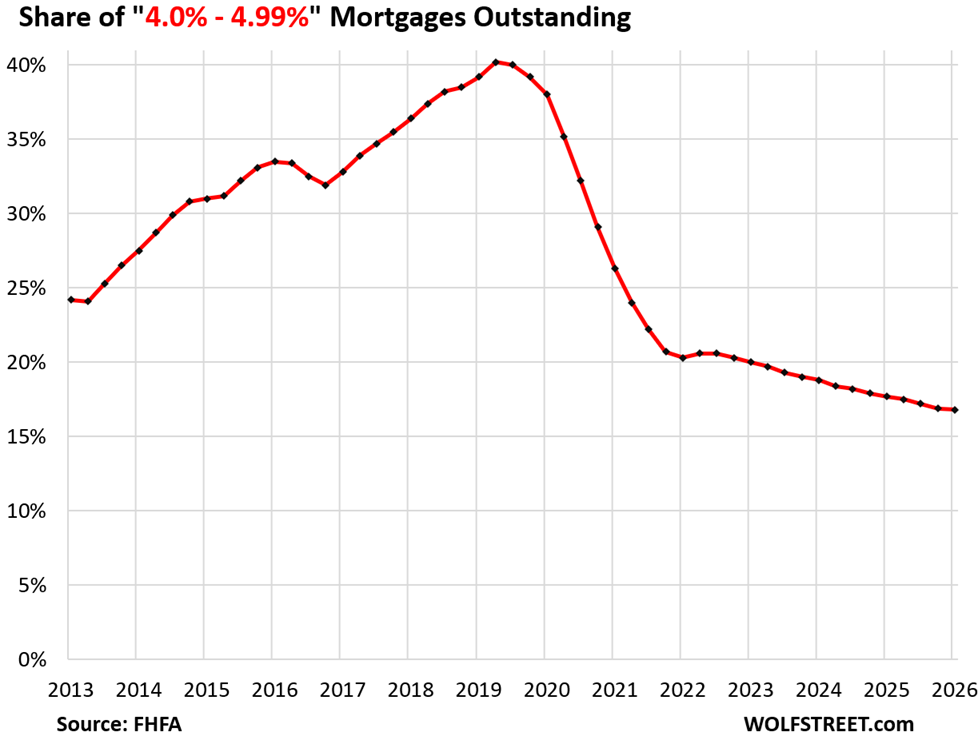
The share of 4.0% to 4.99% mortgages edged down by just 10 basis points to 16.8%, the lowest share in the FHFA’s data going back to 2013, and down from the peak in 2019 of 40%.
When the tsunami of homeowners refinanced their mortgages in 2020-2022 into lower-rate mortgages, not everyone could get a below-4% mortgage.
Homeowners who’d qualified for mortgage rates between 4.0% and 4.99% before 2020 refinanced into the lowest-rate categories, including below 3%, thereby refinancing out of this range.
But a much smaller number of homeowners who had 6% or 7% mortgages before 2020, due perhaps to a tarnished FICO score, also refinanced, but the lowest rates they might have had available were in this 4% to 5% range, and they refinanced into this range.
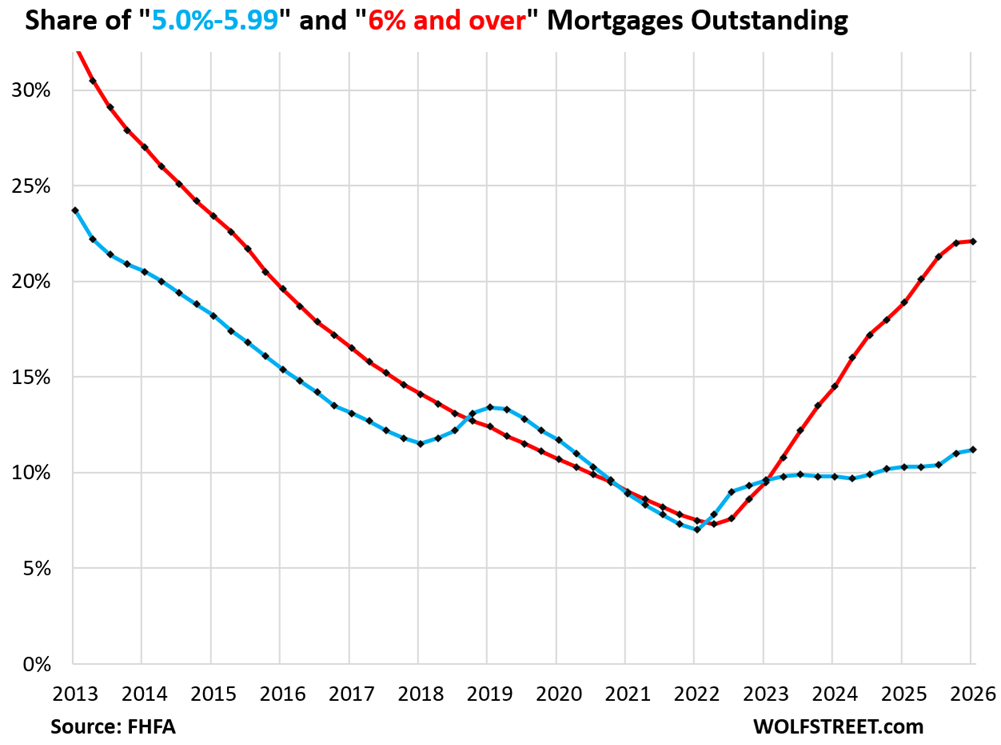
The share of 5.0% to 5.99% mortgages increased to 11.2% of all mortgages outstanding, the highest since Q1 2020 (blue in the chart below).
There are currently fixed-rate mortgages offered in this range. For example, the interest rate of the average conforming 15-year mortgage was 5.84% in the latest week – compared to the average 30-year mortgage rate of 6.49% — according to Freddie Mac. But 15-year mortgages, though they save large amounts of interest over the life of the mortgage, are not popular. Mortgage brokers and bankers don’t even propose them, and borrowers aren’t looking for them, because they come with higher monthly payments, and everyone is chasing after the lowest monthly payments – not the lowest amount of total interest paid over the life of the mortgage.
The share of 6%-plus mortgages edged up a hair to 22.1% of all mortgages, the highest since Q2 2015, up from a share of 7.3% at the low point in Q2 2022 (red in the chart). The bulk of 30-year mortgages originated currently fall into this category.
Combined, these 5%-plus mortgages now account for 33.3% of all mortgages outstanding, the largest share since Q1 2016 (not shown in the chart).
“Locked in” by Free Money.
People know when they get a generationally good deal, and they protect it. Below 3%-mortgages are free money in real terms because inflation is currently running well above 3% (CPI inflation in May was 4.2%). If the cost of borrowing money (the interest rate) runs below the rate of inflation, borrowers face essentially no “real” borrowing cost after inflation.
This gift didn’t fall from the sky but was the result of the Fed’s reckless monetary policies that caused home prices to explode in many markets by 50% and much more in just two years through mid-2022 and that helped trigger the worst inflation in 40 years.
Those ultra-low-interest-rate mortgages and the too-high home prices have chilled part of the housing market: those homeowners are now not selling and therefore are not buying either because they don’t want to finance a much more expensive home with a much higher interest rate.
The real estate brokerage and lending industry has called this the “lock-in effect,” and they loathe it because this effect has dramatically reduced commissions, fees, jobs, and stock prices in the industry.
But homeowners with these low mortgage rates don’t feel “locked in.” They’re just trying to hang on for as long as possible to one of the best deals ever: lower-than-inflation fixed mortgage rates.
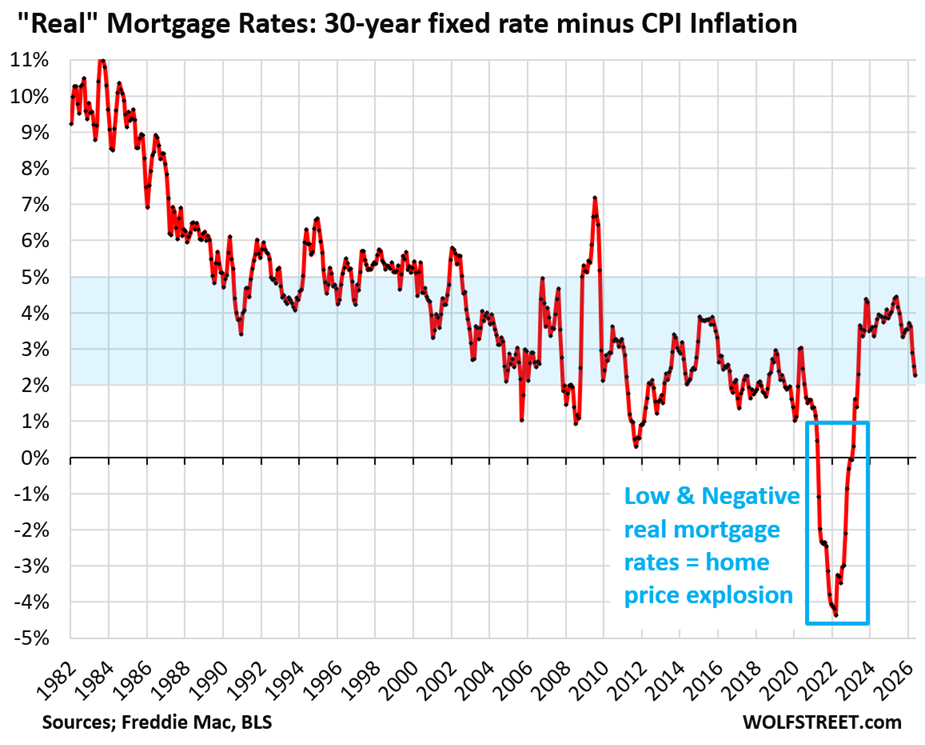
Between early 2021 through 2022, the average 30-year fixed mortgage rate was below CPI inflation – negative “real” mortgage rates.
At the peak of the Fed’s recklessness, “real” mortgage rates were 4 percentage points below CPI inflation, with the average 30-year fixed mortgage rate below 3% and CPI inflation exceeding 7%. This is what wrecked the housing market.
Also note how low these “real” mortgage rates currently are. It shows that mortgage rates today are not too high; if anything, they’re too low, compared to inflation:
Enjoy reading WOLF STREET and want to support it? You can donate. I appreciate it immensely. Click on the mug to find out how: