
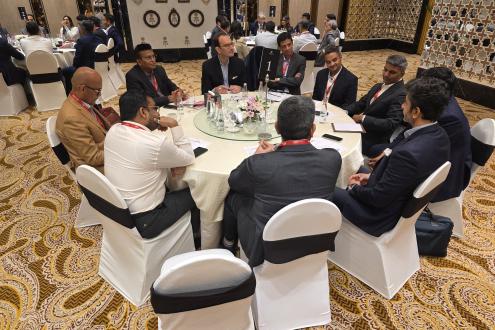
Hosted by Andrew Hendry of Janus Henderson, this WealthTHINK India 2026 table examined how Indian private wealth firms are responding to growing client demand for global investment access, offshore diversification and more scalable advisory models.
The discussion brought together participants from wealth management, private banking, law, structuring, investment advisory and new wealth platforms. The conversation focused on a market where the case for diversification outside India has become more immediate, but where implementation remains constrained by regulation, tax, product availability, adviser capability and business model economics.
Participants explored how Indian wealth firms are building international investment propositions, how clients are using routes such as LRS, GIFT City and Singapore vehicles, why legal and tax advice remain central to cross-border planning, and how technology can help advisers deliver a more scalable, compliant and consistent client experience. The table treated global diversification not simply as an asset allocation theme, but as a broader capability question for the next phase of Indian wealth management.
Key Takeaways
Global diversification has become harder to ignore: For many years, strong domestic returns made overseas investing less urgent for Indian clients. Recent market shifts have renewed interest in global allocation, currency diversification and access to international managers.
Demand is rising faster than product architecture: Clients increasingly ask for overseas exposure, but many wealth firms are still developing the platforms, feeder funds, partnerships and regulated routes needed to deliver it effectively.
Offshore investing requires careful route selection: LRS, GIFT City, Singapore vehicles, feeder funds, referral partnerships and offshore accounts can each play a role, but suitability depends on client profile, ticket size, residency, tax position and regulatory purpose.
Tax and estate issues are part of the investment decision: Participants highlighted that clients often want to invest globally before fully understanding estate tax, reporting, remittance, ownership or foreign jurisdiction implications.
Existing offshore assets create a separate advisory challenge: Some clients already have money or assets outside India. The question then becomes how those assets should be organised, reported and advised on.
Scale is becoming a business model issue: Wealth firms serving HNW and upper-affluent clients cannot deliver fully bespoke advice to every client. They need standardised frameworks, assisted digital journeys, better RM tools and compliance-approved content.
Banks retain structural advantages in scaled wealth: Banks have existing client data, accounts, payment rails and multi-point relationships. Wealth firms need to offset that advantage through product differentiation, specialist access, advisory quality and technology-led productivity.
Setting the Scene: What is WealthTHINK?
WealthTHINK is an exclusive, invitation-only forum designed for CEOs and senior management at leading private wealth management firms. It provides a platform for industry leaders to engage in peer-to-peer networking and collaborative discussion, free from product pitches and formal presentations. The event focuses on proactive, table-specific debates around key themes shaping the future of wealth management, including investment strategy, cross-border structuring, regulation, global diversification, family office development, digitisation, adviser productivity and business model profitability.
By keeping participation senior and the format deliberately interactive, WealthTHINK is designed to encourage honest, commercially grounded exchanges on the issues firms are grappling with in real time.
Global Diversification Has Become A Practical Priority
The discussion opened with the observation that Indian clients have not always felt a strong need to invest outside India. For many years, domestic markets, local growth and rupee returns gave clients a compelling reason to stay focused at home. Offshore investing could appear dull by comparison, particularly when Indian assets were delivering stronger relative performance.
One participant described the change in tone bluntly: “The party ended.”
That was not presented as a negative view on India. Rather, the point was that asset allocation discipline becomes more important when domestic markets no longer appear one-way. Participants noted that clients are now more receptive to global diversification, whether for currency exposure, access to international managers, participation in global sectors, or broader portfolio resilience.
Several wealth firms around the table described how they are building out global propositions through partnerships, feeder funds, GIFT City platforms, Singapore vehicles, offshore managers and international private bank relationships. The market is moving from discussion to implementation. The demand is no longer only theoretical.
However, the table also recognised that the Indian client conversation remains uneven. Some clients understand the strategic case for international exposure; others are reacting to recent returns, currency movement or peer behaviour. Advisers therefore need to frame global diversification as a disciplined allocation decision, not as a tactical response to short-term market disappointment.
The Product Shelf Has To Match The Diversification Narrative
A recurring theme was the gap between the desire to diversify and the actual product architecture available to clients. Participants noted that many wealth firms talk about international allocation, but not all have built the range of solutions required to execute it across client segments.
One participant captured the gap clearly: “There is a lot of sound bites on diversification. But there are very few solutions around it.”
This is a critical point for Indian wealth management. Advisers may believe clients should allocate globally, but if the firm cannot provide suitable, compliant and well-researched access points, the conversation stalls. Clients then either remain domestic, use ad hoc channels, or seek global access through another institution.
Participants discussed a range of approaches, including feeder funds, global bond strategies, partnerships with international asset managers, Singapore-based vehicles, GIFT City structures and cross-border referral arrangements. The right route depends on the client’s size, regulatory status, investment objective and level of sophistication. A family office may need a customised structure; an HNW client may need a more standardised offshore or global fund solution.
The broader message was that global investing cannot be treated as a single product category. It needs a shelf that covers asset classes, geographies, ticket sizes, tax considerations and client use cases. Firms that can build that shelf with credible global partners may gain an advantage as demand broadens.
Regulated Routes Need Careful Navigation
The table spent considerable time on the routes available for Indian clients seeking global exposure. Participants referred to LRS, OPI, ODI, GIFT City, Singapore VCC structures, feeder funds and offshore partnerships. The discussion made clear that these routes cannot be treated interchangeably.
Each route has its own purpose, constraints and documentation requirements. A client sending money abroad for personal investment is not necessarily in the same position as a company investing overseas, a family using an offshore vehicle, or a client who already holds assets outside India. The adviser’s role is to understand the objective before discussing the route.
One participant summarised the discipline required: “It has to be well thought and well planned.”
This matters because clients may approach advisers with a simple request to “send money out” or “invest globally”, without distinguishing between remittance, investment, ownership, residency, estate planning and tax treatment. Participants noted that this lack of clarity can create problems. The client’s intention, the source of funds, the legal structure and the eventual investment all need to be aligned.
The table’s practical message was that advisers should not over-simplify cross-border implementation. Legal, tax and regulatory input is essential where the facts are complex. Wealth managers can identify the need and coordinate the conversation, but they should avoid presenting complex routes as if they are generic products.
Tax, Estate And Existing Offshore Assets Need Review
Another important theme was that global investing creates consequences beyond portfolio construction. Participants discussed the risks clients may face when holding foreign securities, particularly where estate tax, reporting obligations or foreign jurisdiction rules apply.
The table noted that clients may buy global stocks or international funds because the investment thesis is attractive, while giving less attention to what happens if the holder dies, relocates, becomes subject to another tax system, or holds assets directly in a jurisdiction with estate tax exposure. These issues can be material, especially where portfolios grow significantly over time.
This is not a reason to avoid global investing. It is a reason to plan it properly. A global recommendation should take account of more than the underlying asset. Advisers need to understand the holding route, tax implications, reporting treatment, estate consequences and liquidity requirements.
The table also distinguished between clients who want to send money overseas and clients who already have assets outside India. For those with existing offshore assets, the issue may be consolidation, reporting, tax review, risk management, currency positioning, succession planning or coordination with an offshore adviser.
This client segment is becoming more visible. Some families have international accounts, foreign securities, offshore businesses, overseas real estate or assets accumulated while living abroad. The opportunity is not simply to capture assets under management, but to help clients organise what they already have.
Onshore And Offshore Advice Need Clear Boundaries
Participants discussed the challenges faced by India-based advisers when clients have offshore portfolios or cross-border needs. The issue is not only whether a client can access offshore products. It is also whether the adviser is permitted, trained and equipped to discuss those products.
This becomes difficult when the client relationship sits onshore but part of the portfolio is offshore. A client may ask the India RM for a view on an international fund, a China allocation, a US equity holding or an offshore structure. The RM may have the relationship, but not necessarily the regulatory permission, product approval or technical knowledge to advise on that asset.
The table therefore highlighted the importance of clear operating models. Firms need to define when an onshore RM can discuss global allocation at a high level, when an offshore partner must be involved, when reverse solicitation applies, and how information should flow between teams without breaching regulatory boundaries.
This is where strategic partnerships can be useful. Participants discussed models where domestic wealth firms partner with global banks, offshore platforms or international asset managers to provide clients with a more complete proposition. However, such partnerships need to be carefully governed. The client should receive joined-up advice, but the responsibilities of each party must remain clear.
Scale Is Becoming As Important As Sophistication
The discussion then moved from UHNW cross-border structuring to the economics of serving the wider HNW and affluent market. Participants recognised that bespoke advice can work for very large clients, where ticket sizes justify high-touch legal, tax and investment support. The challenge becomes different as firms move down the wealth pyramid.
At the one to ten million dollar segment, or even below that, wealth firms need a more scalable model. Clients still expect quality advice, investment access and service. But it is not economically realistic to customise every recommendation, structure and conversation in the same way as for a large family office client.
This has implications for RM productivity. The industry is dealing with rising compensation, RM turnover, client acquisition costs and compliance requirements. If each RM can only manage a limited number of clients manually, the model becomes difficult to scale.
Participants suggested that the answer is not simply to hire more junior staff. The more sustainable model is to standardise parts of the process, improve adviser tooling, automate routine work and use technology to support client conversations. That does not remove the RM. It makes the RM more productive and the client experience more consistent.
The Assisted Model May Be The Scalable Middle Ground
One of the most practical discussions focused on the difference between fully bespoke advice, assisted execution and pure DIY. Participants noted that pure DIY has limits in wealth management. Many clients do not want to make every decision alone, especially where products, suitability, documentation and portfolio impact are involved. At the other end, fully manual service is expensive and difficult to scale.
The assisted model may therefore become the most important layer. In this model, the RM or adviser prepares the client conversation, initiates the workflow, builds a recommendation or transaction basket, and the client approves through a digital interface. Technology supports the process, but the relationship remains human.
One participant described the opportunity simply: “Tech can work.”
This is where AI and adviser workbenches can be useful. AI can help prepare meeting notes, standardise client reviews, surface portfolio issues, generate approved talking points, reduce routine service work and help RMs handle a larger number of clients. However, participants were clear that AI should sit primarily behind the adviser, rather than replacing the client relationship.
The model also strengthens control. Clients receive a more consistent experience, supported by firm-approved content and workflows. RMs become more effective because they are not starting each conversation from scratch. Firms gain better oversight of messaging, suitability and execution.
Banks Have A Structural Advantage In Scaled Wealth
Participants also discussed why banks may be particularly well positioned in the scaled HNW and affluent wealth market. Banks already hold client accounts, transaction data, service relationships and payment infrastructure. They often have multiple points of contact with the client, including branch managers, regional heads, service teams and relationship managers.
This creates a structural advantage. If a client wants to invest, approve a transaction, move money or access a product, the bank already controls much of the surrounding infrastructure. A non-bank wealth firm may offer specialist advice or differentiated products, but it still has to solve funding, transaction flow and account integration through additional steps.
Participants noted that banks are also well suited to standardised training, process discipline and assisted digital journeys. Where the client segment is broad, those capabilities matter. A scalable wealth business needs repeatable frameworks, not only talented individual RMs.
This does not mean banks will automatically win. Independent wealth firms, MFOs and new platforms may differentiate through specialist products, global partnerships, open architecture, advisory depth or technology-led client experience. But they need to recognise the bank advantage and build around it.
Strategic Summary: From Global Allocation To Global Capability
The WealthTHINK India 2026 discussion made clear that global diversification is now a more serious priority for Indian wealth management. Clients are asking for overseas exposure, international products, currency diversification and access to global investment managers. Domestic wealth firms are responding by building partnerships, feeder structures, GIFT City platforms, Singapore vehicles and offshore referral models.
However, the table also showed that global investing is not only an asset allocation question. It is a capability question. Firms need the right product shelf, compliant routes, legal and tax coordination, onshore-offshore operating models, adviser training, reporting infrastructure and scalable technology.
The adviser’s role will also need to evolve. Clients now have more information, more access to products and more ability to test recommendations. The value of the adviser will increasingly lie in diagnosis, coordination and implementation: understanding the client’s domestic balance sheet, global assets, family location, regulatory position, risk appetite and liquidity needs, then bringing the right specialists and structures into the conversation.
At WealthTHINK India 2026, the message from this table was that Indian wealth firms can no longer rely only on domestic opportunity or product distribution. The next phase will require global investment capability built on disciplined advice, appropriate structures, scalable operating models and partnerships that can connect Indian clients to the wider world without losing regulatory control.