
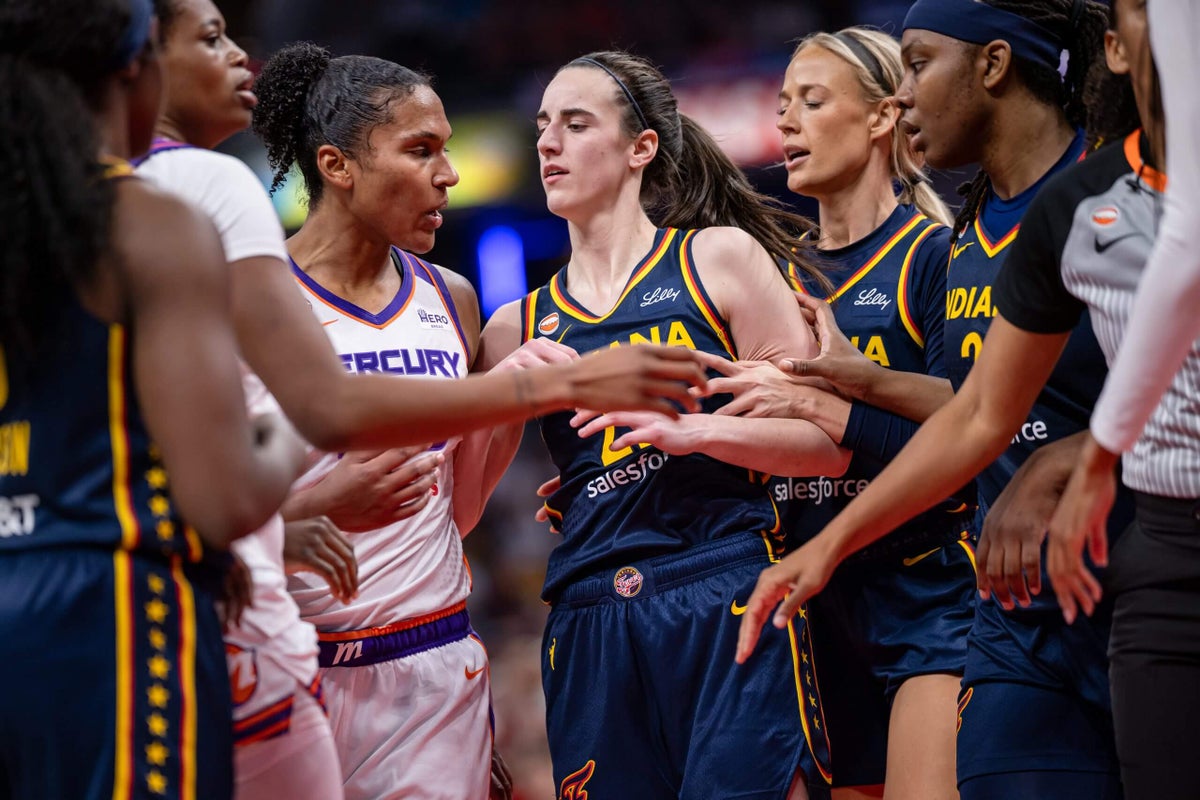
The day the WNBA truly arrives is the day a foul is a foul. Not an inciting event for troll armadas to threaten the people involved. Not an inspiration for craven pundits and politicians to use players as divisive avatars. Not even a reason for teams or coaches to fire blowtorches at each other. When everyone understands it’s all pretty much just basketball, it’ll all be pretty much just fine.
That day is not this day. There’s acid all over what should be a celebratory 30th anniversary season because, apparently, no one can process trash-talking and technical fouls and the occasional fist-to-throat as anything but a cultural reckoning. Death threats and doxxing and a siege on leadership — or lack thereof — are the discourse. Not, you know, wins and losses. A sport gone mad, in every sense.
Let’s go ahead and bring the temperature down. Way, way, way down. Throw the 2026 WNBA season into an ice bath and start reasonably appraising what is happening before our eyes. This is a game played and coached by competitive, passionate people. A game with noble intent and some obvious flaws. All true. But … it’s still a game. It would be great if everyone, including many people in the game itself, could keep that front of mind.
In sum, the lid blew off last week after the Indiana Fever and Phoenix Mercury faced each other twice. During the first game, the Fever’s Caitlin Clark and the Mercury’s DeWanna Bonner got tangled up, said some unkind things, and five players wound up with technical fouls in the aftermath. During the second game, the Mercury’s Alyssa Thomas – among those T’d up in the first meeting – wound up on top of Clark during a loose-ball scramble and then propped herself up using Clark’s neck. The officiating crew missed it in real-time, somehow. The league subsequently hit Thomas with a retroactive flagrant foul and one-game suspension.
In a world populated by people who have watched basketball games before, that could have been that. Should have been that. Even if it involved a player as intensely adored as Caitlin Clark. This was competitors at each other’s throats – sure, literally so is a bit much – and variously penalized for it. Maybe throw in a round of sports-yeller commentary, and then it evaporates. Move along. Nothing to see here but the same kind of occasionally rugged moment we’ve seen in sports for as long as sports have existed.
It was, uh, not that.
To scrape the bottom of the barrel as quickly as possible, a House of Representatives member from Tennessee – which, it should be noted, is not Indiana or Iowa, or even Arizona – called the play “trashy” and brought out his dog-whistle to declare that Clark receives “thug treatment” in the WNBA.
Meanwhile, Thomas said she’s received death threats. Bonner shared screenshots with The Athletic’s Annie Costabile of texts, direct messages and social media comments that included racial slurs and death threats to her family – some of which included her home address.
What a horrifying absurdity. What a wildly aggressive detachment from the reality of a basketball game. None of these comments were the work of people associated with the WNBA, but that is also kind of the point.
The reason the WNBA always has controversies
Importantly – crucially – one of the more recognizable WNBA voices addressed this Wednesday.
“I think as a league, as a whole, there’s been so much more toxicity, racism, homophobia, straight-out nonsense,” Fever coach Stephanie White told reporters. “And it is absolutely unacceptable. Most of this (is) coming from the online community. Most of this, in my heart of hearts, I believe is not coming from WNBA fans, Indiana Fever fans. I believe that this is people who are using our league, using our players to further divisive agendas.”
It was a needed reset, from the most outward-facing person in the corner of one of the most popular athletes in the world.
It ought also be a lesson for her and others in her spot.
Inescapably, White labeled the Thomas fist-to-neck “crazy” and a “cheap shot” and “dangerous” in the first place. She was defending a star player as any coach would. She was correct on the dangerous part. She also activated that very toxicity to a level she surely did not anticipate or wish upon anyone, especially Thomas, a player she once coached. It likewise didn’t help that Mercury coach Nate Tibbetts fired back at White’s comments and the league’s disciplinary process, both defending his own star player and simultaneously aggravating the throng already attacking Thomas and Bonner. Gas on a blaze, all of it.
For every breath you take, there’s a troll waiting to criticize how loudly you exhale. To expect a WNBA coach to put a halt to that is also detached from reality.
But the otherwise aggrieved fan can maybe … relax, a little? And, anyway, the volume here is what’s untenable. The vitriol had force multipliers. So when words lead to death threats, then words must be measured more carefully. Someday, the WNBA might be a place in which White can blast an egregious non-call on Clark and the rest of the world yawns. This day is not that day. This is still a time when most everyone must be mindful of the heat they’re bringing about.
Players may be rationally excused from this, as they’re the ones in the middle of the fray. Clark should be able to lambaste an official for what she deems an unfair whistle without worrying about the repercussions. Thomas and Bonner must call out their experiences to showcase the ugliness out there and, with any luck, prompt a more profound response from the league to the issue of harassment.
But league and team representatives have no such out. They have to understand how a common hard foul can be weaponized, like it or not. So what White said Wednesday was an unambiguous, necessary refresh. Here’s hoping everyone else occupying a leadership position in the league follows the Fever coach’s lead and takes a turn watching the thermostat.
Because, right now, everyone needs to chill all the way out.
The WNBA, like every other major professional sports operation, can pursue a greater impact and also avoid being a vessel for culture wars. The ideal interpretation of the sport can be that it’s a sport. What happens from here can be a significant step in that direction. Imagine the focus being on Olivia Miles’ breakout rookie season, the Las Vegas Aces’ quest to repeat as champions, the expansion Golden State Valkyries resetting the bar for the league at large, and so on.
There will be those who willfully or cynically refuse to see it that simply. They’ll start fires. In those moments, there’s a really easy trick to take care of everyone: Reach for a blanket and smother away.