
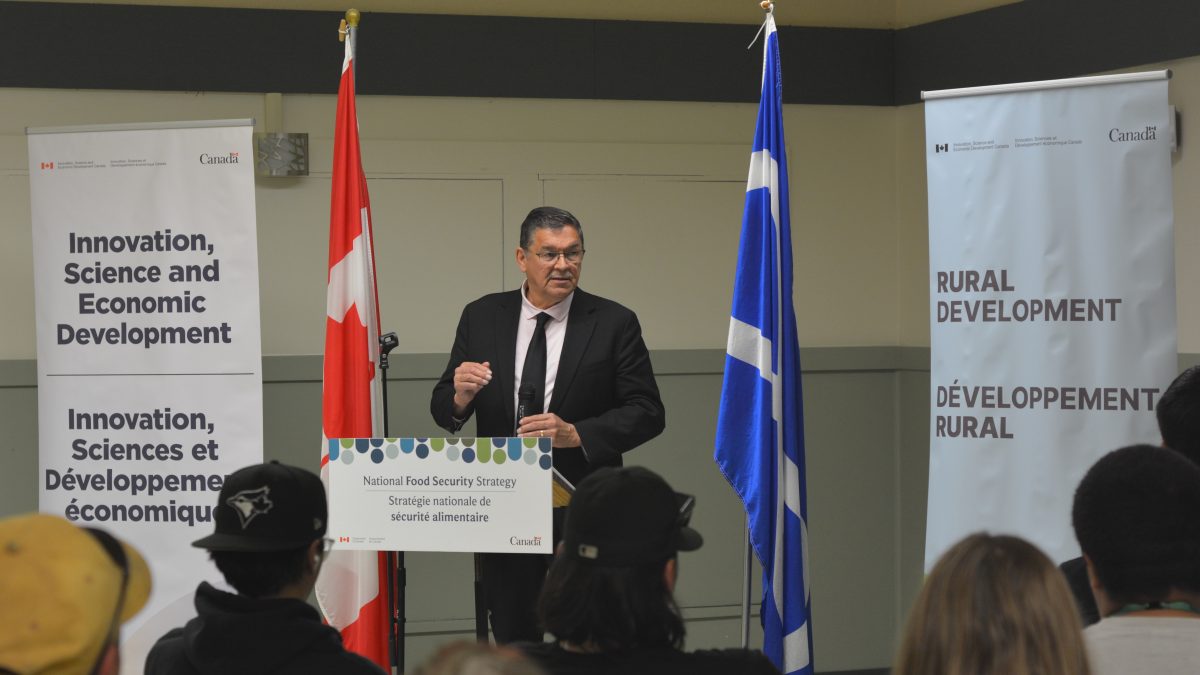
“The answer is absolutely yes.”

“The shorter the distance between where the food is grown and where the food is eaten, the stronger and more reliable our supply becomes,” Belanger said.
“It means less dependence on long distance supply chains, more opportunities for communities and more control over our own food.”
The National Food Security Strategy includes $3.2 billion in investments over 10 years to expand domestic food production, strengthen food infrastructure, increase grocery competition and reduce regulatory barriers across the agricultural sector. The federal government says the goal is to build a more resilient Canadian food system while improving access to affordable, nutritious food.
“We know that secure food security is not just some policy discussion, it’s real life,” Belanger said.
“People in the North are paying more simply because where we live. We know what it means when fresh, healthy food is harder to find.”
The strategy includes $1 billion for food infrastructure such as food terminals and local food hubs, $1 billion through Farm Credit Canada’s Agri-food Project Finance Fund, $750 million to expand greenhouse and indoor food production, and a $150-million Food Security Fund to help Canadian businesses grow, produce and process more food domestically.
The federal government has also opened applications for a new $20-million Community Support Stream under the Local Food Infrastructure Fund to help food banks and community organizations distribute nutritious food to people at risk of food insecurity. Belanger said applications close July 9. Green Lake has previously received funding through the program.
Mayor Jim Laliberte said the initiative builds on Green Lake’s history of local food production, recalling a time when nearly every household maintained gardens and raised livestock.
“We are the council… on behalf of the town people, we would like to reinvent that venture.”
Deputy Mayor Darwin Lafond said the community’s greenhouse project is intended to improve access to fresh food while giving residents an opportunity to become involved.
“The greenhouse that has been erected here, and along with other future greenhouses, will also provide people with a place to have coffee and also a mental wellness break, the taking care of the plants, if they choose to do so.”
While the National Food Security Strategy spans 10 years, Belanger said he hopes many community food hubs will be “well underway” by the end of 2028.
“When we speak with the Prime Minister on a number of initiatives, he always emphasizes speed, so we want to see success in this effort ASAP,” he said.
“The quicker you move, the better and stronger our case becomes.”
“When we tell folks back in Ottawa, Green Lake could grow, Green Lake could sell, and they can do it fast. That’s what I want to be able to see.”
—
Kenneth.Cheung@pattisonmedia.com