
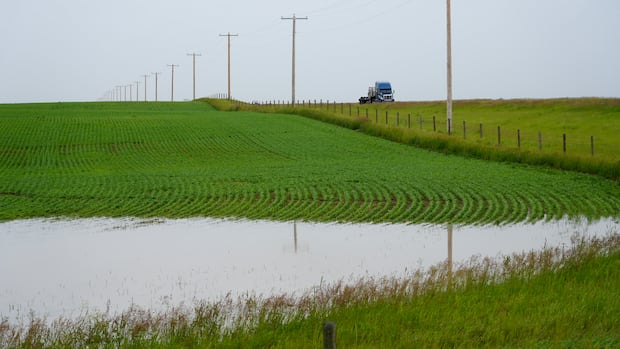
Pat Kunz spent decades toiling in drought-like conditions on his farm near the Alberta-Saskatchewan border.
Now retired and renting out his land, he crossed the province in his camper in June — and wouldn’t you know it, it rained. A lot.
“I don’t think I’ll see it again in my lifetime,” said Kunz, who resides in Medicine Hat, Alta., but farmed near Richmound, Sask. — areas better known for semi-arid conditions, cattle grazing on dry grass and high heat.
“On the whole trip, everything was green,” he told CBC News with a shimmer of amazement in his voice. “Still, I’m sure some guys [who are farming] are saying, ‘Enough already.'”
From the north of the province through to southeastern Alberta, he saw grass and crops blanket the landscape.
That growth is fuelled by precipitation, which now has many ag producers stalled, according to the latest Alberta Crop Report, as they wait for muddy fields to firm up before moving on to spraying or reseeding any washed-out spots.
From Brooks to Medicine Hat — where rainfall in May and June surpassed the annual average — pools of water on fields and pastures dot the landscape.
Irrigation stalled after promising start
Wide swaths of the region typically depend on irrigation to grow crops, but the taps have largely been off so far this season.
“Obviously, the irrigation demand is low,” said Ivan Friesen, the general manager of the Eastern Irrigation District that surrounds Brooks.
He says heavy rain is generally welcome, even though it has caused localized flooding for some producers.
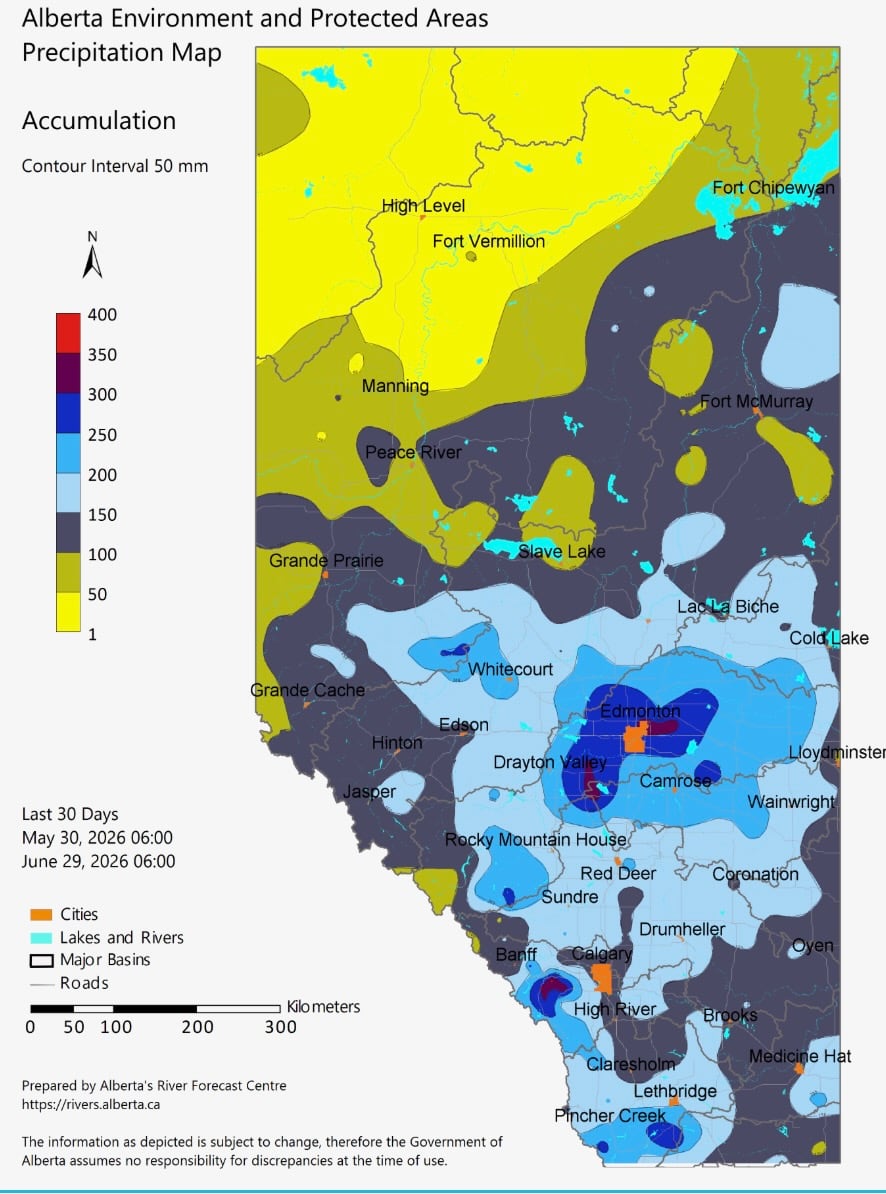 This map shows amounts of precipitation in Alberta between May 30 and June 30. (Alberta Agriculture and Irrigation)
The district has stopped drawing water from the Bow River to off-stream reservoirs because at this point they’re full, with little being delivered to members.
“The [reservoir] level should maintain at constant,” said Friesen. “We expect as irrigation demand does increase in July and August that we’ll be able to bring those levels back down to the normal winter level.”
The deluge comes one year after a wet spring in 2025 was followed by damaging dry heat throughout the province’s southeast.
This spring, irrigators told CBC News they were in a much better position after filling reservoirs over the winter months, compared to the situation from two years earlier when low levels led to emergency water reductions.
Currently, reservoirs on the Bow River system are 74 per cent full, and those on the Oldman and South Saskatchewan systems sit above 95 per cent capacity.
Effects felt across the province
This week, the province activated the Springbank dry dam west of Calgary, built to tamp down high water flows on rivers fed by rain in the foothills.
Rainfall around Edmonton led several municipalities to enact water restrictions last week.
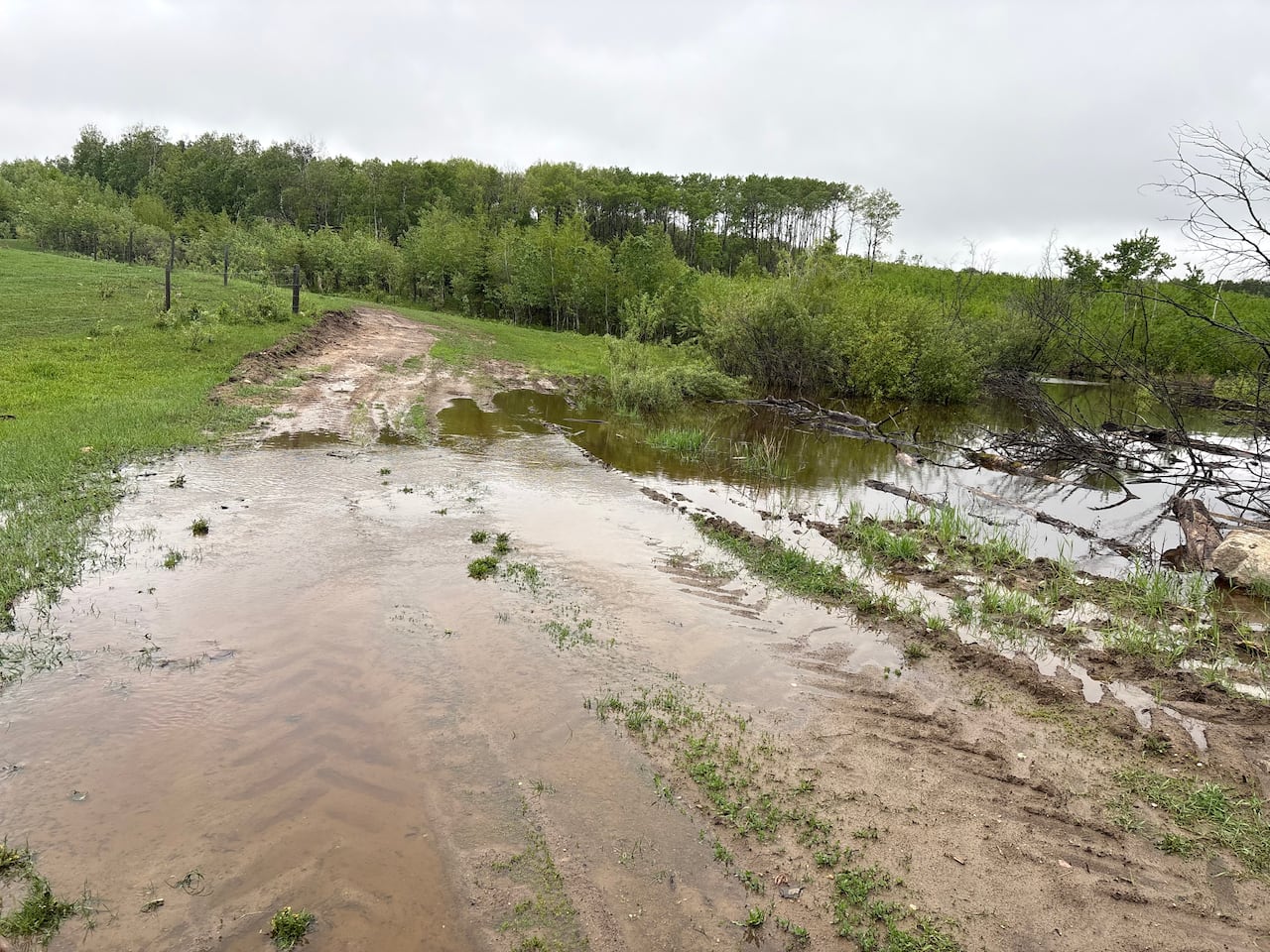 A dirt road leading to one of farmer Elizabeth Robbie’s fields neat St. Paul, Alta., was slick with mud in early June. She says she still had 280 to 325 hectares left to seed. (Submitted by Elizabeth Robbie)
Earlier this spring, officials also activated the emergency “Horsefly spillway” near Taber — another project designed a decade ago after overland flooding hit that area.
This week, the St. Mary River Irrigation District also increased its allocation, or limit, by one-third to members between Lethbridge and Medicine Hat. With reservoirs 92 per cent full, it’s enough water to cover 200,000 hectares in 40 centimetres of water.
That will be metered out over the course of the summer.
Heat required to get crops growing: report
What’s needed now is sunshine and heat, according to Alberta’s latest crop report.
It states that more crop and pasture land had good to excellent levels of soil moisture compared to previous years, but also 13 per cent is considered to have “excessive amounts.”
While crop conditions are also slightly better in all areas except the far north of the province, development is stunted.
“Strong sub-surface soil moisture ratings will allow crops to handle extended warm weather that could be expected in July,” the report reads, adding that many areas “need more warm weather for canola and legumes to catch up in development.”
That could be on the way, according to Environment and Climate Change Canada meteorologist Brian Proctor.
“Farmers are going to have a real tough time getting out in their fields,” he said, regarding the short-term forecast. “When we look at our summer forecast — longer range — it looks warm and dry for most of the province. Hopefully, that’s what we’ll see.”
If so, said Kunz, the result could be a bumper crop, though he doesn’t regret moving into semi-retirement, even with a good-looking crop coming in.
“I didn’t even bother [with hail insurance] last year because it just was dry and destitute,” said Kunz. “I know our renter here, he’s in a little bit better mood.”