

New data shows most community league facilities in Edmonton would get a C grade — and according to the municipal government, many leagues can’t afford to fix them.
Edmonton Federation of Community Leagues (EFCL) hired a firm to assess league facilities from 2023 to 2025. Its data is now part of a City of Edmonton review into community leagues.
The review, which was presented to city council last month, found leagues are facing major infrastructure deficits and don’t have enough money to fix them, according to city documents.
“Community leagues aren’t the same organizations they were back 40 years ago, when the last review of policy around this was done,” Colin Johnson, the EFCL’s deputy executive director, told CBC News.
City document say the federation assessed facility conditions for 130 of the 135 community leagues with “significant infrastructure,” like buildings. Unlicensed community leagues were excluded from the assessment.
More than 80 per cent of the community leagues earned a C grade or lower, including two — Londonderry and Fraser — that failed.
Only two leagues got an A: Belgravia and the nearby McKernan.
Some community leagues didn’t get a grade. Among them were organizations that opted out of the evaluation, leagues that haven’t been recently assessed or had assessments completed before 2023, and those that either had infrastructure being built during the EFCL’s assessment period or don’t have infrastructure on site.
The letter grades are based on facilities, not local programming, and act largely as a comparison tool, Johnson said.
“They’re sort of a shortcut for us to be able to see what some of the common shortfalls may be,” he said.
The city’s review found three main challenges that community leagues face: aging infrastructure, underfunded capital liability and inconsistent service levels across the city.
The review shows “the operational system is strained and service access is inequitable,” said Sian Svendsen, a supervisor with city neighbourhood services, while speaking to council on June 19.
“Each league is its own non-profit entity and relies heavily on local resources and capacity. The level of services an Edmontonian receives is inconsistent depending on which neighborhood they live in,” Svendsen said.
According to her, the geographical distribution of community leagues is based on a time when Edmonton’s neighbourhoods were “largely uniform.” But given the city’s recent rapid population growth, leagues no longer represent similar numbers of people, with some serving populations of 800 versus 32,000.
“Leagues are facing entirely different challenges than in the past,” Svendsen said. “Some are overwhelmed trying to maintain legacy buildings, while others in developing neighborhoods are trying to build new infrastructure.”
Most community hall facilities were assessed to be in fair condition, though their median age is just under 50 years old, according to the city.
According to city documents, community leagues need more money to address aging infrastructure.
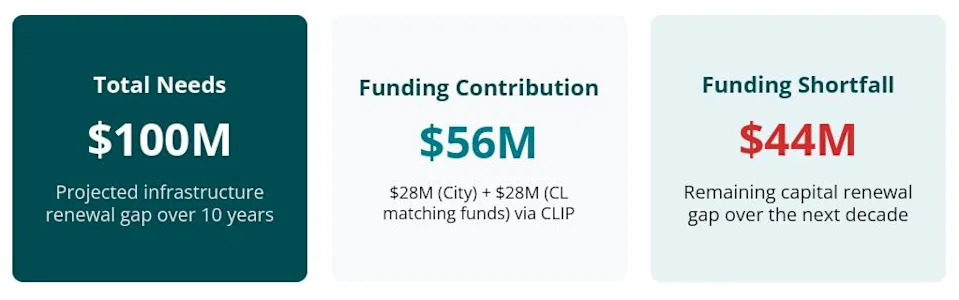
Leagues are projected to need $100 million over the next decade for infrastructure renewal, including $18.6 million for life safety requirements the EFCL has prioritized. But a $44 million funding shortfall is expected over that 10-year span, documents show.
(Submitted by the City of Edmonton)
Municipal budgets don’t have room to help with that gap, beyond what the city already gives to community leagues every year, city administrators told council on June 19. As such, Johnson said the EFCL plans to make an official budget request for funds for safety upgrades.
On June 19, council passed a motion 8–5 to prepare an unfunded service package to address this funding issue. It will be discussed further during council’s 2027-2030 budget deliberations.
The city and EFCL are also designing “a modernized framework … to ensure long-term stability of the community league system and equitable access for all Edmontonians,” city spokesperson Rae Thygesen told CBC News in a statement.
The framework is expected to be completed by the end of 2027, Thygesen said.
Although money is tight, Johnson said community leagues are beacons for Edmonton’s many neighbourhoods and the required funding can improve their facilities — and make the lives of its some 9,000 volunteers easier.
“We know it’s not a great time, but the impact that community leagues have in transforming that money into a great deal more impact is really important,” he said.