
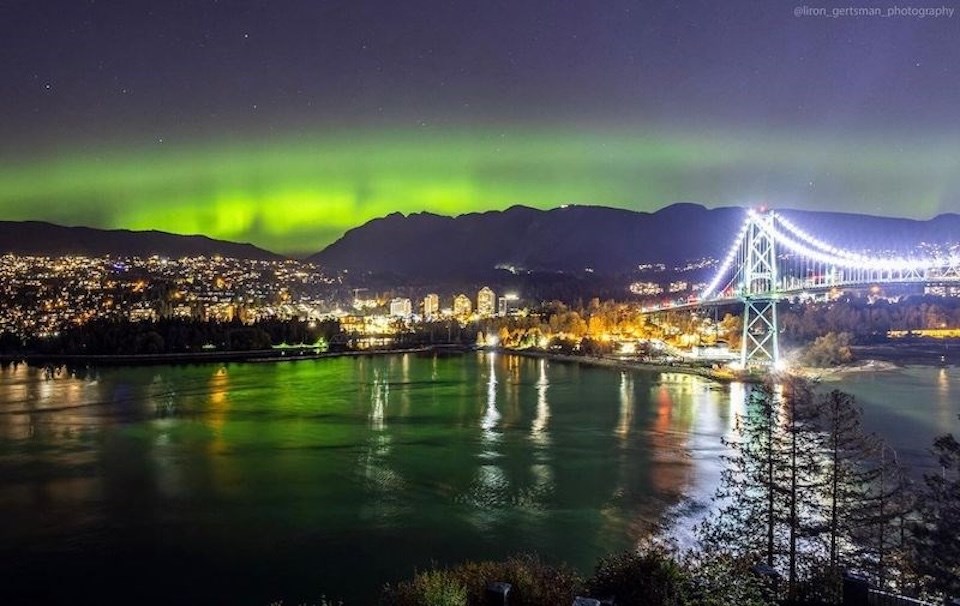
You may have to stay out for a while, but it could be well worth the skygazing.
The Lower Mainland has been red and white for several days ahead of Canada Day and on the national holiday itself. And now the region might also experience some seriously mystical hues in the nights ahead.
The Metro Vancouver weather forecast includes some clouds on Thursday (July 2), but the skies are expected to clear as geomagnetic storms set the stage for a possible northern lights display.
The National Oceanic and Atmospheric Administration’s Space Weather Prediction Center issued a G2 (Moderate) geomagnetic storm watch for July 3. Some solar material ejected from the sun is expected to cause stormy space weather on Earth, beginning on this day (see gallery above for details).
Metro Vancouver weather forecast: Possible northern lights viewing opportunities
The University of Alaska Fairbanks (UAF) expects “high aurora activity” on Thursday, July 2, with displays possible “overhead from locations such as Inuvik, Yellowknife, Rankin and Iqaluit to Juneau, Alaska, Edmonton, Winnipeg, Thunder Bay and Sept-Iles.” They may be visible low on the horizon in cities including Seattle, Des Moines, Chicago, Cleveland, Boston and Halifax.
The university’s online aurora monitor map shows what regions the aurora’s green glow will likely reach, and other areas where it is less likely. Additionally, a brief description below the map shows the aurora activity on that particular day.
But Vancouver’s forecast isn’t co-operating with Thursday’s possible display, with clouds and showers expected. Instead, locals should look out for the colourful manifestation overnight Friday, when skies could clear heading into the weekend.
The UAF calls for the same high aurora activity on Friday, with all of the aforementioned places mentioned as places that could see the colourful dancing lights, including Vancouver.
A third possibility to view the aurora is Saturday, although the display isn’t expected to be as vibrant. The UAF indicates “low activity,” with the aurora’s green hues not expected to reach as far south as Vancouver. But it’s possible that the stormy space weather could evolve as we head into the weekend.
The aurora often appears as a milky manifestation moving in the night sky rather than vibrant hues. While a camera with a long exposure is useful for capturing the vibrancy of the aurora, the newest smartphones have a darklight mode that will also capture colours the human eye can’t see at night.