
SILVERSTONE, UK — In order to keep in touch about pressing matters, Formula 1 drivers rely on a tried and tested means of communication.
A WhatsApp group chat.
As members of the Grand Prix Drivers’ Association, known as the GPDA, the F1 grid will often discuss key topics such as safety or air concerns they may have about the direction of the sport.
But according to Lewis Hamilton, the seven-time world champion, the group chat has been lively with discussion about what to expect at this weekend’s British Grand Prix. Specifically, concerns about what F1’s all-new cars will do to Silverstone, one of the fastest and most iconic circuits on the calendar.
“It’s just a completely different track,” Hamilton said when asked by The Athletic what Silverstone would be like in the 2026 models.
F1’s new cars for 2026 have placed far greater emphasis on electric energy management after moving to a near-50/50 split between combustion and electric power in the engine.
It has drawn scathing criticism from many of its biggest names, world champions Max Verstappen and Fernando Alonso being the most vocal, calling it “anti-racing” and a “battery world championship,” respectively. Some small in-season tweaks have been made for 2026, introduced in Miami, ahead of bigger changes in 2027 and 2028 to reduce the reliance on the energy.
“It’s probably the best test we’ve faced so far since Miami,” Cadillac driver Sergio Pérez told reporters on Thursday. “The other circuits were not so critical with energy.”
But at Silverstone, typically one of F1’s fastest and most exciting tracks thanks to its array of high-speed corners and long straights, the pitfalls of these cars could be far more pronounced.
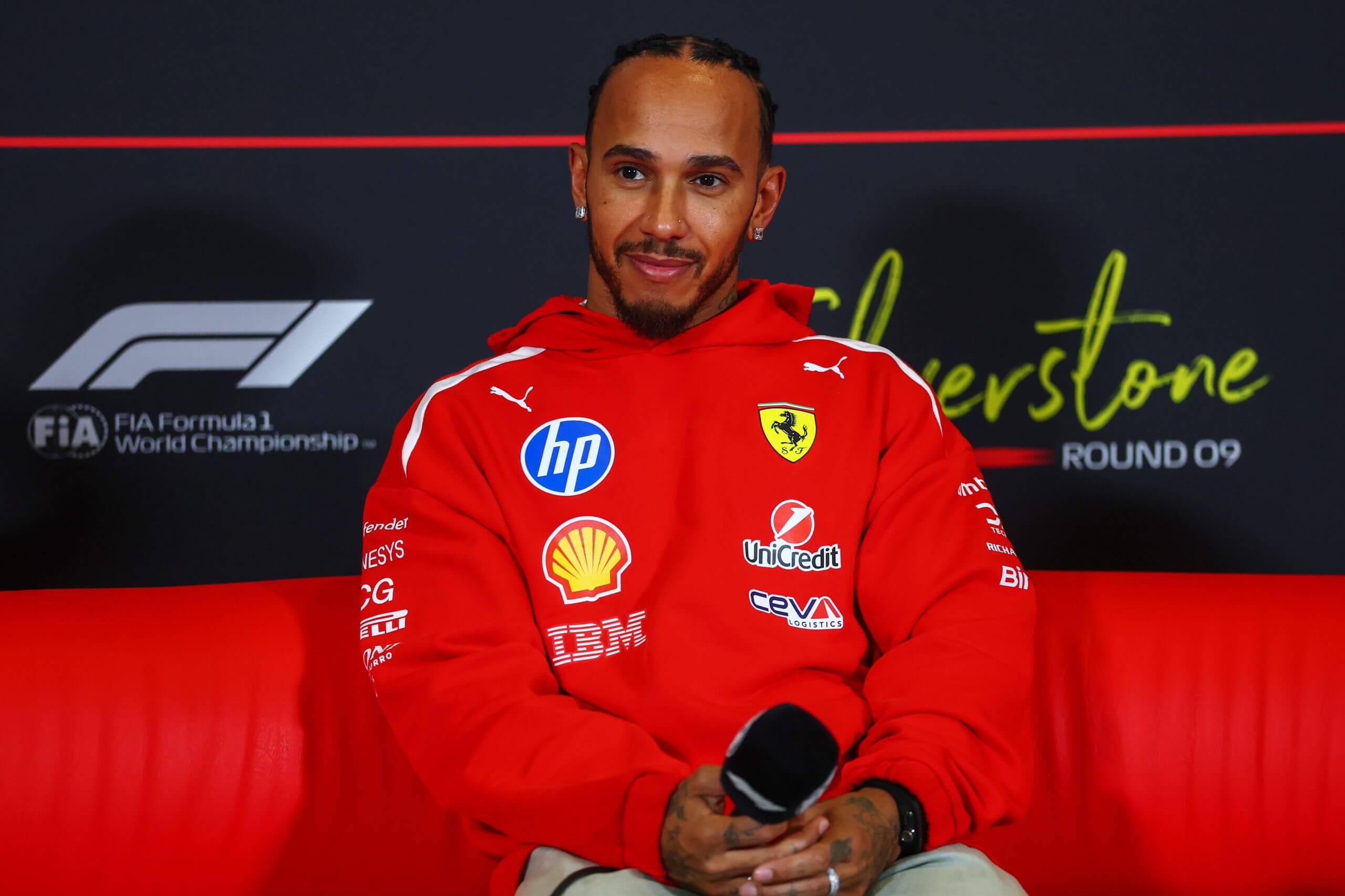
“All us drivers have been talking in the drivers’ chat just how poor the power is going to be through this track,” Hamilton said. “We run out of battery power. There’s only a few corners to charge the engine, so the (battery) will be switched off for a large portion of the lap.”
(Bryn Lennon/Getty Images)
Concerns about Silverstone started long before the drivers spoke out during Thursday’s media day. After finishing second in the Austrian Grand Prix, Verstappen raised the potential issues when asked whether Red Bull’s improved form was track specific.
“Silverstone, I love the track, but I did a few laps on the simulator, I just started laughing,” the Dutchman said last Sunday. “It felt like a different track.”
He highlighted that the British Grand Prix likely will “feel very different” due to the track layout. It’s a thrilling high-speed drive in years past, with the fast corners and long straights.
Fast corners have lost their buzz at some tracks this year. One way the 2026 cars recharge their batteries is by ‘superclipping’ where the top speed drops off while cars are at full throttle to harvest energy. This was most visible in Australia through the fast section at Turn 9 and 10, where drivers were losing chunks of speed at the fastest point of the track.
The hard braking zones, like at the Austria Grand Prix, also allow drivers to recharge the battery and go back on the attack. But if a driver uses up too much of their energy through the high-speed corners, come the next straight, they won’t have as much charge to spend, creating a slower pace. The ‘yo-yo’ style of racing has drawn comparisons to Mario Kart from some drivers.
It’s a cycle that’s been criticized before this season, as the race becomes a management game. Some of the tactics to mitigate the impact include lifting and coasting in corners that previously could be tackled flat out, like the left-hander 130R at Suzuka in Japan.
When asked whether Silverstone’s Copse (Turn 9), a high-speed right-hander, would be like 130R, Pérez replied: “The engine set-up, it becomes quite an important factor around your lap on where you decide to harvest energy.”
The Mexican driver thinks “we’re going to be finding a case where probably going slower through the corner ultimately will be faster, like delaying the throttle application and doing that sort of game will be quite critical around here.”
It leaves the question of whether Silverstone will still be Silverstone. As Oscar Piastri pointed out, the track characteristics that make the cars’ “engines really struggle” are also what make Silverstone “so special.” He’s also driven it on the simulator, and while he “didn’t quite have the same reaction” as Verstappen, Piastri feels “it’s certainly not going to be better than it was last year.”
One of Silverstone’s most iconic sections is S-curved corner sequence called Maggots and Becketts. In the era of ultra-high downforce cars that were used from 2017 to 2021, the cars were capable of pulling 5Gs through that section, making it a challenging thrill for the drivers.
Hamilton said the “best part of the track” started from Copse corner, through Maggots and Becketts, then turning right through Chapel and onto the Hangar Straight before another right-hander at Stowe (Turn 15). This year, that entire section will be different.
“Normally the engine’s screaming as you’re going into Copse and you’re holding on for dear life as you go through there flat out,” Hamilton explained. “This year, the engine will be coasting down, most likely we’ll be downshifting from 8th to 7th (gear) whilst (at) full throttle, trying to keep the engine revs higher.
“It’ll be a long, long straight from (Turn) 9 to 10 with no deployment, basically. And then Maggotts and Becketts is not going to feel the same because I think you have to lift and coast or something through there for a period of time.”
One of the fiercest critics of the new cars has been Aston Martin’s Alonso. He was especially downbeat about what these cars will be like around Silverstone and the next race at Spa in Belgium, another high-speed layout.
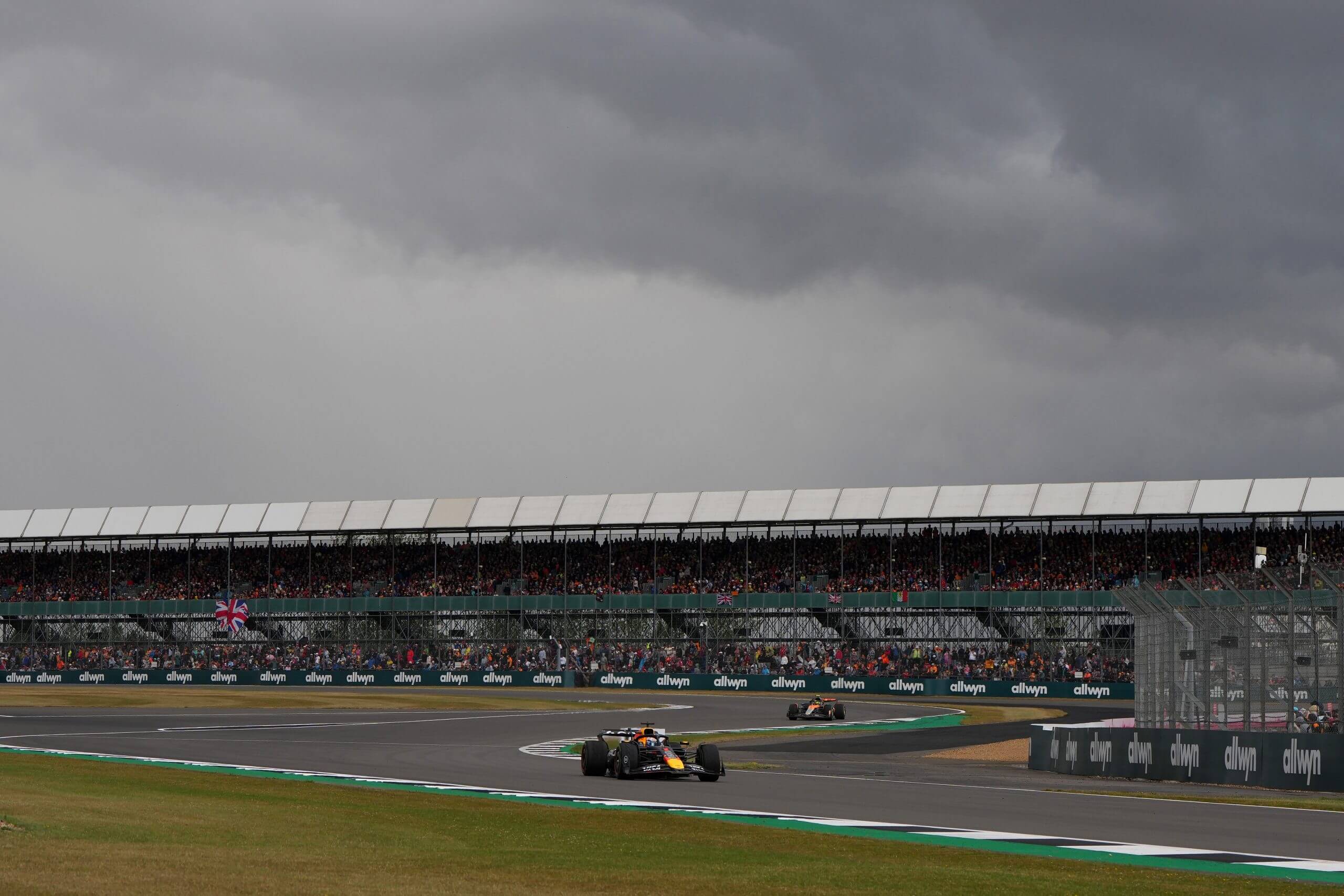
“Silverstone was probably the best of the circuits, suiting that car perfectly,” Alonso said. “I think this year is going to be very different and not fun to drive. The car, looking at the simulator lap and things like that, is going to be quite sad, I think for the drivers, but also for the spectators.”
(Alex Bierens de Haan/Getty Images)
Asked specifically about Maggots and Becketts, Alonso made a plugging-in motion with his hand and quipped: “Charging station!”
Haas driver Esteban Ocon said that while the start of the lap would be OK, drivers would begin to struggle after using a lot of battery power along the Wellington Straight, the first long straight of the lap.
“After that, it gets really difficult,” he explained. “After Turn 9 you basically have no power. So it takes a while to get to Maggots, Becketts. Unfortunately you don’t really have much of a challenge.” He thought that Chapel, typically a tricky braking point in previous years, would now be “all flat out” because drivers arrive at the corner so slowly.
“It’s not as rewarding and challenging as it was in previous years,” Ocon said.
Hamilton’s Ferrari teammate Charles Leclerc believed most of the drivers “feel probably a bit sad” about the level of battery management required, with the extra commitment through high-speed corners that made a difference in the past no longer being so valuable.
“These were tracks where actually the bravest ones in qualifying will make a difference,” Leclerc said. “Because you get into the high-speed corners with quite a lot of power and need to play with the limits of the car at very high speed. Now the high-speed corners are more medium-speed corners, because we have a lot of (super) clipping.”
Not every driver was downbeat. Title contender George Russell, who has a shot at winning his home grand prix for the first time, was happy to play contrarian, even if he recognized the qualifying laps may no longer be as fast.
“There’s 600,000 fans here (over the race weekend) who don’t probably care so much about energy management,” Russell said. “And on the flip side, the tracks that are the most challenging for the energy, such as Melbourne and China, they have so far produced better racing than we’ve seen in the past of those tracks.
“Tracks that are energy starved, the racing will be better. It probably will be a bit more chaotic. So you can look at that as the positive.”
But that racing also comes with a big risk: People driving at different speeds, like what happened with Ollie Bearman’s 50G crash during the Japanese Grand Prix where the speed differential was 29 mph.
Piastri outlined a scenario where a driver may be half a second quicker on one straight and that much slower on the next straight. The speed differences in a straight-line can be staggering, and sometimes, they’re a sitting duck.
The drivers can’t do much about those speed differentials, Piastri said, because of a multitude of reasons, like being out of battery and being unable to deploy if they wanted to do so or the deployment happening “when we wouldn’t necessarily choose to.”
“I think on TV, it looks much, much more simple than it is behind the wheel,” the McLaren driver continued. “So…I won’t say any more. Some tracks it’s a decent balance, other tracks it’s a bit… well…a reference to a certain video game, I don’t need to say.”