
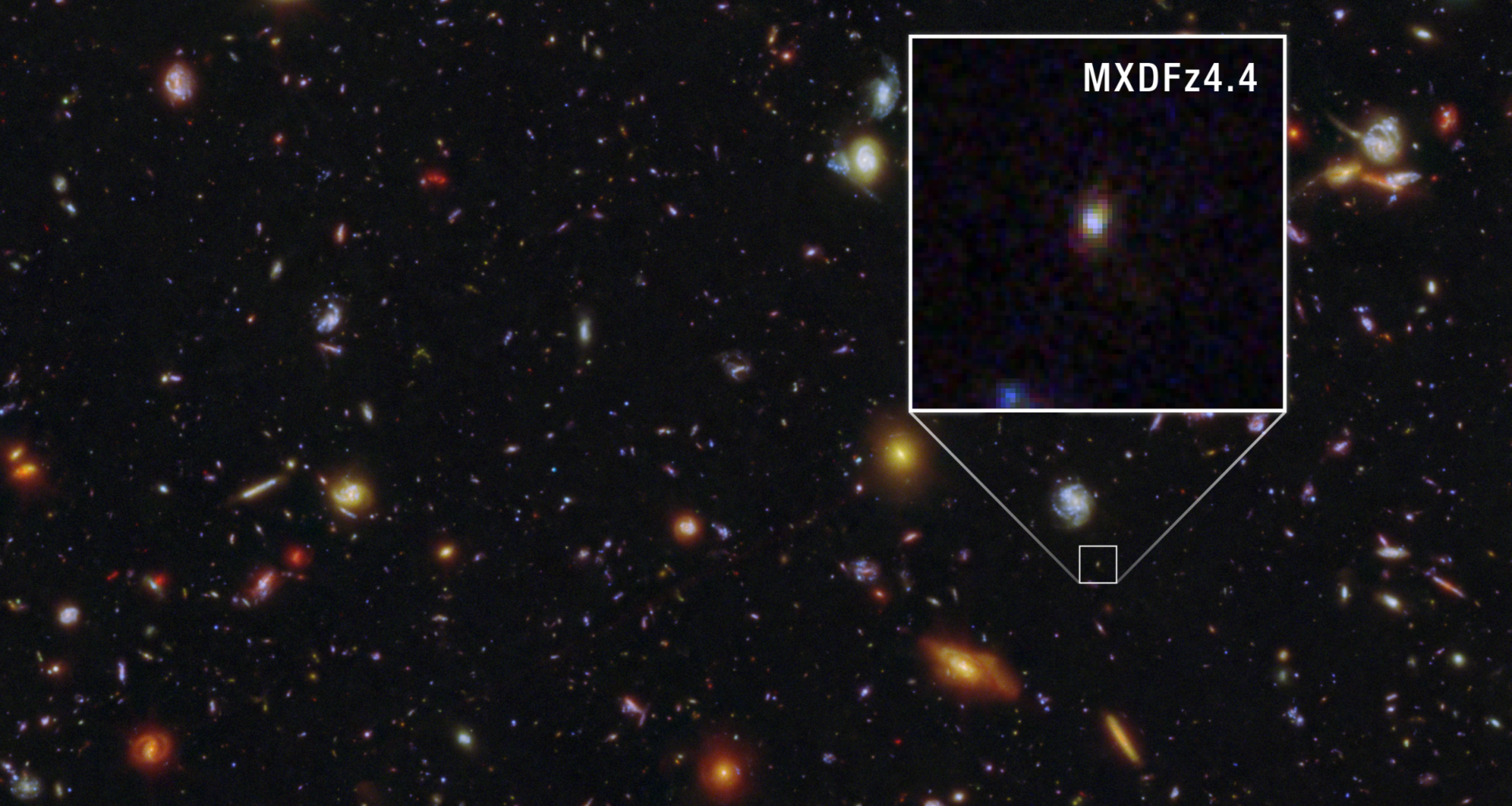
Astronomers have spotted an ancient galaxy shining through the cosmic fog of the early universe, revealing a detailed view that was thought to be impossible.
Using NASA‘s Hubble Space Telescope, along with data from the James Webb Space Telescope (JWST) and the European Southern Observatory’s Very Large Telescope (VLT), researchers detected “ionizing” ultraviolet photons — energetic light capable of stripping electrons from hydrogen atoms — coming from the galaxy, called MXDFz4.4. It’s the earliest such detection on record, arriving only around 250 million years after the end of a major cosmic transition called the Epoch of Reionization, the researchers explained in a study published June 23 in The Astrophysical Journal.
For hundreds of millions of years after the Big Bang, the space between galaxies was filled with a fog of neutral hydrogen gas that blocked this kind of light. Over time, radiation from the first stars and galaxies ionized that gas, clearing the fog and letting light travel freely across the universe — a process astronomers are still working to fully understand.
You may like
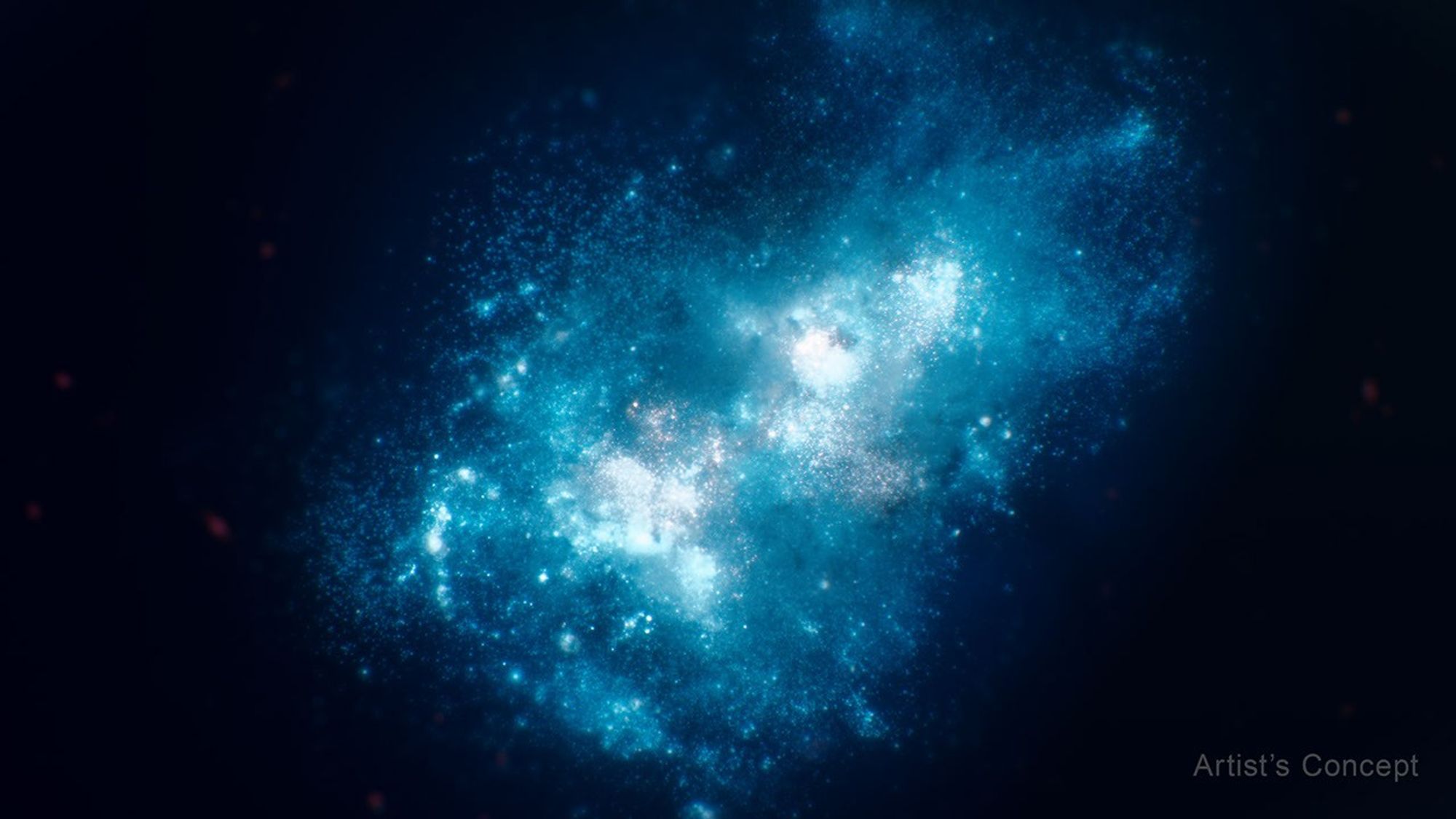
An illustration of the galaxy MXDFz4.4 as it appeared roughly 1.4 billion years after the Big Bang, when the Era of Reionization was drawing to a close.
(Image credit: NASA, ESA, Leah Hustak (STScI))
Goovaerts, I., et al (2026). MXDFz4.4: A LyC Emitter 250 Myr after the Epoch of Reionization and a First Test of Ly α Morphology as a Tracer of LyC Escape at High Redshift. The Astrophysical Journal, 1005(1), 34. https://doi.org/10.3847/1538-4357/ae75b0
TOPICS