

Listen to this article
Estimated 4 minutes
The audio version of this article is generated by AI-based technology. Mispronunciations can occur. We are working with our partners to continually review and improve the results.
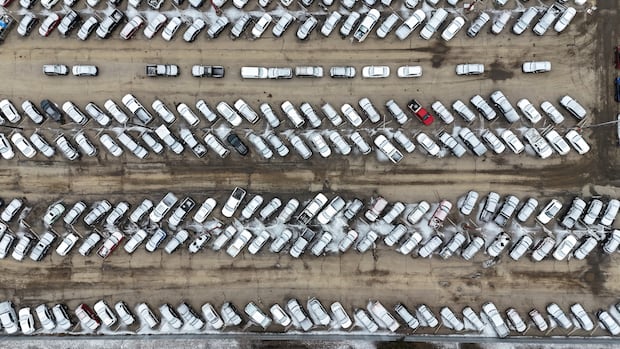
The City of Edmonton has regained access to 150 spaces at a police impound lot near the Yellowhead Trail to address the nearly 400 abandoned vehicles left on streets, alleys and parking lots.
The city and Edmonton police stopped towing cars earlier this year after the main impound lot at 122nd Street and 124th Street became full, the city said in an email to CBC News on Monday.
Additionally, the city said an overflow parcel of land — used when there is an excess of towed vehicles — wasn’t available, as construction crews were using it as a staging area for the Yellowhead Trail freeway conversion project.
Erin Rutherford, city councillor for Ward Anirniq, said the regained spaces take pressure off the towing backlog but she doubts the solution will be effective in the long term due to the high demand for vehicle towing.
“In the last two years, the request for parking enforcement has gone up 45 per cent,” she said in an interview with CBC News on Tuesday.
“When we hear that … the waitlist is in the 400s and 500s for towing of enforced vehicles, then 150 alone isn’t going to solve the problem.”
WATCH | Edmonton is running out of space for towed vehicles:
One city councillor is concerned about Edmonton’s lack of towing
The City of Edmonton tows vehicles that are abandoned or face infractions, but as of mid-April that hasn’t been the case. Tristan Mottershead looks at why that is and why an Edmonton city councillor is concerned about the message it sends drivers.
Rutherford said abandoned vehicles are eyesores and they can pose safety issues.
“For example, the car window is smashed in and it starts to look derelict, then it starts to invite bad behaviour,” she said.
Rutherford added an abandoned vehicle left too close to an intersection can also be dangerous.
A vehicle is legally considered abandoned if it is left on public property for more than 72 consecutive hours unmoved, the city said in an emailed statement on Monday. Parking bylaw officers can issue tickets before slating the vehicles for towing.
As of June 26, 362 abandoned vehicles were on towing queue, said Alan Le, the city’s superintendent of parking enforcement.
That’s down from the 693 vehicles on the books on May 26, Le said in a statement to CBC News on Tuesday.
“The reduction in the queue is partly due to new lot capacity, but also in part because owners moved their vehicle after it was ticketed as abandoned,” he said.
Clearing the backlog is a steady, phased process, with crews managing the daily movement of 10 to 15 abandoned vehicles to balance the load, the city said.
The City of Edmonton said its personnel and Edmonton police are focused on public safety issues first, such as removing vehicles obstructing regular traffic flow or emergency access, handling criminal and investigative seizures and managing impaired driving tows.
Rutherford said she wrote to the Edmonton police commission in April, expressing concerns that the capacity of the tow lot, operated by police, was insufficient to meet demand.
“These factors directly hinder the ability to address essential public safety problems and effective enforcement,” Rutherford said at the time.
She urged the commission to relocate the tow lot to a larger area and make it a capital project in the next four-year budget.
In response, the commission said it was unable to propose a new impound lot project under its capital funding.
In an email to CBC News on Tuesday, the commission said it held the same position, noting that the tow lot provides “suitable functionality” for Edmonton police and city bylaw for the foreseeable future.
“Going forward, the commission would always be prepared to consider advancing new proposals should functionality change and new pressures [be] detected.”