

It’s virtually impossible for Dr. Gerald Batist to name just one thing when asked what has made him most proud in the 20 years since the Segal Cancer Centre opened its doors at the Jewish General Hospital.
Batist, who has been the centre’s director the entire time, keeps listing examples of notable discoveries, breakthroughs and accomplishments that have revolutionized cancer care not only in Montreal, but in Quebec, Canada and around the world.
“We take care of our patients in every aspect: spiritual, psychosocial and of course physical and medical. But at the same time, each opportunity is an opportunity for new knowledge, and we’re generating new knowledge that will help patients the world over,” Batist said. “We’ve helped develop drugs and new treatments and treatment approaches that help our patients, but have been disseminated globally and helped other patients. That’s what I’m most proud of.”
The Segal Cancer Centre began with a $10-million Canada Foundation for Innovation grant, a $20-million donation from philanthropist Alvin Segal and a novel plan: consolidate the different oncology departments spread throughout the Jewish General with laboratories conducting cutting-edge research under one roof.
Five floors were added to Pavilion E and the first patients were welcomed in early 2006. Over the past two decades, thousands of the 184 Quebecers per day who receive a grim diagnosis of cancer have received life-saving care — or at the very least, compassion and hope — thanks to this stalwart Montreal institution. And many more have benefited, too.
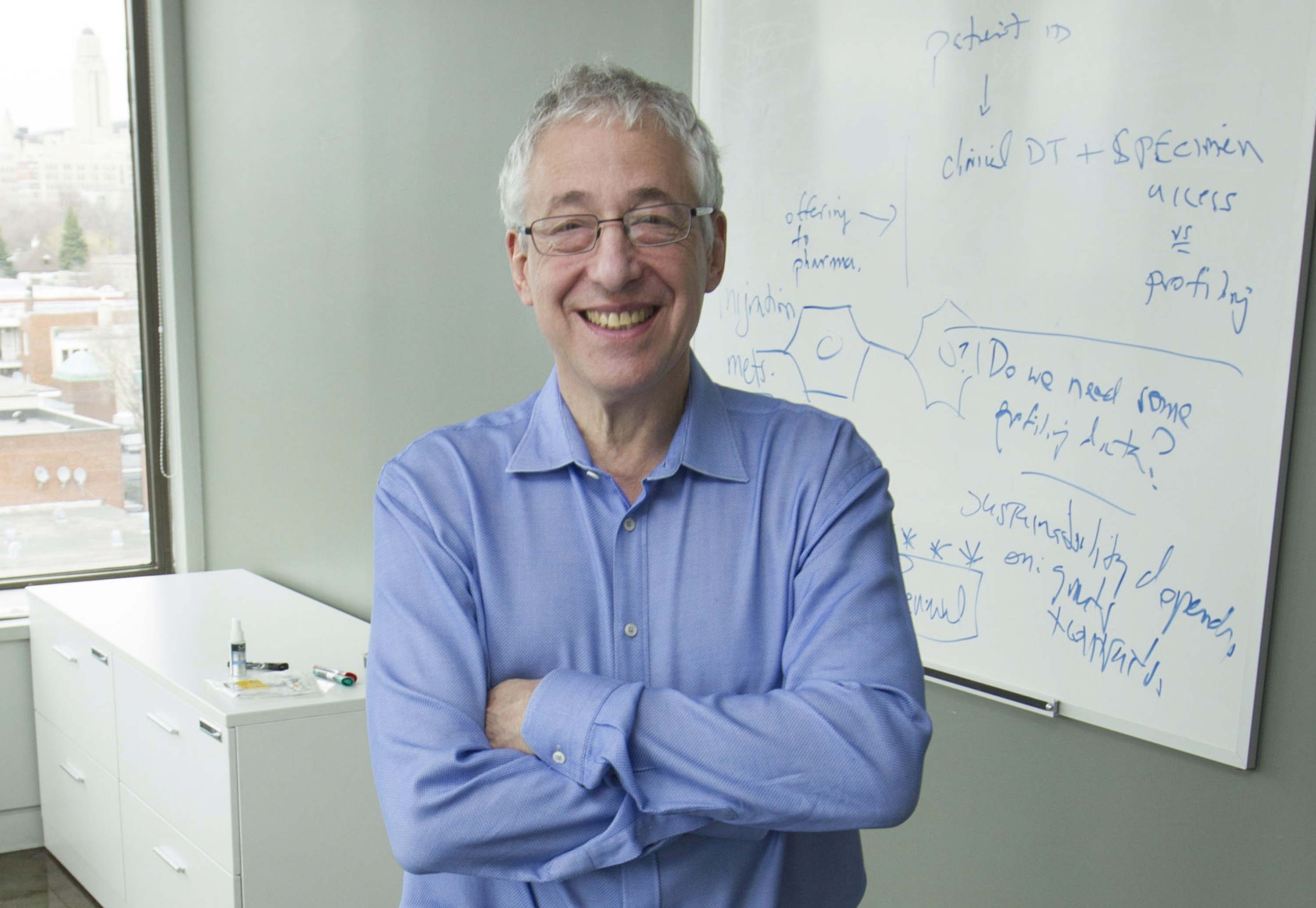 “Wherever the patients’ needs seem to go and wherever there’s a scientific question that can be addressed, we’ve tried to extend ourselves and move in those directions ,” said Dr. Gerald Batist, the Segal Cancer Centre’s director. John Kenney / Montreal Gazette
“We have doctors who know the questions that are necessary because they take care of patients and also know how to address them in the research lab, and conversely know how to bring things from the research lab into the clinic for clinical testing and clinical research and then back to the lab for refinement,” Batist said.
As the Segal Cancer Centre marks its 20th anniversary, the Jewish General Hospital Foundation published an impact report looking back at some of its major milestones. Batist also offered up a few greatest hits of his own.
An early success story was work on clinical trials for the human papillomavirus, which has dramatically reduced rates of cervical cancer. Researchers also helped validate whether it would prevent head and neck cancers.
Dr. Richard Margolese, an early breast cancer pioneer at the Jewish General, uncovered a family with a history of the disease and submitted their DNA to researchers who eventually detected the BRCA genes. Building on that in recent decades, researchers have made further strides in understanding BRCA gene mutations and identifying other cancers with genetic origins.
The acquisition of one of only three Da Vinci robotic surgery machines in Canada at the time boosted the number of delicate operations carried out with greater precision from two dozen in 2008 to nearly 400 in 2024-25.
Advances in the treatment of rectal cancer using brachytherapy are now catching on around the world.
“We’re the first in the world to apply alpha-wave therapy to pancreatic cancer,” added Batist. “We did a study using modified bacteria to treat pancreatic cancer that doubled the survivorship of patients with metastatic pancreatic cancer. We’re just going to keep pushing forward on all fronts.”
Progress hasn’t been limited to medical procedures. There have also been significant gains in all aspects of care.
“We’re one of the centres in Quebec and in Canada that has taken the concept of nurse-physician partnership to heart,” Batist said, giving one example. “I always say that doctors are very good at finding the problem — that is, diagnosis — and nurses are always good at finding the solution. And so the partnership works.”
Hypnosis is offered for patients who have needle phobias. Specialized care, including psychosocial support, is provided for adolescents and young adults fighting cancer, whose needs differ from those of both children and older adults. Cancer sufferers experiencing persistent depression are being treated with psychedelics.
During the pandemic, doctors experimented with taking cancer care outside the hospital. Using new diagnostic tools and delivery options, like subcutaneous chemotherapy instead of intravenous, the Segal Cancer Centre is now able to treat some cancer patients in CLSCs, increasing efficiency and reducing health costs.
“Wherever the patients’ needs seem to go and wherever there’s a scientific question that can be addressed, we’ve tried to extend ourselves and move in those directions — and share all the time with our colleagues in other hospitals and partner with them on projects or things that they can do that we can’t do,” said Batist.
None of this would have been possible without the help of donors.
Through the Jewish General Hospital Foundation, philanthropists have funded major initiatives like the Maria Saputo Monticciolo Clinical Research Unit, which has helped make once-experimental personalized therapies based on genetics the standard of care, or the Anna and Peter Brojde Lung Cancer Centre, which opened in 2012 to facilitate treatment and study of that deadly disease in one place.
Batist said the benefits of such donations trickle down.
“We view ourselves as very much a part of the Quebec health network,” he said. “When donors give money to our programs, they understand that some of that money may end up at another hospital, because of all of our collaborations. We collaborate with a whole network at (Centre hospitalier de l’Université de Montréal, Centre hospitalier universitaire de Sherbrooke and CHU de Québec-Université Laval) and all of the hospitals. We support the projects wherever they are.”
Very early on, the Segal Cancer Centre launched a major annual fundraising campaign that involves patients, doctors, survivors, their families and the community.
What started in 2005 as the Weekend to End Breast Cancer, a two-day march, became Le Week-end pour combattre le cancer for all types, a cycling tour. This year’s ride — to be held Sunday, July 5 — aims to raise $1.4 million. Over the years, the events have brought in $65 million.
“When people do something physical together, either bicycle or run or walk, they bond. And they connect with one another and they talk about people in their family who have suffered. And when their muscles start to ache, their commitment strengthens to help make this go away,” said Batist. “So the physical action is a really excellent way of raising funds and awareness and bringing people together around a cause.”
After 20 years of pushing the frontiers of medicine, Batist said the pace of discovery has accelerated in recent years. New developments in immunotherapy, CAR-T cell treatment and vaccines research are all bringing the Segal Cancer Centre closer to one day finding a cure for this terrible disease — and all the faster.
“We’ve gone from treating cancer and trying to move from an acute lethal disease to a chronic manageable disease, which we’re very good at now. But we’re at the point where we can actually cure a large number of patients, even with metastatic disease,” said Batist. “I can think of patients five years ago that died of various cancers that today I would have something real to offer them in terms of therapy.
“The half-life of knowledge, the turnover of knowledge, the evolution of knowledge in cancer treatment and research is getting shorter and shorter. Five years is quite something.”
I started at The Montreal Gazette in 2000 as an intern. Since then I have covered the National Assembly and courts, worked on the assignment desk and written editorials, before debuting as city columnist in 2017.
ahanes@postmedia.com
Editor’s Picks