
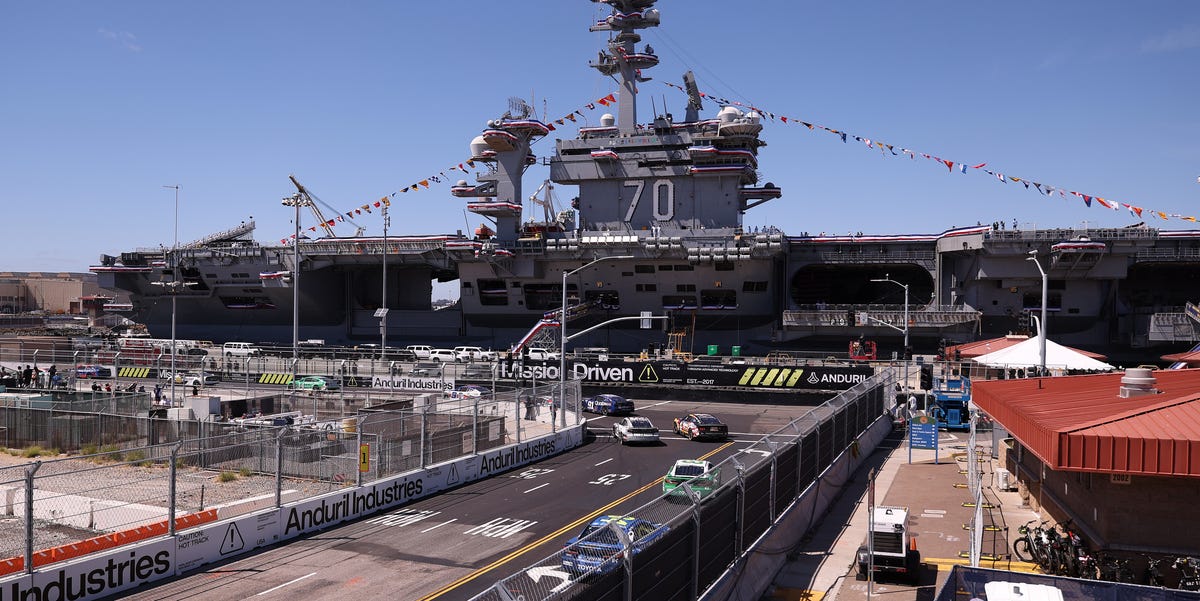
Two weeks ago, NASCAR ran all three of its national-level series on a street circuit built around a U.S. Navy base. The race at Coronado had some issues, but it also provided what may be the most unique views ever seen at a temporary race track. And in a video posted last week, series officials showcased how exactly the track was built and raced on an active military installation.
Footage starts with construction already well underway, 72 hours before cars hit the track for the first time. More clips of the track being built are dispersed throughout, but the real gems are the quotes from the people who managed the ordeal of building the circuit.
Tristen Lora, director of operations the race, says that the event required 1700 trucks worth of equipment and other resources needed to actually build the event. (For comparison, he says that the music festival Lollapalooza requires just 200 trucks.) A portion of that came in the form of 18.5 miles of temporary fencing, up from seven miles of fencing used at the former Chicago street circuit event.
Much of the complication comes from working within the constraints of the Navy still using the area around the event during the race. Two huge half-cylinder hangars along the side of the track that historically housed seaplanes are normally used for helicopters; during the race weekend, the choppers were relocated, operating out of a different spot on the base. The hangars, which would go back to typical Navy use immediately after the race, were used during the weekend for trackside hospitality.
Access to the Navy’s resources also meant additional help constructing the course and facilities. Track president Amy Lupo says that Amphibious Construction Battalion 1, the crew that recovered the capsule used in NASA’s first manned Artemis mission earlier this year, worked as part of the team that helped build out the track itself.
NASCAR has not yet confirmed a possible return to San Diego, but Lupo told the San Diego Union-Tribune that the series is “really hopeful to be back [on the base] in 2027.” If the event does happen again, data from this year should help the series iron out some of the problems drivers faced during races on the temporary circuit this year.
Fred Smith’s love of cars comes from his fascination with auto racing. Unfortunately, that passion led him to daily drive a high-mileage, first-year Porsche Panamera. He is still thinking about the last lap of the 2011 Indianapolis 500.