
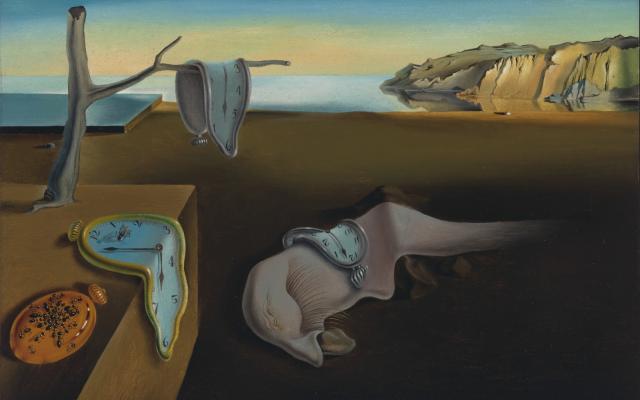
Highly influenced by Freudian psychoanalysis, Dalí created a rich iconography. Some of his favorite themes were death and decay, erotic desire and sexuality, metamorphosis and spirituality. This phantasmagorical painting is rife with symbolic imagery such as a brass pocket-watch covered with ants, which Dalí frequently used to represent decay. The ants grotesquely collecting on the metallic surface add to the oddity of the scene while hinting at death and the end of time. The three clock-faces limply draped across various surfaces could signify the mutability of temporal reality, and indicate experiences of the past, present and future. The rectangular mirror-like object in the background reflecting the sky could signify the conscious mind, and the small object near the shoreline appears to be an egg, a common symbol of rebirth and renewal.
The focus on psychoanalysis and dream-like imagery has inspired many artists working today such as Glenn Brown and Julie Curtiss.
For a painting that looms so large in cultural consciousness, The Persistence of Memory is surprisingly small. It measures approximately 9.5 x 13 inches—only slightly bigger than a typical sheet of notebook paper. And while it is worth some $150 million today, it was sold for a mere $250 around the time of its first exhibition in 1932 at the Julien Levy Gallery in New York. The painting was anonymously donated to New York City’s Museum of Modern Art (MoMA) a few years later and remains in its collection today.