
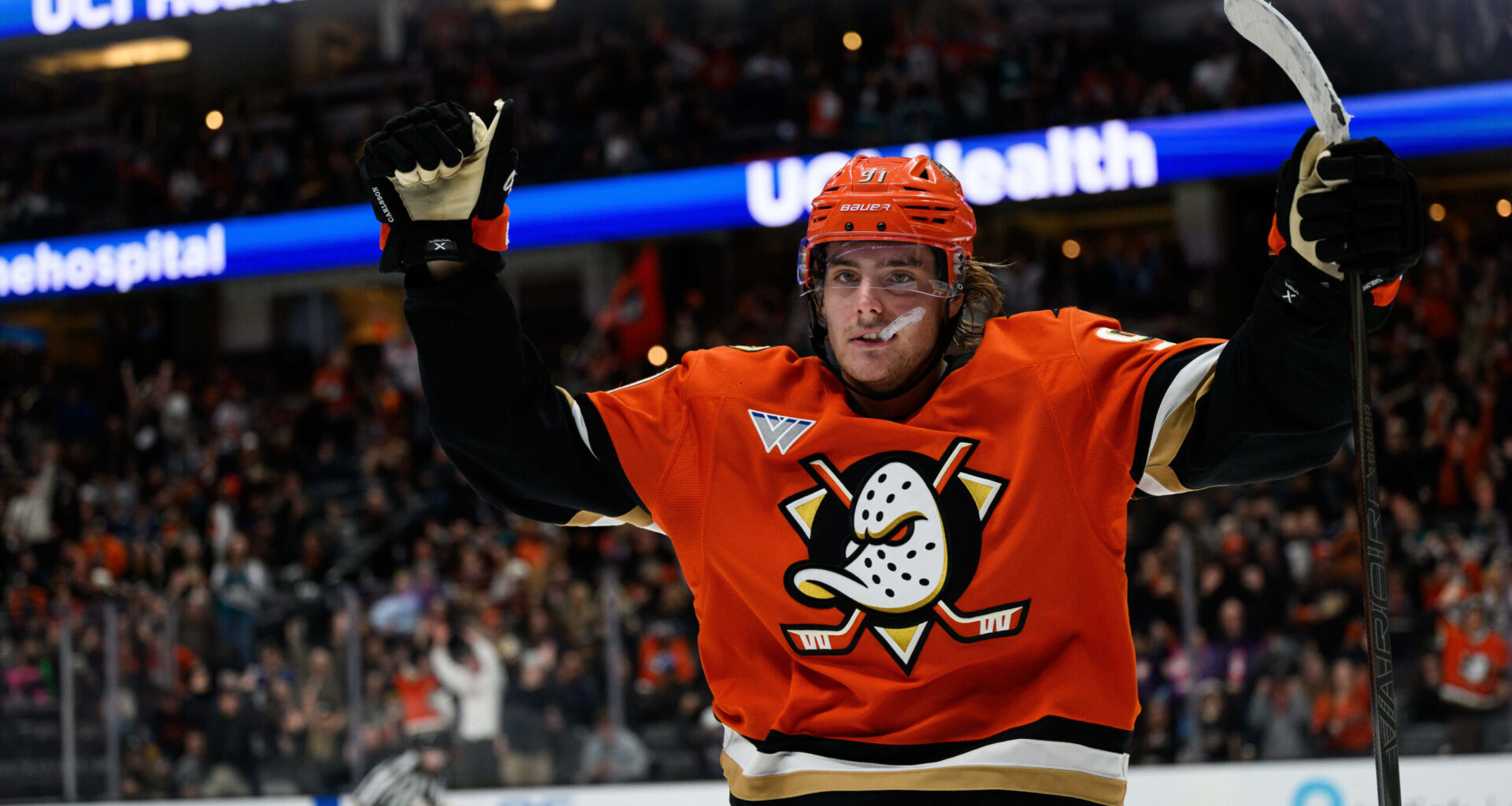
The restricted free agent (RFA) offer sheet market has been the NHL’s Cold War of sorts. The NHL Collective Bargaining Agreement (CBA) essentially handed every general manager the nuclear codes – but GMs seldom push the button. Since the dawn of the salary cap era in 2005, only 12 offer sheets have been tendered, 4 of which were “not matched” (a.k.a. “accepted”), resulting in the signing team obtaining a young player. Some believe the threat of retaliation keeps everyone in a standoff: you leave my restricted free agents alone, I’ll leave yours. Others disagree, like the late Ray Shero, former general manager of the New Jersey Devils. “There is no gentleman’s agreement. F*** that s***,” he once said. Regardless, for nearly two decades, the bombs generally sat in their silos.
Since 2019, this Cold War has developed into a battle. The Montreal Canadiens fired first by tendering an offer to Sebastian Aho. The Carolina Hurricanes shot that missile down by matching the offer and then successfully retaliated against the Canadiens by signing Jesperi Kotkaniemi two years later. In 2024, the St. Louis Blues got in on the action by signing Philip Broberg and Dylan Holloway to simultaneous offer sheets, and a cap-strapped Edmonton Oilers team found their defenses overwhelmed and lacked the financial armaments to even consider striking back.
Now, a GM of a middling or developing team should look to convert this battle into a full-on warzone. If you aren’t a basement-dwelling team, you can’t expect to acquire elite talent through the draft – but for some lottery luck or astute scouting. Yet you aren’t a Stanley Cup contender, and elite talent is necessary to compete with the top teams. So, if another team gives you an inch, take a mile. If they find themselves with a couple of albatross contracts or pending RFAs; if they show the slightest crack in financial stability – it’s time to pounce. But how, exactly?
The NHL salary cap is increasing to $104 million in 2026-2027, up from $95.5 million this past season. Plenty of cap space is available to tender offer sheets. But the thing about an increasing salary cap is that it helps all 32 teams, including those with free agents. Exhibit A: the unrestricted free agent (UFA) market this year. Players that were slated to hit UFA status this summer – elite players like Connor McDavid, Kirill Kaprizov, Jack Eichel, Artemi Panarin, Martin Necas, and Kyle Connor, among others, all signed lucrative extensions with their current teams.
Much like the UFA market, teams with RFAs susceptible to offer sheets have a lot of cap room to match anything that comes across their desk. “You always look, you always explore different things, but most teams have a lot of cap space available,” Philadelphia Flyers General Manager Danny Briere said in response to a question about the offer sheet market – just days after his team was swept by the Stanley Cup Champion Carolina Hurricanes. It seems that teams looking to tender offer sheets are aware of their slim chances.
But with slim chances, it’s time for signing teams to get creative. Dig into every nook and cranny of the NHL Collective Bargaining Agreement (CBA), study organizational operating revenue across the league, and explore all possible ways to maximize their chances of enticing another team to let a talented, young player go. In the NHL’s metaphorical offer sheet warzone, the teams with the best preparations and tactics will be best positioned for success. In this article we will do a deep dive on four strategies that could help a hungry team pry away a young player via offer sheet:
The Reconnaissance: Target Weaker, Financially-Stressed Teams
The Surveillance: Study the Original Team’s Tendencies and Break from it
The Pincer: Multiple Simultaneous Offer Sheets Against the Same Team
The Blitzkrieg: Heavily Front-Loaded Contracts Using a “V-Shaped” Structure
Like any armed conflict, one must master the rules of engagement to prepare for battle. Before we can get into the details of these offer sheet strategies, we need to know the rules and regulations in which an offer-sheeting team is confined. Here is a quick refresher on the relevant portions of the NHL Collective Bargaining Agreement (CBA) and Memorandum of Understanding (MOU).
Offer Sheets and Draft Pick Compensation
Only “Group 2” RFAs are offer-sheet-eligible. (CBA §10.2(a)(i))
In general, these are free agents under the age of 27 that have received qualifying offers, with some exceptions based on years of professional experience.
When the RFA signs the offer sheet with the new club, the prior club has 7 days to exercise its “Right of First Refusal” a.k.a. “match” the offer sheet. (CBA §10.3(a))
Matching binds the prior club to the salary terms of the offer sheet and freezes any trade of the player for one year. (CBA §10.3(b))
“Accepting” (or “not matching”) the offer sheet means the player signs with the new club and the prior club receives draft picks from the signing team as compensation. (CBA §10.3(c))
The specific draft pick(s) owed as compensation is determined using a tiering system based on the average annual value (AAV) of the contract. (CBA §10.4)For offer sheet purposes, the AAV is calculated by dividing the total dollar value of the offer sheet by the lesser of: the number of years of the offer sheet or five years.
The AAV tiers for draft pick compensation are updated each season. Per CapWages, the tiers for the current offseason are:
Note that the draft pick offered as compensation must be in the next available draft(s). For this offseason, that would be the 2027 draft. However:If two draft picks from the same round are owed, the team can utilize picks from the next 3 drafts as compensation.
If four draft picks from the same round are owed, the team can utilize picks from the next 5 drafts as compensation.
In other words, if a team has traded a 1st round draft pick, they may still be eligible for the two highest offer sheet tiers.
Draft pick compensation must be provided using the signing club’s own, original draft picks; they may not use picks acquired from another team. (CBA §10.4)
A club may have several outstanding offer sheets at once, if and only if, it has the available draft picks necessary to satisfy draft pick compensation for all of them. (CBA §10.3(d)(i))
Contract Structure
All contract terms must be fixed, determinable cash amounts with no contingencies or indexes (e.g., a contract that pays “10% of the salary cap in that League Year” is not permitted). (CBA §10.3(f) and CBA §50.6(b))
The maximum allowable annual salary on a contract is 20% of the league salary cap in the year of signing. (CBA §50.6(a))
In this offseason, a $104 million salary cap means that no contract can have a salary higher than $20.8 million in any year of the contract.
The minimum allowable annual salary on a contract is the following based on the league year. (MOU Item #26):
Each contract is categorized into one of two groups: “Front-Loaded” and “Non-Front-Loaded” (a.k.a. “100% Rule” contracts). The category a contract falls under determines the amount of change in salary from a given year to the next year permitted on the contract, as well as the minimum salary allowed in any given year. Front-Loaded and Non-Front-Loaded contracts differ as follows: (CBA §50.7 and MOU Item #67)
Front-LoadedNon-Front-LoadedDefinitionThe salary owed to the player in the first half of the contract is greater than the salary owed in the second halfThe salary owed to the player in the first half of the contract is less than or equal to the salary owed in the second halfThe Maximum Year-over-Year Salary Variability25% of the year 1 salary amountIn the first two years:
a change (increase or decrease) cannot exceed the lower salary amount of the first two years
For all subsequent years:
An INCREASE cannot exceed the lower salary amount of the first two years;
A DECREASE cannot exceed the 50% of the lower salary amount of the first two yearsMinimum Salary in Any Year60% of the highest salary in any yearNone
Clubs may sign free agents of other teams for a maximum term of 7 years. (CBA §50.8(b)(iv))
Target Financially Stressed Teams
If the offer sheet market is a warzone, then these first two strategies are akin to studying your enemy before striking. Much like a battle commander may scout the enemy’s defenses, a GM needs to identify and target teams that don’t have their guard up and are more likely to accept offer sheets.
The obvious factor at play here is the salary cap; teams close to the upper limit and with several roster spots to fill are less likely to have the space to match a lucrative offer sheet. But that’s just the surface level reconnaissance – the teams that dig deeper into studying other teams’ financial books will have the edge.
That could entail targeting low-revenue or small-market teams with heavily front-loaded contract structures. The thought being that the owners signing the checks for these teams may feel their hand is forced to accept the offer sheet. In other words, their low cash flow means they may end up in the negative on their balance books and can’t stomach that possibility.
This was the strategy behind the Philadelphia Flyers’ behemoth $110 million offer sheet of Shea Weber in 2012, which paid him $14 million per year ($1 million in base salary + $13 million in signing bonus) for the first four years of the contract. As Frank Seravalli reported in the Philadelphia Inquirer at the time, the Predators would be on the hook for $27 million to Weber within the first 365 days of the contract, representing “16.5 percent of Nashville’s entire franchise net worth [at the time] ($163M as valuated by Forbes Magazine in 2011).” Despite the fact that it was considered, “at the time, a long-shot” that Nashville would match, they ultimately did. Regardless, this strategy had been put on the map.
Today, the financials are not as tight. Forbes’ 2025 reporting on NHL team finances pegged the Columbus Blue Jackets as the lowest-valued team at $1.3 billion. Equating that to the aforementioned 16.5 percent of Nashville’s valuation paid in the first year of Shea Weber’s contract, an offer sheet would need to pay at least $214 million over the same time frame, which is impossible under the terms of the CBA. But the point still holds: if you want to maximize your chances of a successful offer sheet, target the cash poor teams.
Study the Team’s Tendencies and Break from it
The initial reconnaissance of strategy #1 can help you identify who to target but more information is needed to determine how to attack. After those target teams are identified, their actions should be monitored over time to learn their tendencies and preferences. Those that “know thy enemy” are the ones who win the battle before it is fought.
For example, at one point during the 2025-26 NHL season, the total compensation owed to Anaheim’s players looked like the picture below, per CapWages.
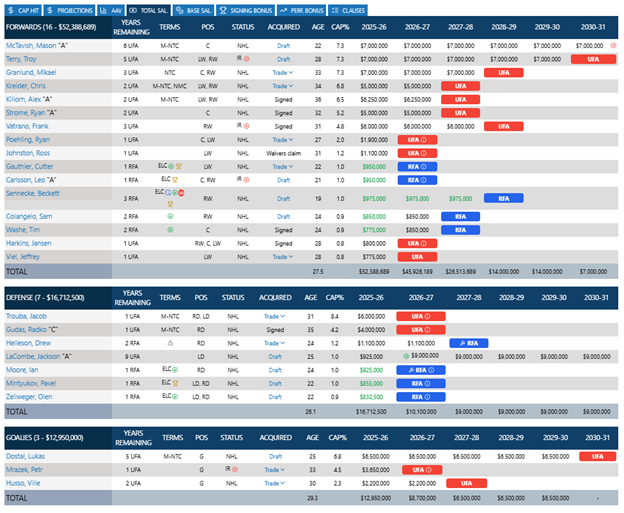
Notice anything? As a reminder, this is total salary, not adjusted annual value. That’s right -every single Anaheim Ducks player, with the exception of entry-level contracts, was signed to a contract with zero year-to-year variability in total salary over the length of the deal. And that’s not coincidence. Since Pat Verbeek took over as GM of the Anaheim Ducks in February 2022, he has signed 14 standard contracts to terms of 3 years or longer – all 14 have zero variability in year-to-year total salary, per CapWages. For whatever reason, Pat Verbeek is allergic to a changing balance book. The Ducks’ previous GM, Bob Murray, had no problem deviating from this strategy, so it’s not a sign of a preference from owner Henry Samueli. Regardless, these are the tidbits shrewd teams will keep tabs on as they identify their offer sheet targets. Some other examples of team tendencies include:
Craig Conroy, GM of the Calgary Flames, has signed 6 standard contracts of 3 years or more. Only 1 of the 6 (Matt Coronato) has any year-to-year salary variability, and even then, the highest and lowest salary years on this contract only differ by $1 million.
Since joining the Oilers, GM Stan Bowman has included a no-move or no-trade clause in all 10 standard contracts with a cap hit greater than $2 million that he has tendered.
Ultimately, when it comes time to make an offer sheet, the offers that are the biggest nuisance are most likely to be successful, and that includes structuring a contract in such a way that does not comport with the strategy of an opposing team, GM, or owner.
Multiple Simultaneous Offer Sheets Against the Same Team
If a single offer sheet is like a frontal assault, then it is the easiest kind of attack to repel. Tender one offer and even a poorer or cap-strapped team may be able to plant its feet and absorb the blow. However, a pincer maneuver aims to thin the enemy’s defenses by attacking on two fronts. “He who defends everything defends nothing,” and therefore, the opponent has to make a choice.
In NHL terms, a pincer looks like this: a club tenders offer sheets to two or more of a rival’s restricted free agents, on or about the same day. The target team has only so much cap space, only so much cash on hand, or only so much ownership patience; it can either a) pour all these resources into saving one player, b) save both players and deal with the financial consequences, or c) relinquish both players and fight their battles elsewhere. The St. Louis Blues were the first to succeed in the offer sheet pincer, enveloping a cap-strapped Edmonton team with simultaneous offers to Philip Broberg and Dylan Holloway – and the Oilers, unable to hold both fronts, surrendered both to the Blues.
The key CBA language giving GMs this power is found in section 10.3(d)(i), stating a “Club may have more than one Offer Sheet […] provided that it has the available draft picks to satisfy its obligations […] with respect to all Offer Sheets outstanding at the relevant time.” In the Blues’ case, they compensated the Oilers with a 2nd round pick for Broberg and a 3rd round pick for Holloway. Since there was no overlap in the picks owed as compensation, these offer sheets were valid.
But there are other “tiers” of draft pick compensation that can be combined when giving simultaneous offers. For example, a team can owe compensation for the 1st + 3rd round picks tier and the 2nd round pick tier simultaneously. But most notably, the top draft pick compensation tier, which calls for four 1st round picks, can be combined with nearly all other compensation tiers, assuming the signing team owns their next 5 1st round draft picks. The following visualization outlines which compensation tiers can be combined across two offer sheets from the same team, assuming the team has not traded away any of their original picks:
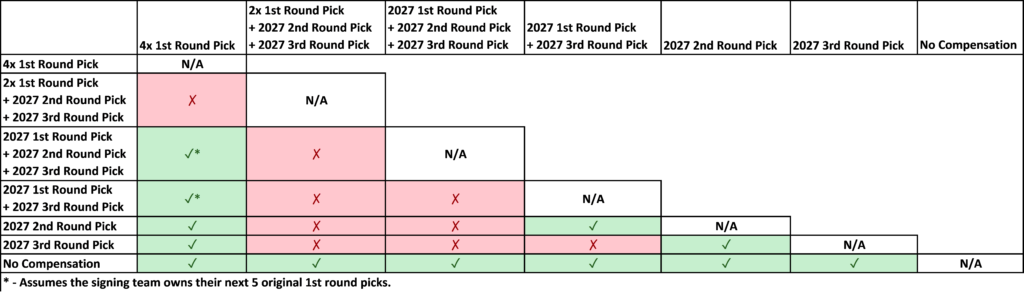
If a team wants to coordinate a pincer, these are their options. And if they wanted to step their game up even further, they have one outlandish option at their disposal as well – a three or four-pronged attack, with any combination of the following offer sheets tiers that do not overlap in compensation: four 1st round picks, one 2nd round pick, one 3rd round pick, and no compensation.
Heavily Front-Loaded Contracts Using a “V-Shaped” Structure
In WWII, flash warfare (aka blitzkrieg) found success by being concentrated – massing force at a single point and breaking through the enemy. A standard contract with little year-to-year salary variability is the opposite of that and would be easy for a cash poor team to match, even if the sheer size of the contract were large. But as with the aforementioned Shea Weber contract, concentrating salary to be paid up front can overwhelm an opposing team.
As discussed in the CBA/MOU primer, the NHL puts all contract structures into two buckets: front-loaded or non-front-loaded contracts. With front-loaded contracts, their aim is to have restrictions in place to prevent teams from making extremely top-heavy contracts. But the only problem is that front-loaded contracts, per the NHL’s definition, are not the most “front-loaded” option because non-front-loaded contracts offer much more flexibility in terms of year-to-year salary variability. In particular, the salary in any given year of a front-loaded contract a) cannot vary from the adjacent year by more than 25% of the Year 1 salary and b) cannot fall below 60% of the highest salary in any year of the contract. On the other hand, non-front-loaded contract salaries can change by as much as 50-100% from year to year and do not have a minimum (other than the league minimum salary).
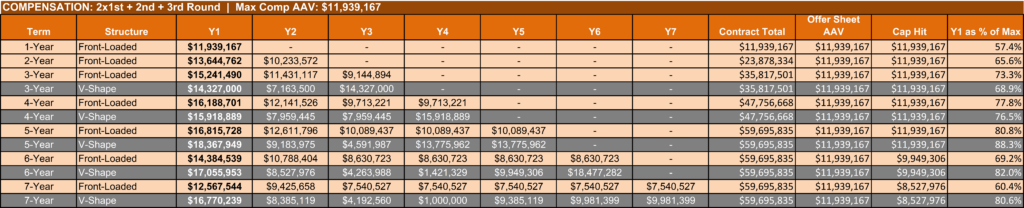
With that added flexibility, a contract structure can be created where a non-front-loaded contract actually pays more salary to the player in year 1 compared to a front-loaded contract. However, since front-loaded contracts are defined as contracts where the salary in the first half is greater than the salary in the second half, a non-front-loaded contract with a high year 1 salary would also need to be “back-loaded” so that it does not meet the NHL’s criteria as front-loaded. The resulting contract has a V-shaped salary structure that would have an exorbitant first payout and exhibit more variability compared to a standard front-loaded contract. For example, on a 5-year contract in the two 1st + one 2nd + one 3rd draft pick compensation tier, the highest year 1 salary achievable with a V-Shaped structure is $18.37 million, $1.5 million more than the maximum achievable on a standard front-loaded contract.
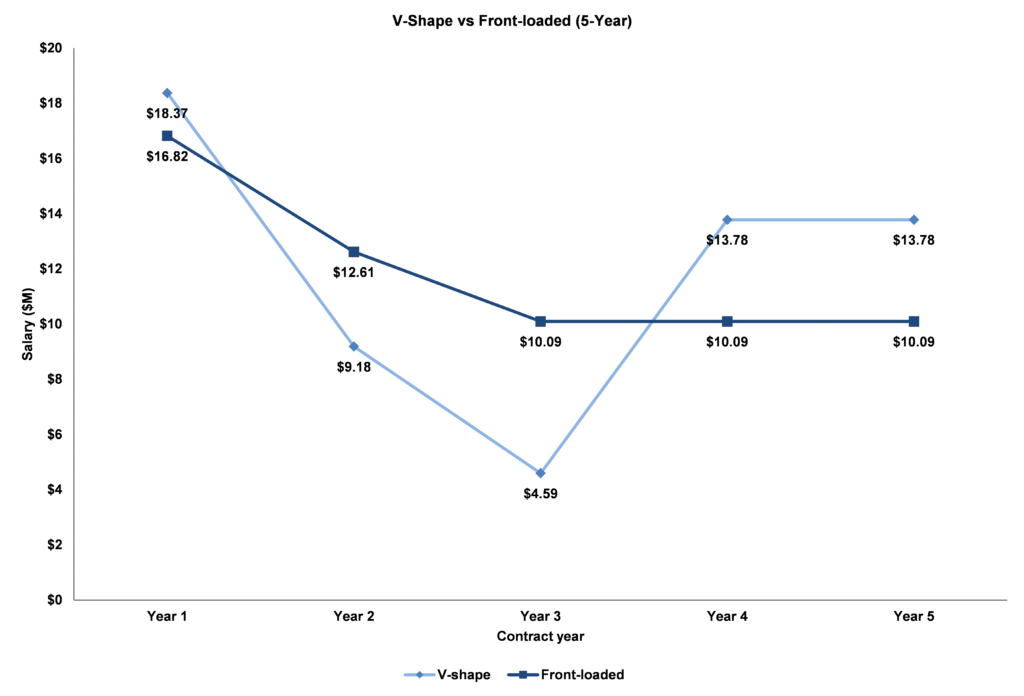
Across all terms and structures, the contracts to maximize year 1 salaries in the two 1st + one 2nd + one 3rd draft pick compensation tier would be as follows. Note that the 5-year contract returns the highest Year 1 salary because the AAV of offer sheets is calculated by dividing the total dollar value of the offer sheet by the lesser of: the number of years of the offer sheet or five years. As far as I know, the V-Shaped contract structure has never been utilized, but a desperate GM could certainly use it to their advantage.
Now that the strategic theory has been established, let’s see what it looks like to put it into practice. Let’s suppose Philadelphia Flyers GM Daniel Briere keeps his promise of exploring the offer sheet market in pursuit of a center, specifically the Anaheim Ducks’ Leo Carlsson. In fact, Anthony DiMarco of DailyFaceoff reported on the O and B Puckcast that this is something the Flyers may legitimately be looking into. But as Briere has said, “most teams have a lot of cap space available” to make or match an offer. By applying the four strategies above, here is how Briere and the Flyers could maximize their chances.
First, the “reconnaissance” of identifying cash-poor teams flags Anaheim immediately. The Ducks are a relatively low-revenue, small-market club, precisely the kind of balance sheet that flinches when a large check has to clear inside a single calendar year. In 2025, Forbes reported Anaheim to be the 28th ranked franchise in value at $1.4 billion, along with estimated revenue and operating income of $185 million and $32 million, respectively. While their 14% operating margin could be considered “good” by business standards, it finds them 6th worst across the league.
Next, the “surveillance” of studying Anaheim’s tendencies sharpens the picture. As previously discussed, since he took over in February 2022, every standard contract GM Pat Verbeek has signed of three years or longer carries zero year-to-year variability in total salary. Verbeek does not write front-loaded nor back-loaded deals; he writes flat ones. That tendency is not just a quirk to note, it is a pressure point to press.
The “blitzkrieg” of heavily front-loading and back-loading an offer sheet would apply that pressure. AFP Analytics projects a fair, market-value long-term contract for Leo Carlsson would carry a cap hit of about $11.5 million. Given this, the Flyers could tender an offer that places Carlsson in the two 1st round picks + 2nd round pick +3rd round pick tier, but create the maximum amount of year-to-year salary variability with a “V-Shaped” structure. Such a structure would pay Carlsson $18.4 million in year 1 and $9.2 million in year 2. With the league minimum salary slated to be $900k in year 2 of this potential deal, the Flyers could offer a signing bonus of $8.3 million in year 2. As a result, if the Anaheim Ducks matched the offer, they would owe Carlsson $26.7 million in the first 365 days of the deal, representing nearly all of Anaheim’s reported $32 million annual operating income. Of course, another option is to simply offer Carlsson a record-shattering, multi-year $20.8 million per year contract. It would pay him $40.7 million in the first 365 days, but would come at the cost of four 1st round picks. Since Philadelphia owns all of their upcoming draft picks, they have that optionality at their disposal.
Finally, comes the choice of whether to attack on a single front or employ the two-pronged “pincer” by tendering offers to multiple players simultaneously. The latter would up the pressure on Anaheim to accept the offer sheet on Carlsson by – on the same day – tendering a second offer sheet to another notable offer sheet-eligible Anaheim player such as defenseman Pavel Mintyukov. AFP Analytics projects a fair-value, long-term contract for Mintyukov would be about $6 million per year, placing him in the 1st round pick + 3rd round pick compensation tier. With a $7.1 million salary cap limit in that tier, a contract structure paying Mintyukov up to $11 million in year 1 of the deal could be offered. This would comport with the draft pick compensation tiering if combined with an offer to Carlsson in the four 1st round picks tier. Say Carlsson was then offered a contract at the $20.8 million maximum; the resulting financial stress on Anaheim would cost $27.9 million towards the salary cap and up to $36.4 million in actual salary owed in the first 365 days after signing. On Philadelphia’s end, they would owe five 1st round picks and one 3rd round pick if both offers were accepted; a steep but debatably worthy price to pay when young first-line centers are almost never available on the open market.
That is the value of having an arsenal of draft picks, salary cap space, and disposable cash – it gives the offering team optionality. Philadelphia can fire an attack at Anaheim and maximize their chances of obtaining Carlsson. It can widen the assault to two fronts and force a genuine choice. It can dial the compensation up to four firsts or down to a second, lengthen the term or shorten it, front-load the cash or flatten it. The CBA handed every general manager the launch codes yet most still leave the bombs in the silo. Teams sitting on cap space – shut out of the trade and free-agent markets for the young, elite players they need – have every reason to walk to the console and start turning keys.
By Ted Getselman
[email protected] | @Tedeward on X