

Listen to this article
Estimated 5 minutes
The audio version of this article is generated by AI-based technology. Mispronunciations can occur. We are working with our partners to continually review and improve the results.
It’s widely expected Prime Minister Mark Carney will end long-running speculation and announce Monday whether German or South Korean companies will build Canada’s next fleet of submarines.
The Liberal government has been extraordinarily tight-lipped and secretive about the impending announcement in Halifax.
Carney made clear at the end of May that a decision on the replacement of the Royal Canadian Navy’s aging Victoria-Class boats would happen by the beginning of the summer.
The prime minister is headed to Ankara, Turkey, for the NATO summit, where Secretary General Mark Rutte has made clear that allies are expected to show up not only with a plan to meet the defence spending benchmark but military capabilities.
Sources within the defence and diplomatic communities, as well as the defence industry, say Carney is planning to stop in Halifax on his way to the summit in order to announce whether Germany’s ThyssenKrupp Marine Systems (TKMS) or South Korea’s Hanwha Ocean will be the preferred bidder.
It’s been almost a year since Carney announced the field of submarine bidders had been narrowed to two choices: the German-designed Type 212CD and the South Korean KSS-III.
Both bidders and their governments were given until the spring to submit detailed bids and promises of economic offsets — proposals that could mean billions of dollars in investment in the Canadian economy.
Germany, South Korea competing
The navy is looking for 12 submarines. The acquisition cost could run to $24 billion, but with lifetime maintenance and support, the final bill over three decades could be upwards of $100 billion, according to some estimates.
The joint German-Norwegian bid is heavily arranged around infrastructure, energy, and advanced defence manufacturing. The projects include redevelopment of the Port of Churchill Manitoba; an interest partnering to construct a dedicated space launch complex inside Canada; and advanced weapons manufacturing, including plans to establish a heavy torpedo plant and hypersonic missile testing.
The bid forecasts an $86-billion impact on Canada’s gross domestic product.
The South Korean bid proposes investments in green infrastructure and to manufacture hydrogen-powered trucks, as well as building hydrogen refuelling networks across Canada. There’s a proposal to build armoured vehicles in Canada using Canadian steel — a plan that has the backing of the Automotive Parts Manufacturers’ Association. There are also commitments to increase domestic weapons production.
The cumulative impact of the South Korean bid is expected to be $94 billion.
Speaking at an Ottawa arms expo at the end of May, Carney said both submarines meet the navy’s requirements and that a decision on which bid to choose will hinge on both the economic package and the long-term geostrategic partnerships and alliances the deal will create.
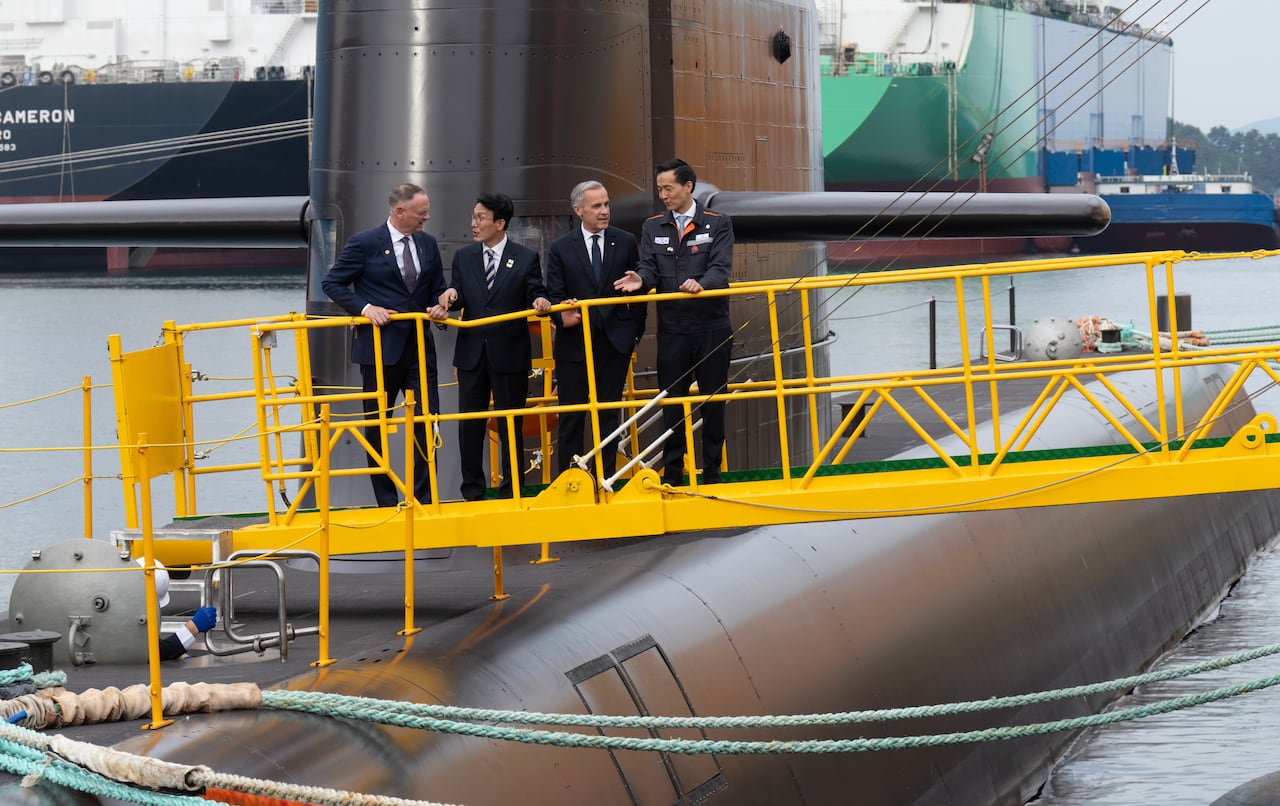 From left, National Defence Minister David McGuinty, South Korean President Lee Jae Myung, Prime Minister Mark Carney and Hanwha Group vice-chair Kim Dong Kwan speak after touring a submarine at the Hanwha Ocean shipyard in Geoje Island, South Korea, on Oct. 30, 2025. (Adrian Wyld/The Canadian Press)Pressure ‘to get subs fast’
The Germans and Norwegians have leaned heavily on their status as North Atlantic Treaty Organization allies alongside Canada.
In an interview with CBC News a few weeks ago, German Defence Minister Boris Pistorius said when Germany, Norway and possibly Canada’s fleet of submarines are combined, they become strategically important to NATO.
“If we come to that decision of the Canadian government, we talk about at the end about a fleet of up to 24 submarines of the same type,” Pistorius said. “This is really an advantage, really a benefit, for NATO and for all of the allies to be able to operate with 24 of the same type of submarines.”
He also said that it’s conceivable German and Norwegian submarines could be there to backstop in the Arctic if there was a crisis.
The South Koreans, for their part, have looked upon the potential of a deal with Canada as a litmus test of how serious the federal government is about increasing engagement and investment in the Indo-Pacific region. They have also played the allies card, but in a different way. Canada was among the United Nations forces that fought in Korea in the 1950s.
In an interview with CBC News at the outset of the bidding last year, the country’s former minister of defence acquisition, Seok Jong-gun, characterized it as his country repaying a debt.
“By sharing our capabilities that we own, I’m sure that we will work closely with Canada to contribute to international stability and peace,” the minister said. “And by doing so, I think Korea will be able to pay some of the debt that we have and also express our gratitude and appreciation to the Canadian people.”
The South Koreans are promising delivery of four boats by 2035. The Germans say they can have four submarines to Canada by 2036.
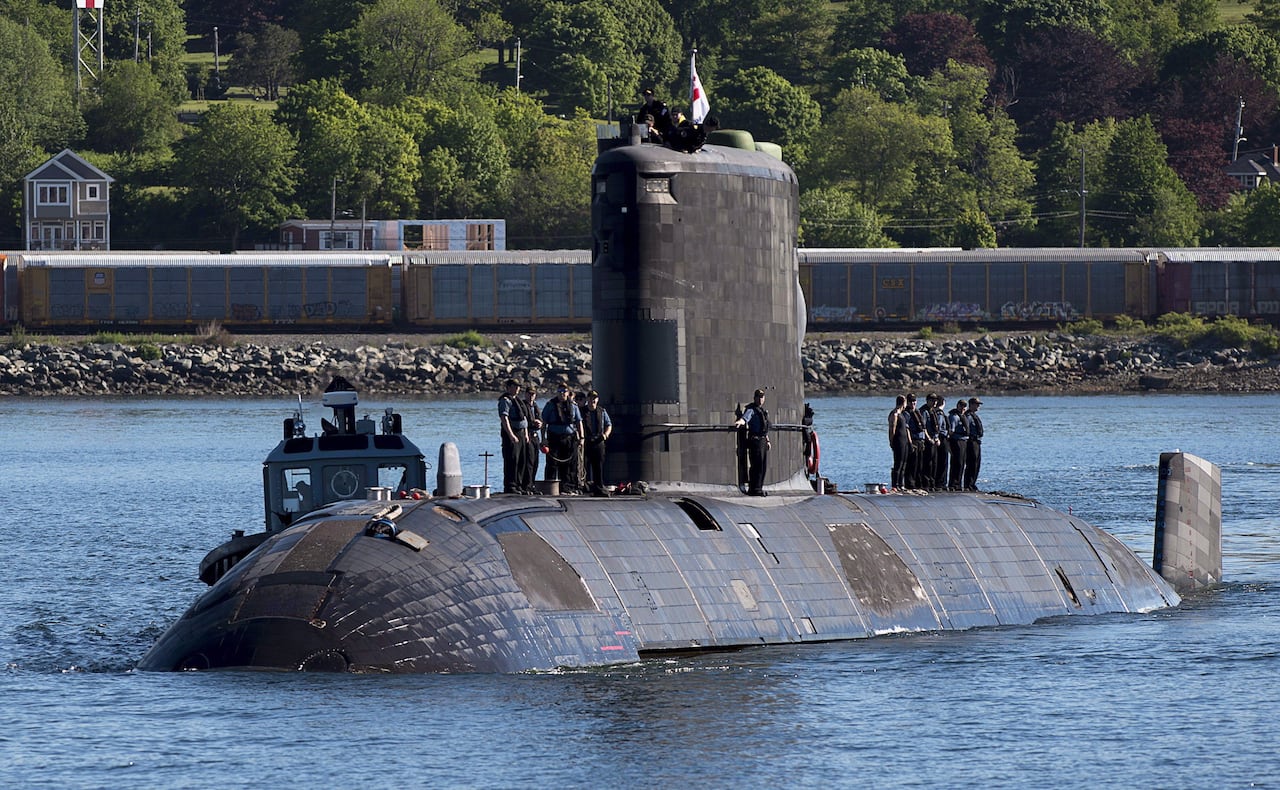 HMCS Windsor, one of Canada’s Victoria-class long-range patrol submarines, returns to port in Halifax on June 20, 2018. (Andrew Vaughan/The Canadian Press)
Stephen Saideman, who holds the Paterson Chair in International Affairs at Ottawa’s Carleton University, said there’s enormous pressure “to get subs fast” because of the state of the current fleet.
Only one in four Victoria-class submarines is able to conduct operations.
“I think we already have a real crisis in our sub force of not being able to actually have a submarine out in the water for any length of time,” Saideman said. “We only have one, yet we have three oceans.”
Saideman said he’s not certain Canada will go all of the way and buy 12 boats, but with the U.S. possibly pulling its submarines out of NATO crisis planning, the decision is significant.