
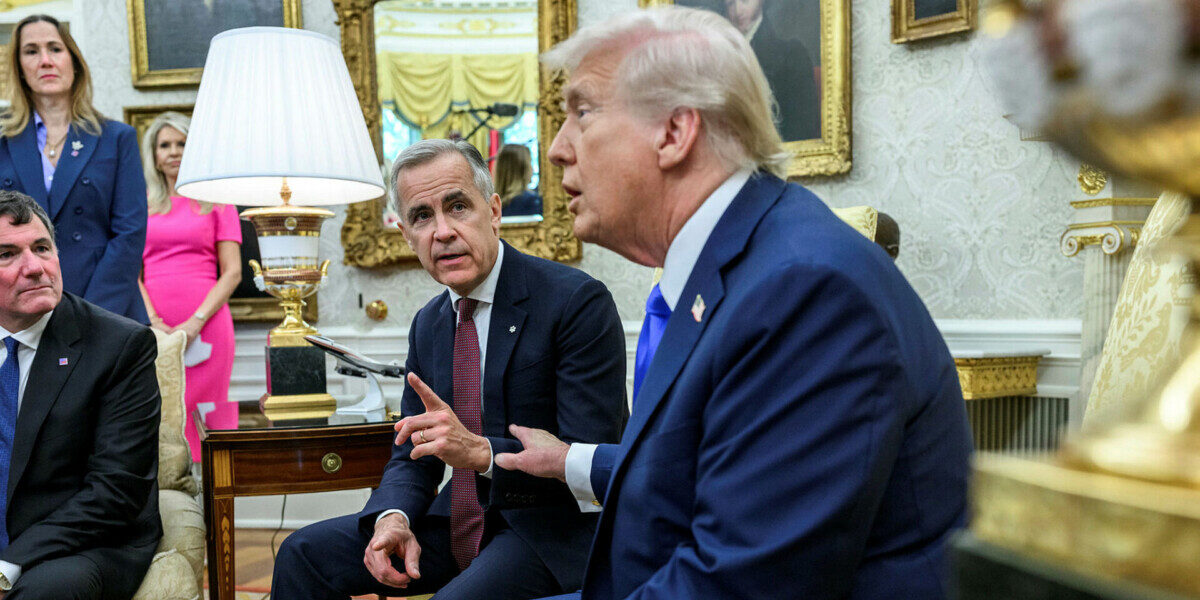
HALIFAX—Prime Minister Mark Carney is proving that politics at its most important is a big-picture game.
Which is to say, it isn’t only about the price of gas, the cost of housing, and the dozens of other kitchen-table issues that normally dominate the public debate.
The PM’s words in recent speeches have shown that deeper philosophical issues are also an indispensable part of the national conversation—or should be. There is today’s reality to be sure, but there are also all those tomorrow’s.
In an informal conversation with Canadians around Canada Day, Carney spoke frankly about some very big ideas normally left to erudite professors or pundits with an academic bent.
In keeping with his promise not to sugar-coat his message, the PM bluntly told Canadians that Canada must change in response to a changing world order.
His words conjured up Alfred Lord Tennyson’s famous poem Morte d’Arthur, particularly the line “the old order changeth, yielding place to new.”
Without getting into personalities, Carney made clear that Canada must somehow replace its super dependence on a mercurial United States. Why? Because recent events have proven that Canada can no longer depend on the U.S. as a steadfast and reliable partner.
The rise of U.S. President Donald Trump should have provided the ultimate wakeup call to all Canadian politicians, as it clearly has with the PM.
Trump has demonstrated that the Canada-U.S. relationship is one bad president away from disaster.
Trump is that disaster. He has insolently insulted and belittled this country’s sovereignty, telling Carney to his face that he would like Canada to be his 51st state.
Who can depend on a nation whose leader sees your country as no more than a nice piece of real estate to be annexed if possible?
And Canada isn’t the only country whose territory this political kleptomaniac has coveted. Trump also mused about annexing Greenland, which just happens to belong to Trump’s NATO ally Denmark.
In the past, the Canada-U.S. relationship seemed to be the safest and mutually beneficial arrangement in the world: there was plenty of evidence to support that belief. Decades of friendship and trust, epitomized by sharing the globe’s longest unguarded border.
For a long mite, the relationship was based on shared cultural values and mutual respect. Trump changed all that by turning America into a belligerent bully. The Iran war and Trump’s domestic war on immigrants are the antithesis of Canadian values. For Canadians, the use of force is the admission of defeat. And immigrants are not a problem for society. They are a solution.
Paradoxically, Trump reserves his worst behaviour for America’s allies, rather than its enemies. He even accused the United Kingdom’s soldiers of avoiding the front lines during the Afghanistan war.
Trump also ridiculed the European Union for not assisting in his feckless war with Iran. Never mind that he never briefed the Europeans or anyone before going to war.
And, oh yes, while he was doing that, Trump was playing huggy-bear, kissy-face with Russian President Vladimir Putin, his bosom dictator buddy.
Up until recently, Trump mistreated other countries—including Canada—because he believed that they needed the U.S. more than the U.S. needed them.
When it came to Canada, he went so far as to claim—albeit absurdly—that this country had nothing America needed.
He seems to have forgotten that Canada sends four million barrels of oil per day to the U.S., and accounts for 60 per cent of its oil imports.
In what may be his greatest legacy moment, Carney disabused Trump and the America he represents of that insolent assumption. Not only would Canada work assiduously to find new trading partners, the PM announced a trillion dollars in spending over several years aimed at achieving sovereign energy independence. Carney’s bold move has been dubbed the Canada Day bomb.
Carney’s massive plan would “electrify” Canada, and build a new pipeline from Alberta to the West Coast. Those projects would boost our sovereignty, and reject the notion that Canada is America’s “captive backyard.”
Carney’s push to protect Canada from a hostile American president is laudable, but not without risks.
Trump has proven time after time that he is the most vindictive president in U.S. history. Then-president Richard Nixon presided over the Watergate break-in in the 1970s. But Trump has turned the U.S. Justice Department into a weapon to be used against his perceived political enemies.
Among those who have been maliciously targeted by Trump’s Retribution Department are James Comey, Letitia James, John Bolton, E. Jean Carroll, and Jerome Powell. Carney could soon be on that list.
As bad as Trump is—and as right as Carney is to reduce dependence on the U.S.—the task will not be easy.
Get Weekend Point of View Newsletter
Top Canadian political and policy opinion and analysis. Saturdays and Sundays. Weekends.
By entering your email address you consent to receive email from The Hill Times containing news, analysis, updates and offers. You may unsubscribe at any time. See our privacy policy
Canada sends approximately 85 per cent of its exports to America. Cross-border trade is extremely important to several provinces, especially Ontario. And as much as Canada has to offer, it will not be easy to replace the U.S. market.
That said, Carney’s vision of a Canada Strong, based on greater economic activity amongst provinces and new trading partners is worth pursuing through any hardships.
For far too long, Canada has sent its amazing natural resources out of the country without value added. It is time to add the value to those exports before they are exported. It is past time to invest in this amazing place rather than leave that to others.
Canada is blessed with so many advantages: abundant natural resources, an educated and talented workforce, and the most impressive piece of real estate on the planet.
It is time to depend on the only partners we can really trust—each other, and the vision of a country like no other. Free, prosperous, independent and welcoming.
Michael Harris is an award-winning author and journalist.
The Hill Times
