

One of the most heavily criticized moves made by any NHL team in the 2026 offseason has been the Ottawa Senators’ acquisition of forward André Burakovsky from the Chicago Blackhawks, in exchange for a 6th-round pick in 2027.
A 31-year-old winger that scored 11 goals and 22 assists in 75 games, carrying a cap hit of $5.5M for one more season, added before the opening of unrestricted free agency. Supposedly, Chicago was unimpressed with his 2025-26 season such that they were reportedly buying him out before the trade.
Even after addressing the departure of Brady Tkachuk by adding William Eklund, general manager Steve Staios was still in the market for a top-six winger. Burakovsky hasn’t been one since 2022-23 with the Seattle Kraken, during which he had 39 points in 49 games.
However, just because he doesn’t address the Senators’ issue of lacking a top-six forward group worthy of a contender, that doesn’t mean Burakovsky can’t provide significant value to Ottawa’s roster. As we’ll come to find out, he brings some intriguing qualities to the table, and for a good chunk of last season, was dominating alongside one of the most talented young players in the world in Ryan Greene. Connor Bedard was also there.
Through his first 26 games, Burakovsky had 21 points, playing most of his minutes on a line with Greene and Bedard. This trio outscored opponents 13-6 at 5-on-5, while posting a 47.3% expected goals share and 51.6% Corsi share per NaturalStatTrick – somewhat impressive for a team that ranked 31st and 32nd in those metrics overall.
It was only after an injury to Bedard, suffered on December 12th, when we saw Burakovsky begin to decline in performance. Granted, he did still put up 8 points in 12 games with above-average possession numbers in Bedard’s absence, but he was on the ice for a lot of goals against, even by Blackhawk standards, with a 4-13 differential at 5-on-5. Burakovsky suffered an injury of his own in November – a concussion, which may have also impacted his play upon returning to the lineup.
After Bedard returned, at a point in time in which Chicago was just three points back of a wildcard spot, Burakovsky crashed and burned, putting up just 4 points in the final 37 games of the season, with below-average possession metrics on the Blackhawks, with the lowest on-ice goal differential of -19.
Burakovsky predictably performed worse without Bedard, but encouragingly, Bedard also had worse numbers away from Burakovsky. Now on a good team for the first time in four years, can he return to his former self, that began last season on a heater?
We know he can hold his own with skilled centers, of which Ottawa has three – Tim Stützle, Dylan Cozens, and Shane Pinto. He’s shown some finishing ability in the past, but recently, not with nearly enough consistency to be a 20-goal scorer. Instead, he profiles as a playmaking winger who excels at facilitating breakouts and rush opportunities at 5-on-5, with added power-play utility from the point.
I don’t use the phrase “excels” lightly here. According to data tracked by Corey Sznajder through All Three Zones, Burakovsky’s proficiency in these skills is only surpassed by Stützle, Cozens, and the other new forward addition, Eklund. The following graphic is from LB-Hockey’s Comparison Atlas, which takes data from All Three Zones, and separates it into eight different categories. For example, compared to Drake Batherson, Burakovsky is a more effective player when attacking and defending on the rush, while falling well short in terms of cycle chance generation, suppression, finishing, and checking.
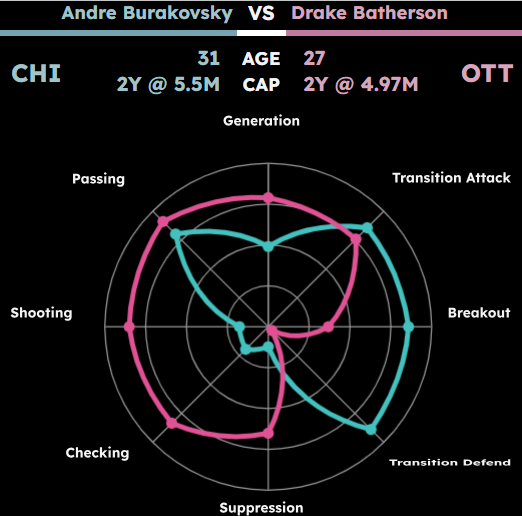
Visuals like these reinforce the idea that while a player might not have all the tools necessary to be considered a “top-six player”, they still may be able to contribute on the top two lines with the right teammates.
In his press conference following the trade, Staios referred to Burakovsky as a “puck transporter”, which sounds like something you say about an 11-goal scorer to appear smarter than you actually are, but on closer inspection, the numbers don’t lie. Sean Tierney would also call this guy a “puck transporter” and anyone who gives a damn about them fancy stats wouldn’t take issue to his claim.
I also took the liberty of going through footage of all of Burakovsky’s points throughout the season to verify the statistical analysis – see the three clips below as prime examples.
Several of his plays begin in the defensive zone, in which he blends quick decision-making and finesse to not only create zone exits, but punish overly aggressive forechecking teams to materialize odd-man rushes.
Here, you’ll see Burakovsky handle a breakout pass on the boards, and chip it past a pinching defenceman to spring Bedard and Tyler Bertuzzi on a 2-on-1 opportunity:
Here’s another similar play – this time Burakovsky receives a breakout pass directly, and once again, is able to move the puck to Bedard before both Anaheim forecheckers can threaten him, springing another 2-on-1 chance:
And in the right moments, Burakovsky can absolutely take matters into his own hands and lead the rush himself:
Here in the nation’s capital, Travis Green’s offensive system heavily relies, ironically enough, on dump-and-chase (#FireDJ) and effective forechecking, and with Trady, who lives and breathes that style of play, out the door, adding a player of Burakovsky’s skillset can add another dimension to the Senators’ offence, one they desperately need.
Conversely, as mentioned earlier, Burakovsky lacks some of the traits that are common among Ottawa’s existing group – relentless forechecking (Amadio, Foegele), a quality shot (Foegele, Zetterlund), and cycle chance suppression (Amadio, Cousins), which means they can cover for each other’s weaknesses and play a supporting role to the club’s top players.
Ottawa’s defence corps is also worth mentioning, in that their 4th-best defenceman (whether you think it’s Artem Zub or Jordan Spence) is better than everyone in Chicago’s group – yes, including Bowen Byram. With Jake Sanderson or Thomas Chabot on the ice for 75% of the time, Burakovsky will be spending far less time in the defensive zone than before – more clean breakouts will lead to more opportunities to create those high-danger rush attempts that have been missing from Ottawa’s attack.
To me, the acquisition doesn’t reek of desperation. Rather, this is Staios holding onto his most valuable assets for a potential future trade, while picking up a clearly skilled veteran that brings some important tools that were previously lacking from Ottawa’s middle-six, on a better contract than the majority of which were signed on July 1st. With Batherson, Zub, and Amadio as key UFAs in 2027, keeping that cap space uncompromised is well worth the late pick and a slightly overpaid deal today.
The uncertainty is the risk associated with Burakovsky’s pendular 2025-26 season – the version of him we’ll see in Ottawa could make or break their campaign.
Either way, I’ll consider the trade a win for the Senators if he does this against the Panthers with Brady on the ice: