
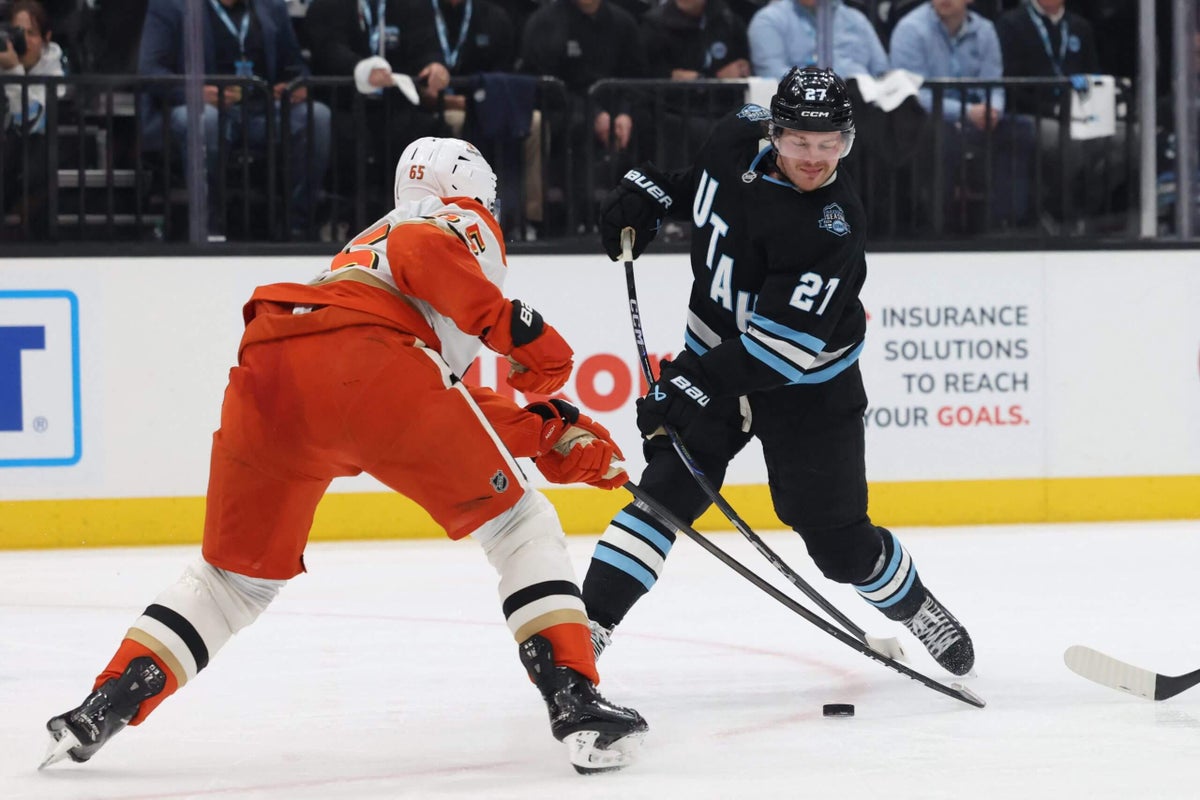
Just how wild is this offseason? Offer sheets are being tendered. Not hypothetical or idealistic proposals, but actual offer sheets — and it’s changing the landscape of the NHL.
Usually, offer sheets feel like an unrealistic mechanism for acquiring talent. Even when teams use them successfully, like the St. Louis Blues did in summer 2024 to pry both Dylan Holloway and Philip Broberg out of Edmonton, it’s viewed as more of a one-off than the start of a trend.
Not this summer, though. Offer sheets and the threat of them have shaken up this offseason.
Why?
In the simplest of terms, the salary cap is rising, and there are few available needle-movers to invest in. While the best path to finding difference-making talent is through the draft, that involves a developmental process with its own curves, hurdles and (sometimes) a lengthy timeline. Free agency is no longer a reliable source of high-end talent, either. Few stars make it to July 1, which has led to major overpayments of the middle class in recent years.
The trade route is the next-best bet for adding top-caliber players. But even that has its own challenges, like astronomical asks and returns. Offer sheets can help change that for up-and-coming talent, even if it’s just the threat of one.
Let’s unpeel all of the layers of this summer’s chaos swirling around offer sheets and what could come next.
How offer sheets fueled some trade movement
Heading into this summer, there were a handful of realistic offer sheet targets around the league. Pavel Dorofeyev, Mavrik Bourque, Jack Drury and Mackie Samoskevich all headlined that list, thanks to their respective teams’ cap pictures. The Vegas Golden Knights, Dallas Stars, Colorado Avalanche and Florida Panthers likely would have either needed to sign these players to team-friendly deals or moved salary out to make everything click. Matching offer sheets could have totally blown up any of those teams’ salary outlooks. An $11 million extension never would have worked for Dorofeyev in Vegas; $5.5 million for Bourque would have been extremely tough to sign in Dallas before the Jason Robertson situation had been settled.
Brandt Clarke joined the group based on his limited usage over the years and management’s tendencies in Los Angeles. Olen Zellweger made sense with the Anaheim Ducks’ offseason and overall RFA picture in mind.
While Clarke’s staying in L.A. on a five-year contract worth $7.40 million a season, the other five RFAs were all moved before an offer sheet could be cooked up. It’s not the first time teams took a proactive approach to avoid that; just last summer, the threat of an offer sheet for K’Andre Miller helped shape his trade to the Hurricanes.
The trade route makes sense for both sides of these trade scenarios. Take the Samoskevich trade; had Seattle offered a contract above the $4.8 million mark, the compensation would have been a first-rounder and a third-rounder. The risk for Seattle is the uncertainty of the value of that 2027 pick: if the Kraken are a lottery team again, that pick would be unprotected and sent right to the Panthers. By trading No. 25 this year plus a conditional second, Seattle maintained a little more control.
The Dorofeyev trade was similar. The compensation for his $11 million cap hit would have been two firsts in the next three drafts, a second and a third. The Rangers’ actual return had a little more certainty. New York flipped pick No. 26 during the draft (after getting an idea of who would be available with that particular pick), No. 92 and a top-10 protected 2028 first.
The Predators only had to move a second and third to land Bourque, and that return ultimately is below the compensation threshold his $5.5 million AAV would have cost. With Drury, Nashville was able to move players instead of draft capital.
The Hayton offer sheet
Two things are true: Barrett Hayton hasn’t lived up to the draft pedigree of a No. 5 draft pick, but he’s also worth a one-year deal worth $4.775 million. So on paper, this is an easy match for the Utah Mammoth.
Except it’s not that simple.
The cap hit comes in right below the $4,775,667 compensation tier of 2027 first- and third-rounders, and would instead only cost the New Jersey Devils a 2027 second-round pick. Considering the market for centers in this league, that’s a steal for the 26-year-old.

Hayton suppresses chances well on one end of the ice and generates high-danger looks on the other. His finishing needs more consistency. Last year, he scored 10 in 67 games when his xG was closer to 17. The year before, he was on the other side of the ledger, with five goals above expected. So getting his shooting back on track would be a priority, but that gap in finishing also wouldn’t be glaring in a 3C role.
Last year, Hayton spent about 60 percent of his five-on-five minutes with either Dylan Guenther or Clayton Keller. That usage exposed what he lacks to be a true top-sixer. His comps after last season are in the realm of middle-six talent, like Brandon Dubinsky, Boone Jenner, Nicolas Roy and Josh Anderson.
And that’s what he’d be in New Jersey, as the 3C this team has been missing. Dawson Mercer is a better fit on the wing, while Cody Glass has durability concerns. Hayton’s presence would solidify one position and provide some top-six insurance with Jack Hughes’ injury track record in mind.
But that only happens if Utah doesn’t match the Devils’ offer.
The Mammoth could hope for the same rebound season in a 3C position, now that the team acquired Vincent Trocheck to (presumably) take over as 2C. The problem is, a team that matches an offer sheet 1) can’t trade the player for a year, and 2) the one-year term would walk him right to unrestricted free agency. And considering how signing offer sheets can fray relations, there’s no guarantee Hayton would extend in Utah after all of this.
So the risk is losing him for a second-rounder now versus nothing in a year. Maybe that doesn’t matter much for a team with players like Tij Iginla and Caleb Desnoyers in the pipeline; Hayton can be a placeholder for next year. But those two factors add a little more weight to the Mammoth’s final decision.
The Carlsson offer sheet
The Hayton offer sheet is fun, but Carlsson’s ramps things up to another level. A five-year deal worth $18 million a year, making Carlsson the highest-paid player in the league, is the kind of chaos the NHL has been missing. And it has the power to change everything.
To convince a player to sign and put pressure on their current team, the contract has to be big and bold. This one absolutely is, for a few reasons.
A five-year contract positions the 21-year-old Carlsson to cash in again at 26. The $18 million AAV could put that next contract in another stratosphere altogether.
The flaw here, and beyond, is that Carlsson isn’t an $18 million player now and doesn’t project to become one over the next five years — even after accounting for cap growth.
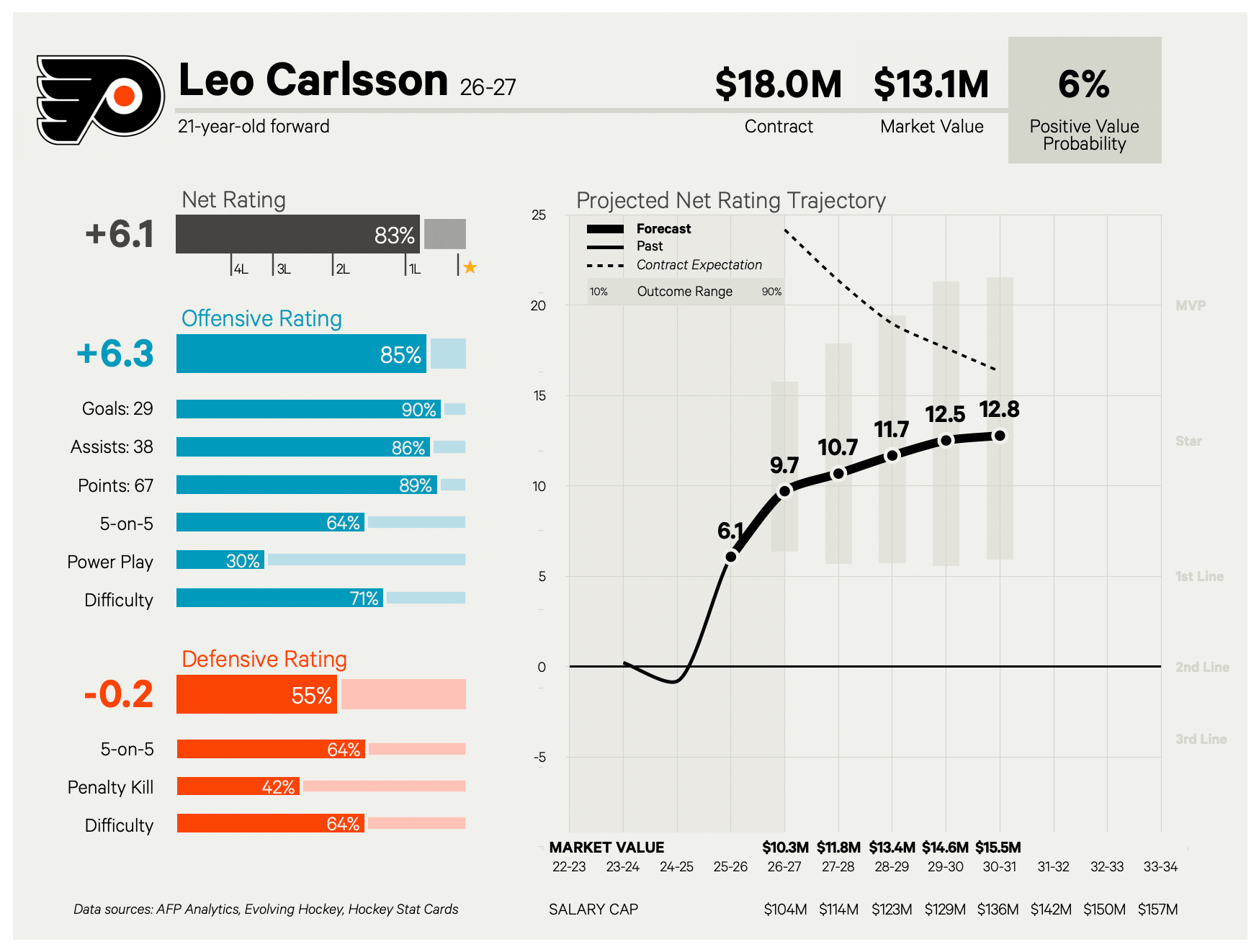
It’s not a knock on his game. Carlsson has some game-breaking ability in him, and he showed it in glimpses this past season. He leveled up and showed similar traits to Leon Draisaitl in the early going of the season. But the Ducks (and Carlsson) hit a wall in early 2026, and his comps tilted down as a result. That path is still there for him if he can find more consistency and add a little more strength behind his skill. Maybe then he can truly be a $18 million player. It’s just a massive leap that no one in today’s NHL has made.
So, the Ducks (or Flyers) have to 1) hope for Carlsson to reach his ceiling, and 2) be prepared to pay for whatever gap forms between that level and his earnings.
Teams are always going to overpay players. If anything, it should be players of Carlsson’s caliber, through the prime of his career; it’s the overpayments on the fringes of a lineup that become back-breakers. Anaheim (or Philadelphia) may be able to offset that with entry-level talent in the coming years, anyway, considering the depth of both teams’ prospect pipeline.
It’s just a matter of balancing those costs and the ripple effect with the compensation of those four first-round picks.
The Flyers have clearly made the decision and are ready to take the leap. And it makes perfect sense for an up-and-coming team that has the chops to do some damage in the playoffs — especially considering the major hole at the top of the lineup is for an elite first-line center. Instead of overpaying a past-their-peak free agent, the Flyers would add someone whose timeline lines up with theirs and help reset the rest of the depth chart into more fitting roles.
Carlsson, plus another year of growth from Porter Martone, would be an absolute game-changer in Philadelphia. That can be worth the value of four first-rounders, which are essentially mystery boxes. And if the Flyers stay in the playoff picture over the next few years, those mystery boxes will likely all have longer paths to impact status at the NHL level.
One added bonus for the Flyers is revenge for the Cutter Gauthier situation. While Jamie Drysdale (and Trevor Zegras) both have found their footing in Philadelphia, the team still doesn’t have a 41-goal-scoring winger in its arsenal, either.
Now, it’s up to the Ducks to respond. In a vacuum, keeping Carlsson is a slam-dunk decision. This is a franchise player who helped Anaheim turn the corner back into the playoff picture. Why take a step back now?
But it’s not a slam dunk in a vacuum. In the context of an $18 million AAV that could potentially change the pay scales in Anaheim moving forward, it could crush the Ducks’ rebuilding efforts and hamstring this window of contention in the early stages.
Plus, there’s one other structural element that’s important here: this contract primarily pays out in signing bonuses, including almost $20 million in Year 1. Carlsson’s base salary will, at most, be $1 million in a single season over the next five years. Only two players had signing bonuses on the Ducks at the time this offer was made: Beckett Sennecke (entry-level contract) and Chris Kreider ($1 million on a contract that was signed in New York). Now Pavel Mintyukov joins the fold with a $3 million signing bonus.
The whole situation is rich, especially for general manager Pat Verbeek, who agents described in this year’s poll as being difficult to work with. Too often, teams squeeze restricted free agents who don’t have a lot of leverage. That’s no longer the case in Anaheim.
Verbeek said he would match any offer sheet thrown the Ducks’ way. The Flyers challenged that.
The ripple effect
First, let’s start with the Ducks. What helps is that Cutter Gauthier is not eligible for an offer sheet as an RFA. If he were, it could absolutely obliterate all of the progress Anaheim has made over the years.
Mintyukov was, though, and that seems to have helped him leverage a pricey new contract. While he’s shown flashes of upside over the years, he has yet to hit his stride consistently in Anaheim. But his presence is even more important after the Ducks made so many subtractions on the back end, losing three of last year’s veterans plus Zellweger. It set Mintyukov up to cash in on a five-year deal worth $7.2 million a year. That’s close to what Clarke signed for in LA, though there’s a lot of separation between the two defenders. His trajectory could change with more development, but as things stand, he only projects to be worth $4 million a year on average over the next five years.

With that deal on the books, plus Carlsson’s $18 million, the team would have less than $10 million in cap space to extend Gauthier and Tyson Hinds, on top of making any other improvements. It’ll be interesting to see if Gauthier, like Mintyukov, has the leeway to push for a signing bonus, too.
Zoom out, and this is bigger than the Ducks. It could be what resets how teams view and value RFAs and gives rising stars some power again.
From a team perspective, the best path forward with franchise players is to take a proactive approach. The Canadiens are the shining example of that. Ivan Demidov’s extension, signed a year early, is the new piece to the puzzle of cost-effective long-term contracts signed early. Montreal’s core is now locked in through its playoff window at fantastic value.
The flip side of this, however, is that restricted free agents could try to drag these situations out to become offer-sheet eligible. The middle ground could be splashier contracts signed ahead of time. If not, maybe the floodgates finally open.
There’s still time for that to happen this summer. While players like Trevor Zegras, Jason Robertson and Cole Sillinger all filed for arbitration (which makes them ineligible for an offer sheet), there are still options to pursue this summer and a lot of cap space to go around. Connor Bedard, Adam Fantilli and Simon Edvinsson all headline that list. And while the Blackhawks have the power to match any Bedard offer, just look at the wrench the Carlsson situation is throwing at the Ducks’ outlook.
Then there’s the wave of Carlsson’s $18 million AAV specifically. Does that raise the ask for Bedard or Fantilli? What about Macklin Celebrini next summer? Did the threshold just rise for every franchise player?
Now that the threat of offer sheets is real and general managers are finally willing to use it as a competitive advantage, it has transformed the landscape of this offseason and beyond. The only question now is what comes next and what shockwaves each development will create.
Data via Evolving-Hockey, HockeyViz, HockeyStatCards, All Three Zones, Dom Luszczyszyn, Natural Stat Trick, CapWages, PuckPedia and AFP Analytics. This story relies on shot-based metrics; here is a primer on these numbers.