
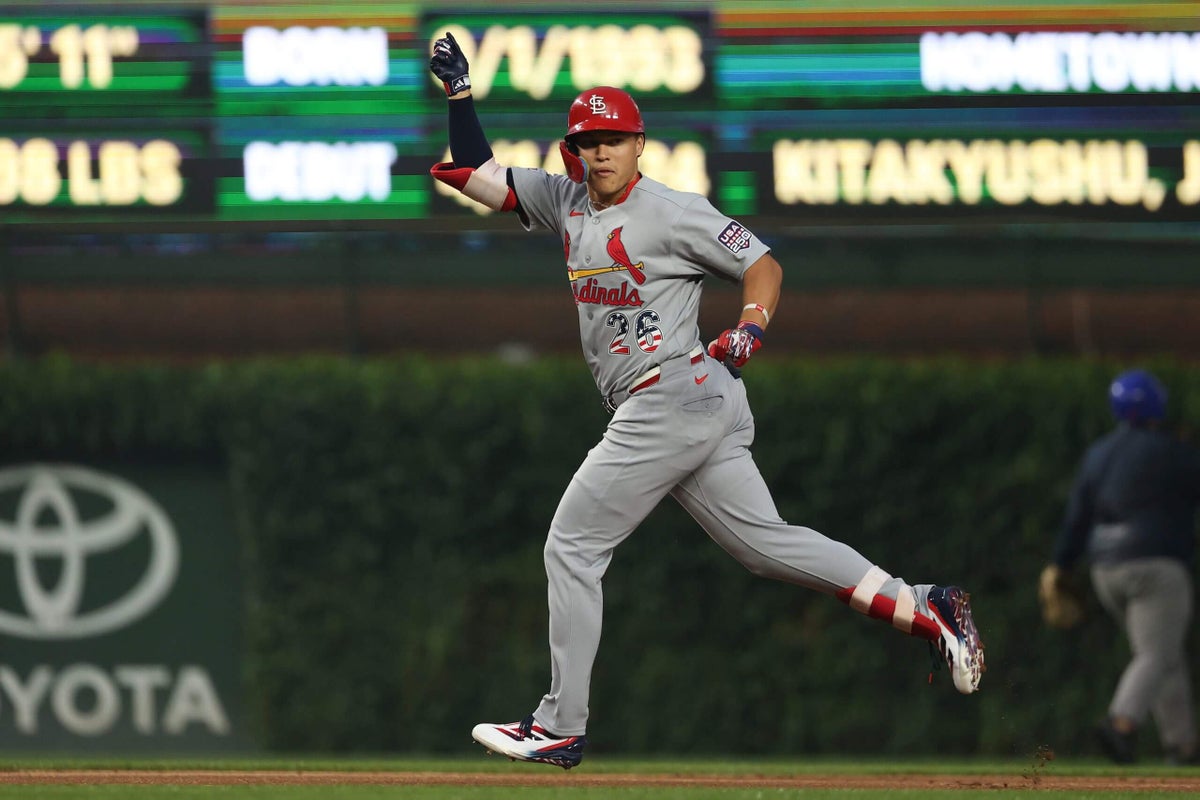
As the St. Louis Cardinals ponder their deadline strategy, they must factor in one of the season’s most remarkable developments, knowing it partly explains their unexpected success.
The Cardinals have used the injured list only six times. They currently have only one player, infielder Ramón Urías, on the IL. They have yet to lose a starting pitcher to injury. Contrast that with the Chicago Cubs, who currently have 13 pitchers alone on the IL. Or pretty much every other team, almost every one of which has dealt with one injury after another.
The Cardinals’ good fortune also includes breakouts from All-Star right fielder Jordan Walker, rookie second baseman J.J. Wetherholt and catcher Iván Herrera.
Which is not to say they’re entirely lucky.
The Cardinals, in a difficult part of their schedule, have already won road series against the Atlanta Braves and Cubs. They currently hold the third National League wild-card position as they prepare for their final homestand before the break, five games in four days against the Milwaukee Brewers, then three against the Braves.
On June 29, 2025, the Cardinals were in the same wild-card position but an even better place in the division, 2 1/2 games out of first place as opposed to their current 7 1/2 games. But they proceeded to lose 17 of their next 25 games, prompting them to unload relievers Ryan Helsley, Phil Maton and Steven Matz at the deadline.
It’s conceivable the same type of collapse will occur. The Cardinals’ position-player group is the second-youngest in baseball. Their pitching staff is the fifth-youngest. But if the Cardinals stay relatively healthy and keep playing at a high level, first-year president of baseball operations Chaim Bloom will have little choice but to supplement his roster.
Bloom isn’t about to abandon his plan to build a sustainable contender, according to people briefed on his thinking. But he also won’t ignore the opportunity for the Cardinals to return to the postseason for the first time since 2022. The long-term impact of playing meaningful games in September cannot be quantified. But the experience can help lead to future success.
The Cardinals are deep in an area where most other teams are not — catching.
Herrera (26), Pedro Pagés (27) and Jimmy Crooks, soon to be 25 years old, are in the majors. Rainiel Rodriguez, playing at Double A at 19, is probably untouchable. But the Cardinals have another catching prospect, Leo Bernal, 22, at Triple A. Perhaps Bloom can leverage that relative surplus to address the team’s most pressing need, controllable pitching.
Rival clubs also are likely to show interest in right-hander Dustin May, closer Riley O’Brien, left-handed reliever JoJo Romero and outfielder Lars Nootbaar. All are vital to the success of the 2026 Cardinals. But Bloom at least holds the option of maneuvering creatively and turning one or more of them into pieces for now and the future.
Superior health helped the Cardinals reach this point. So did quality performance. The next month will determine their next steps.
How Cubs’ Swanson turned it around
Major-league teams carry multiple hitting and pitching coaches to handle the additional preparation necessary in baseball’s age of information. The different voices enable players to seek different perspectives, as Cubs shortstop Dansby Swanson did in mid-June when he went to assistant hitting coach John Mallee in something of a desperate state.
Swanson, 32, praised the consistency of Dustin Kelly, the Cubs’ lead hitting coach, saying, “Our team is so stable in general because he’s Steady Eddie.” But as the 11-year veteran sank to a .175 batting average and .587 OPS, he wanted a fresh perspective.
“I’m my own worst enemy at times,” Swanson said. “Someone said to me that I’m a great player and a great coach and helper for other people. But I’m a really bad coach for myself.
“I basically just had those honest conversations with some folks on staff: ‘I legitimately need help. I know I can do it. I just need actual guidance.’ Most pros are pretty self-sustainable. But we still love being coached. Because we always feel like we can continue to get better.”
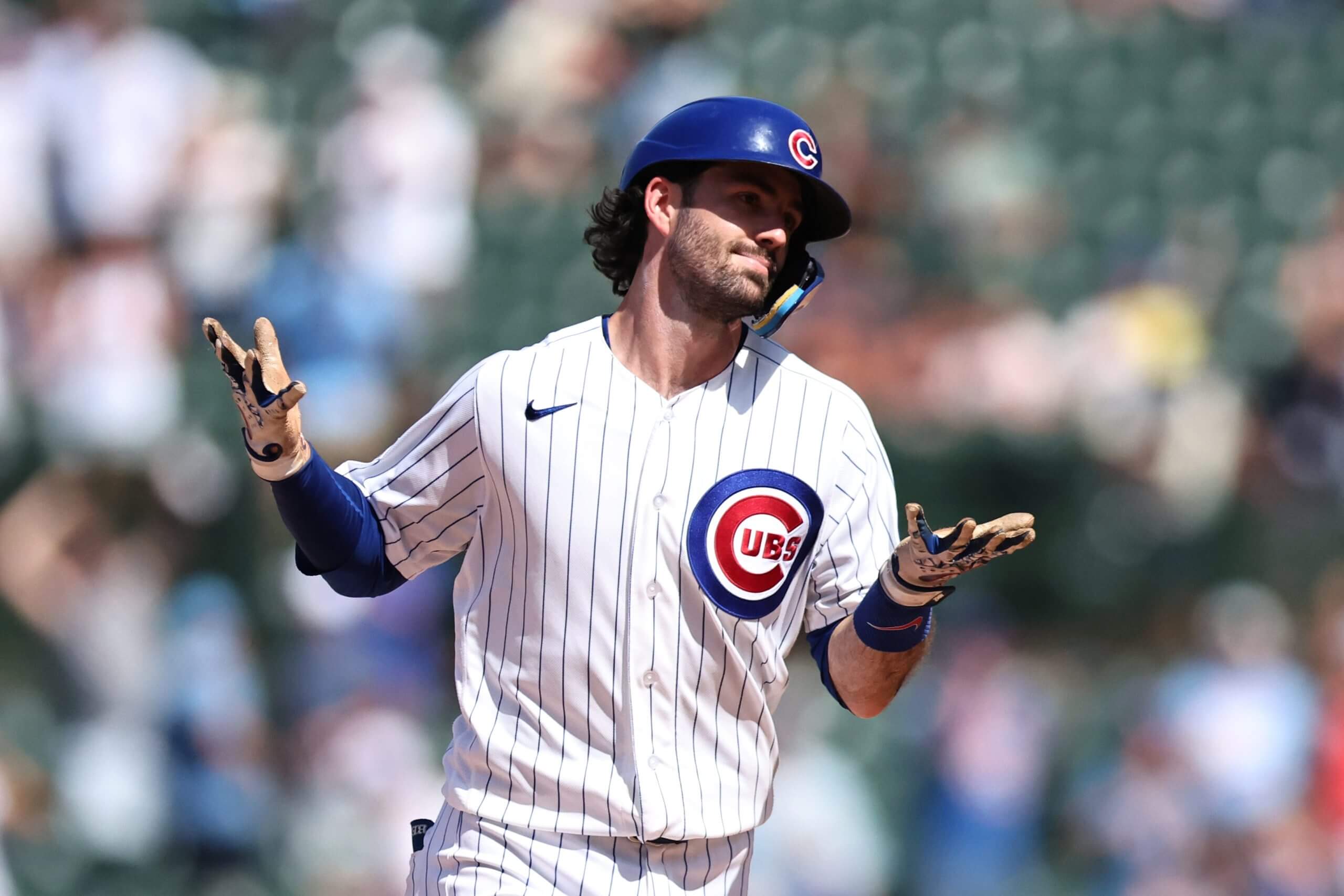
Before Dansby Swanson went on a tear, he was stuck in a hitting slump. (Geoff Stellfox / Getty Images)
The Cubs employ three hitting coaches — Kelly, Mallee and Juan Cabreja — plus an analytically oriented staffer, assistant director of major-league development Ben Martin, who is assigned to position players.
Kelly said he had no problem with Swanson going to Mallee, who also works closely with All-Star center fielder Pete Crow-Armstrong. The way Kelly describes it, a coach can tell a player the same thing over and over, but sometimes it only clicks after the player hears it from someone else.
Swanson told Mallee, “Whatever you think I need to be doing, I’m in.” The two got to work, trying to bring Swanson back to the place he was at the start of the season, when he talked about being more athletic in the box and less worried about mechanics.
“We’re trying to get his (bat) path to match the planes of the pitch more,” Mallee said. “All his work is driving the ball to right-center, staying on the ball. Which keeps him closed longer and allows the bat to unfold toward the middle of the field.
“That’s the athleticism. His practices are not mechanically oriented now. They’re more feel, direction — the path itself, trying to drive the ball in a certain area. That’s result-oriented training. The body will evolve and respond to it.”
Swanson sure did, going from perhaps the worst stretch of his career to arguably his best, becoming the first player since Joe DiMaggio in 1939 to produce 26 RBIs in a 10-game span. He was just waiting for the right advice, the proverbial light bulb to go on.
“When it does,” he said, “I feel I can do some special things.”
Rangers facing difficult reality
Might it happen again? Might the Texas Rangers again sucker president of baseball operations Chris Young into becoming a buyer when their performance does not necessarily warrant that type of commitment?
In 2024, the Rangers entered the deadline 3 1/2 games back in the American League West, six back in the wild-card race, but their record was only 52-55. They probably should have sold, but as defending World Series champions, it would have been a bad look.
So, Young traded only pitcher Michael Lorenzen while acquiring left-handed reliever Andrew Chafin and catcher Carson Kelly. Part of the cost for Kelly was catcher Liam Hicks, who is now thriving with the Miami Marlins. And Texas missed the playoffs by eight games.
In 2025, the Rangers were in a better place — 57-52 at the deadline, tied for the third wild card, five games out in the division. They needed offense but instead doubled down on their pitching, acquiring right-hander Merrill Kelly and relievers Phil Maton and Danny Coulombe.
It didn’t work. The Rangers went through a 2-10 stretch in August and finished the season in a 2-11 funk, this time missing the playoffs by six games.
Now here they go again.
Playing in the B-list AL, the Rangers hold the third wild card and are only 1 1/2 games out in the division. But their record is 45-45, and two of their best hitters, shortstop Corey Seager and left fielder Wyatt Langford, are again on the injured list. The two have played in only 25 games together this season. The Rangers’ record with both in the lineup is only 13-12.
Young is intensely competitive. He will want to buy. But he gave up three pitchers for Kelly who now rank among the Arizona Diamondbacks’ top 16 prospects, according to The Athletic’s Keith Law. In January, he gave up top-100 prospect Gavin Fien and four other minor leaguers for left-hander MacKenzie Gore. Per Law, Fien and two of the others rank among the Washington Nationals’ top 18.
The Rangers’ remaining strength of schedule is tied for the second-easiest in the majors. Their rotation could be dominant in the postseason, but that would require Jacob deGrom and Nathan Eovaldi remaining effective into October, a risky proposition.
Banking on Seager and Langford also would be problematic. Seager has made six trips to the injured list in the past two seasons, twice this year for back trouble. Langford has gone on the IL five times in the last two years.
With limited prospect capital, it will be difficult for the Rangers to address all of their needs. Law rates their farm system in the bottom five, and their top prospect, shortstop Sebastian Walcott, is recovering from internal brace surgery on his right elbow.
Young will not want to concede. Neither will his new manager, Skip Schumaker. But the Rangers will need to be realistic. And this deadline might be the time.
Why O’s must go long with Rutschman
Toward the end of June, Baltimore Orioles president of baseball operations Mike Elias dismissed the idea of trading catcher Adley Rutschman, saying, “We want him here forever.”
Well, what’s Elias’ definition of “forever?”
Rutschman, 28, is under control for only one more season after this one. He is the 11th catcher to earn three All-Star selections within his first four seasons. At this point, he is unlikely to settle for anything but a long-term deal.
In March 2025, before his 60-homer season, the Seattle Mariners’ Cal Raleigh signed a six-year, $105 million extension. Catchers often struggle to get paid, so the contract was considered fair market value, maybe even slightly above.
The only problem, in the eyes of some rival agents, was that the deal extended only through Raleigh’s age-33 season. Free agents, and catchers in particular, often are vulnerable on the open market once they reach their early to mid-30s.
Rutschman, then, would probably want a deal that makes him a lifetime Oriole, or close to it. His benchmark might be the nine-year, $167 million extension Buster Posey signed with the San Francisco Giants in March 2013.
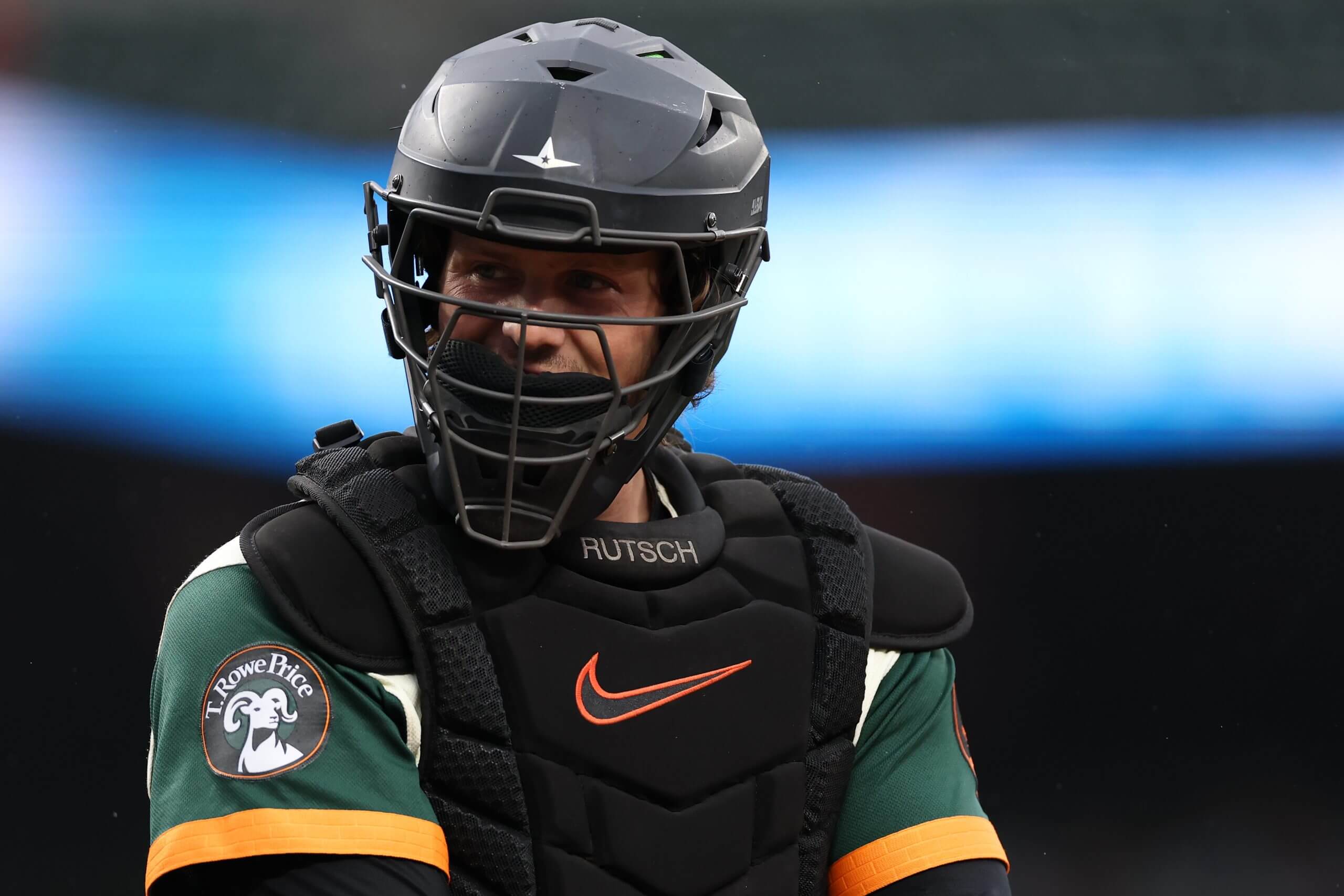
The time toward Adley Rutschman becoming a free agent is ticking. (Patrick Smith / Getty Images)
In March 2024, the Los Angeles Dodgers awarded Will Smith an even longer extension, a 10-year, $140 million deal extending through his age-38 season. But that contract is not necessarily applicable to Rutschman. The Dodgers stretched the length to lower the average annual value for luxury-tax purposes.
At the time of his extension, Posey was a Rookie of the Year, MVP and two-time World Series champion — a more accomplished player than Rutschman. His contract took him through his age-34 season. Nine years for Rutschman would take him through age 37, the point at which J.T. Realmuto’s current deal ends.
The Orioles surely would want a shorter term. The eight-year extension they awarded Samuel Basallo last August expires after his age-28 season, and the team holds an option for an additional year.
Basallo signed that deal less than a week into his major-league career. Rutschman holds considerably more leverage. And the clock toward him becoming a free agent is ticking.
Dodgers’ pitching evolving
Right-handed reliever Evan Phillips returned from Tommy John surgery on Monday. Fellow righty Blake Treinen could rejoin the Dodgers shortly after the All-Star break, followed by closer Edwin Díaz and left-hander Blake Snell in late July and righty Tyler Glasnow in August.
On paper, at least, the Dodgers potentially are looking at an excess of pitching, creating the possibility of spillover into their bullpen. So, could they exploit the market the way they did at last year’s deadline, sending May to the Boston Red Sox for outfield prospects James Tibbs III and Zach Ehrhard?
May was a potential free agent. The current Dodgers starter who fits that description is lefty Eric Lauer, who arrived in a trade from the Toronto Blue Jays in mid-May. The 31-year-old has a 2.88 ERA in six appearances (five starts). It’s classic Dodgers, turning a seemingly fringe piece into something of value.
Righty Roki Sasaki is struggling. Snell and Glasnow hardly are pictures of durability. The Dodgers are perhaps more likely to add a starter than subtract one. And if the Detroit Tigers make lefty Tarik Skubal available, they surely will go into their usual “hang around the backboard” mode, if only to drive up the price for other clubs.
Around the horn
— The Minnesota Twins, coming off their first series win at Yankee Stadium since 2014, look increasingly unlikely to sell. They are only 1 1/2 games back in the race for the third AL wild card, and their new control person, Tom Pohlad, is motivated to win over his players and win back fans.
One player the Twins could move regardless of their standing is catcher Ryan Jeffers, who is on a rehabilitation assignment as he works his way back from a left hamate fracture. Jeffers is a potential free agent who could bring back bullpen help, and the Twins could replace him with Victor Caratini and Alex Jackson.
Speculation persists that the New York Yankees will pursue Jeffers. The Tampa Bay Rays are another team interested in catching help, creating the possibility of an AL East bidding war. In addition to pitching, the Rays want to add an impact hitter to complement Junior Caminero, Yandy Díaz and Jonathan Aranda.
Could be at second base. Could be in the outfield. Could be at catcher.
— The latest uncertainty with right-hander Brandon Woodruff should only heighten the Brewers’ pursuit of help in their rotation as well as their bullpen. The Brewers, though, also could stand to upgrade their offense by adding a shortstop or third baseman.
Entering Sunday, the Brewers ranked 30th in OPS at short and 28th at third. Rookie Cooper Pratt remains the future at short. The shortstop Pratt displaced, Joey Ortiz, is holding down third with David Hamilton. If the Brewers are serious about winning in October, they likely will need more of an impact at one of those spots.
The Brewers are unlikely to trade big prospects for a rental like Skubal, according to people briefed on their thinking. But the depth of their system gives them the potential to make multiple moves.
— On June 19, I reported that the Pittsburgh Pirates are open to trading their competitive-balance round pick in the upcoming draft, No. 34 overall, as well as prospects from their minor-league system.
What I failed to mention at the time is the possible financial incentive for the Pirates in trading the pick. The slot value for the 34th selection is $2,897,400. The Pirates, under owner Bob Nutting, might prefer to redirect that money toward major-league payroll or save a chunk by acquiring a player who earns less.
The Athletic’s Katie Woo, Fabian Ardaya, Dan Hayes and Chandler Rome contributed to this report.