

Two proposed class-action lawsuits are taking aim at the cities of Montreal and Dollard-des-Ormeaux, alleging that the municipalities failed to adequately prepare for the flash floods that overran parts of the West Island last month.
Almost 900 people have already expressed interest in the class actions, said Jeff Orenstein, the Consumer Law Group lawyer behind the battle.
As much as 170 mm of rain pummelled parts of Dollard-des-Ormeaux and the Montreal borough of Pierrefonds-Roxboro on June 20, outstripping the level of rainfall typically expected over the entire month in a matter of hours. Drainage systems were overwhelmed, resulting in flood damage that left many homes in need of extensive renovations.
“I (know) people who lost everything,” Orenstein said. “They don’t have money to make renovations.”
Although Orenstein estimated that some renovations will cost more than $200,000, he said he had heard of insurance payouts as low as $10,000. Others have no insurance, he said, after insurers pulled coverage in the wake of the 2024 floods.
The class-action applications target Pierrefonds-Roxboro and Dollard-des-Ormeaux, accusing local governments of negligence for failing to install sufficient flood-protection infrastructure.
The municipalities did not respond to The Gazette’s request for comment in time for publication.
Although Orenstein said he was still waiting for an expert report, “my inclination is that there should have been no flooding” had the cities done more to prepare.
Given the intense damage already suffered in 2024, he said the municipalities “would have known that any serious rainfall … could not be handled by the system.”
The class-action applications, which require a judge’s approval before Orenstein can go ahead with the lawsuits, are seeking monetary damages as well as a court order to force municipalities to increase their flood-prevention infrastructure.
Sponge parks, which absorb rainfall, as well as catch basins, retention facilities, cisterns and reservoirs could all form part of the added infrastructure, the applications say.
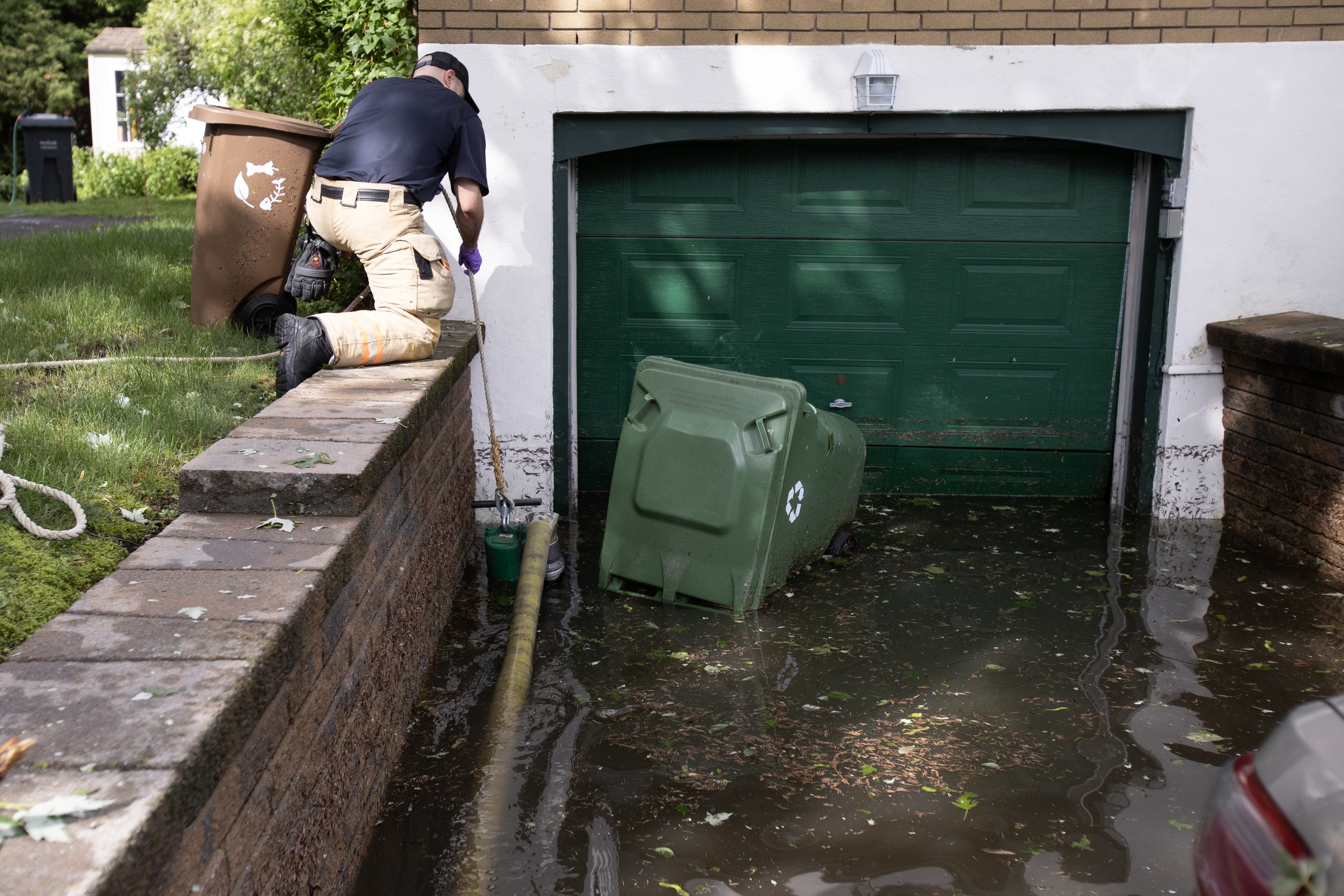 A Montreal firefighter pumps water from a house on Kent St. in Pierrefonds on Sunday, June 21, 2026, after flash flooding the day before. Tim Snow / Montreal Gazette
No infrastructure will ‘reduce damage to zero’: expert
Protecting against floods at the scale seen last month isn’t realistic, said Susan Gaskin, a McGill civil engineering professor with expertise in flood management.
The flooding on June 20 was concentrated in a small section of the West Island, she said, and occurred at too high a volume for flood-prevention infrastructure to stop.
“That localized precipitation event could have happened anywhere in the city,” Gaskin said.
“If we were to build infrastructure that would cope with 170 mm across the whole city, that would cost an enormous amount. Essentially, it’s not possible.”
Historical data would predict that such heavy rainfall would only occur once every 1,000 years or so, Gaskin said.
“The fact that we have climate change means it’s happening more frequently.”
Montreal-area municipalities have added flood-management infrastructure, including sponge parks, which Gaskin said reduce the amount of water sewers need to take in.
“But those sponge parks will never be able to cope with the event that we had on June 20.”
Gaskin blamed much of the flood damage on lax zoning regulations, which she said allowed developers in both Dollard-des-Ormeaux and Pierrefonds-Roxboro to build homes in flood-prone areas.
“If we had much tighter regulations on where people could build, we would have fewer flooding problems,” she said.
Homeowners tasked with rebuilding in the wake of the floods should now consider future flooding when making decisions, Gaskin said. That could mean installing tiles instead of carpet, she said, or even using blocks to keep items off the floor to avoid water damage.
With continued emissions expected to exacerbate climate change, floods “are going to keep happening,” Gaskin said.
“I don’t think that we’re ever going to be able to reduce damage to zero, because these precipitation events are so big.”
More information on the class-action lawsuits is available at this link.