
It has been a minute since I listened to a new Vince Staples album, but by no means is that out of lack of respect or appreciation for the man. We do 20-30 reviews a month (depending on how many Tuesdays there are) and it’s still a drop in the bucket compared to the amount of shit that gets released. If you’re a Steam user you’re familiar with this problem. There are over a thousand new games on the service every month, which means even a full time dedicated team of critics could never cover them all. Of course a lot of them are asset flips and AI slop designed to make a quick buck, but there could always be one diamond in the rough from an indie studio hidden amongst the garbage. I try to look at album reviews the same way — covering the big names is easy to do, but I like to hold out hope that something I picked randomly will be dope. Sometimes that hope pays off. Anyway, back to Vince.
“Hard to mourn from in the casket
Stars are born, I’m niggalactic
When the pigs see a young black man in traffic
Why they treat me like I’m in a UFO?
Cuff me in the backseat so I can’t phone home
How does it feel to be all alone? Quite familiar”
It feels ironic to be discussing the single “White Flag” off “Cry Baby” immediately after the 4th of July. I’m sure I’m not the only person who felt ambivalent about celebrating 250 years of the United States given that bigotry, racism and hatred currently flows from the top down in our government. Vince has always been a rapper with a lot to say and I’m not surprised to see him tackle this touchy topic, but what did surprise me was how similar he’s become to someone else. A production team that features Vince and includes SAINT MINO, Joseph Harrison & Homer Steinweiss gives “White Flag” a sound you could easily mistake for The Neptunes, and the sing-song flow sounds like a West coast style Pharrell.
If this was an isolated phenomenon for one single I couldn’t mention it, but you hear it on “Cotton” too and throughout the album. This had me thinking I misremembered what Vince sounded like, so I went back to the last album I covered and listened to the songs again. To be fair the tendencies were there even then, but with five years of distance they’ve only become more pronounced. The glass half full is that this was the natural evolution of his style to its current form, while the glass half empty take would be that market forces made him shift away from a traditional rap flow to a more commercial friendly one. This made “Only In America” feel like a breath of fresh air.
“America the beautiful, I’d like to take a look at you
It’s hard to see past the stars from behind the bars
know they love to throw the book at you
We barely can read, plus speech not necessarily free
Black folks always embarrassing me
with that face down, ass up, hands on your knees”
I can’t lie. I like hearing Vince rap more than hearing him sing, especially given he has a pen with a point and writes bars that dice up American hypocrisy. That Vince + SAINT MINO sound (this time assisted by Mike Hector) is still Pharrell-esque though. Whether he’s singing or rapping it’s unavoidable. The thing that confounds me is it sounds like Pharrell of the last decade, while modern day Pharrell keeps coming up with newer and wilder “Cash In Cash Out” style beats. If he’s not sounding like that he winds up sounding like Gnarls Barkley on songs like “Do You Know the Devil.” It’s not BAD, it’s just FAMILIAR.
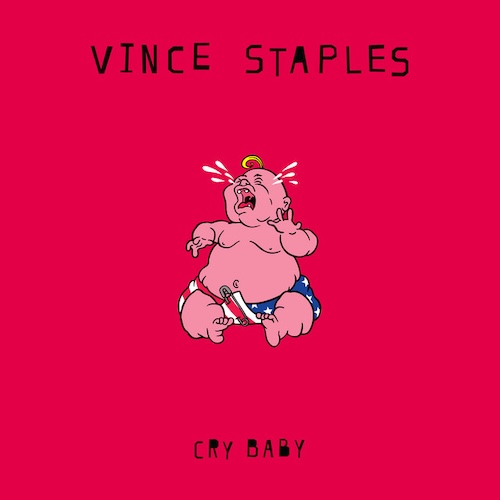
“Cry Baby” isn’t pulling any punches when it comes to topics or even the artwork. A bawling baby in an American flag diaper with a suspiciously familiar haircut tells you what you need to know up front, and song titles like “Do You Know the Devil” make that seem even more on point. Lyrically the song isn’t really about that — it’s Vince casting an eye inward toward his own behavior and then outward looking for salvation. This might briefly make you think the album isn’t political. Having a closing song like “Tulsa, OK” (sadly a vinyl exclusive) makes sure you don’t and couldn’t miss the tone that he’s setting.
“Bobby Hutton dead
Fred Hampton dead
Bunchy Carter dead
Huh, Eldridge Cleaver dead
but niggaz mad at me”
I might be a little ambivalent about the changing sound of Vince Staples, but “Cry Baby” is a subversive little pill meant for the mainstream to swallow whole. He ranges on this album from looking at himself to looking at racial issues to looking at American society as a whole. He’s able to make his points with a sly suggestion as to where the problem stems from (1600 Pennsylvania Avenue) but does so with subtle gestures instead of loud FDT proclamations. Radicals would say he’s cowardly. I say he’s clever. This is chocolate covered medicine and I enjoyed the taste.