
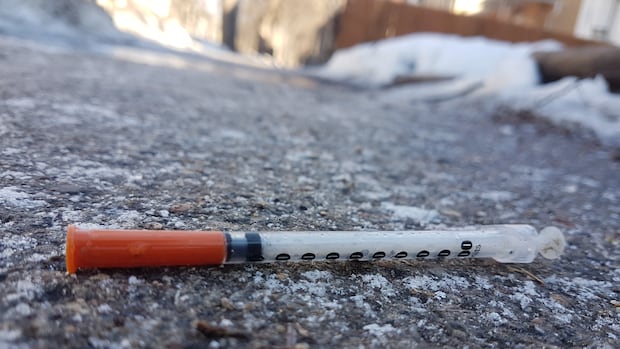

Listen to this article
Estimated 5 minutes
The audio version of this article is generated by AI-based technology. Mispronunciations can occur. We are working with our partners to continually review and improve the results.
This First Person article is the experience of Winnipegger Amanda Mondaca. For more information about CBC’s First Person stories, please see this FAQ.You can read more First Person articles here.
It was one of those warm Winnipeg summer evenings where the city felt alive. Patios were full, sidewalks were busy, cars lined the streets. It felt good to see the city like that.
My partner and I were on our way to Alleyways Market in the Exchange District. As we were walking down Bannatyne Avenue toward Main Street, we noticed someone slumped over on the corner.
At first glance, he could have easily been mistaken for someone sleeping. There was a half-empty bottle beside him. It would have been easy to assume he had simply passed out.
But we didn’t assume. We walked over and asked if he was OK. No response.
We asked again, louder. Still nothing.
He was shaken, then a sternum rub was performed. Nothing.
He was carefully lowered onto his back and checked for breathing and pulse. 911 was called. The line was busy at first.
He was not hidden. And somehow, nobody stopped.- Amanda Mondaca
While trying again, a naloxone kit was pulled out and the first dose was given. The man was breathing, but only about seven breaths a minute. Far too slow. He remained completely unresponsive. The 911 operator instructed rescue breaths, which were begun immediately while a second dose of naloxone was prepared.
Still no response.
A few minutes later, a fire truck turned off Main onto Bannatyne Avenue. For a brief moment, it felt like help had arrived. But it kept going. There was another emergency nearby.
Eventually, his breathing became more regular, but he still did not wake up. That detail has stayed with me.
Naloxone reverses opioids, but it does not reverse the effects of an increasingly toxic and unpredictable drug supply, which may include sedatives and other non-opioid substances. People can start breathing again and still not regain consciousness.
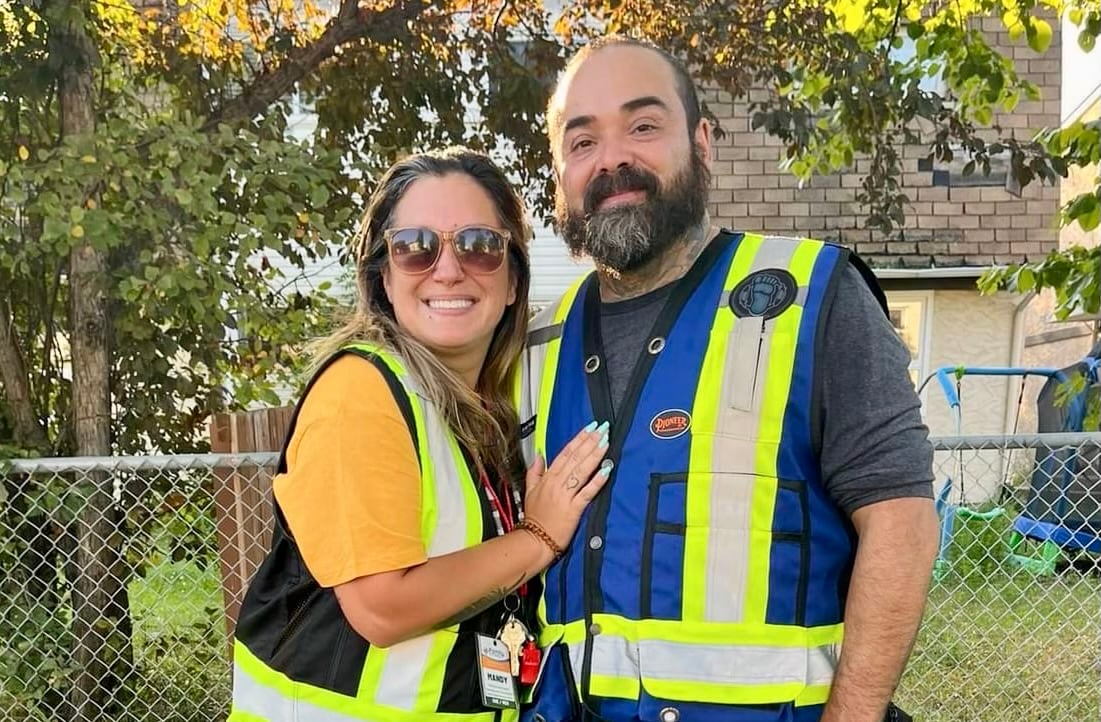 Amanda and Victor Mondaca. ‘We make communities safer by making sure fewer people are suffering in the first place,’ she writes. (Submitted by Amanda Mondaca)
And I keep coming back to something else. He was found because he was visible. It was a busy corner on a Friday night. People were walking in every direction. Cars were passing constantly. He was wearing a bright red shirt. He was not hidden.
And somehow, nobody stopped.
Hiding suffering not a solution
This is not said to blame anyone. It is said because it is easy in a busy city to assume someone else has already checked, or to not fully register what is being passed. But in that moment, no one had stopped.
It raises something I cannot stop thinking about — what would have happened if he had been in a quieter place, farther from traffic, farther from foot movement, farther from chance? Visibility is what made intervention possible.
That is what I keep thinking about when I read about what is happening downtown.
Recently, there have been reports of people who are unhoused being searched, detained, having harm reduction supplies confiscated, and being pushed away from areas where outreach workers and health-care teams know to find them.
And I keep thinking about what that changes.
When people are pushed farther from public spaces, services and supports, we have to ask what gets lost in that distance.
We cannot confuse making suffering less visible with making people safer.
I understand why people are frustrated by visible substance use in public spaces. I understand the desire for safety and order. But I think we have to be honest about what we are actually reacting to.
We should be angry that visible suffering is treated as the problem.- Amanda Mondaca
We should be angry. Not at people living through substance use disorder, trauma, homelessness and poverty, but at the conditions that leave so many people with nowhere safe to go. We should be angry that people are using substances in public, because there is no private place where they will be safe if something goes wrong.
We should be angry that the drug supply is so toxic that one exposure can require multiple interventions and still leave someone unconscious.
We should be angry that visible suffering is treated as the problem, rather than what created it.
What we need is not one approach, but several. Housing that people can actually access. Mental health care without barriers. Trauma-informed supports. Detox and treatment without long waits. Safe supply and drug checking. Recovery supports. And connection to community and culture.
Because people cannot recover if they are not alive. And I cannot stop thinking about what happens when people are moved farther away from the places where they are most likely to be seen in time.
We do not make communities safer by making suffering disappear from view. We make communities safer by making sure fewer people are suffering in the first place — and by ensuring that when they are, they are not alone and out of reach.
To me, the question shouldn’t be whether or not people are tired of witnessing addiction and homelessness. To me, we should ask ourselves: Will we be the kind of community that responds to suffering with care? Or the kind that demands suffering disappear out of view?