
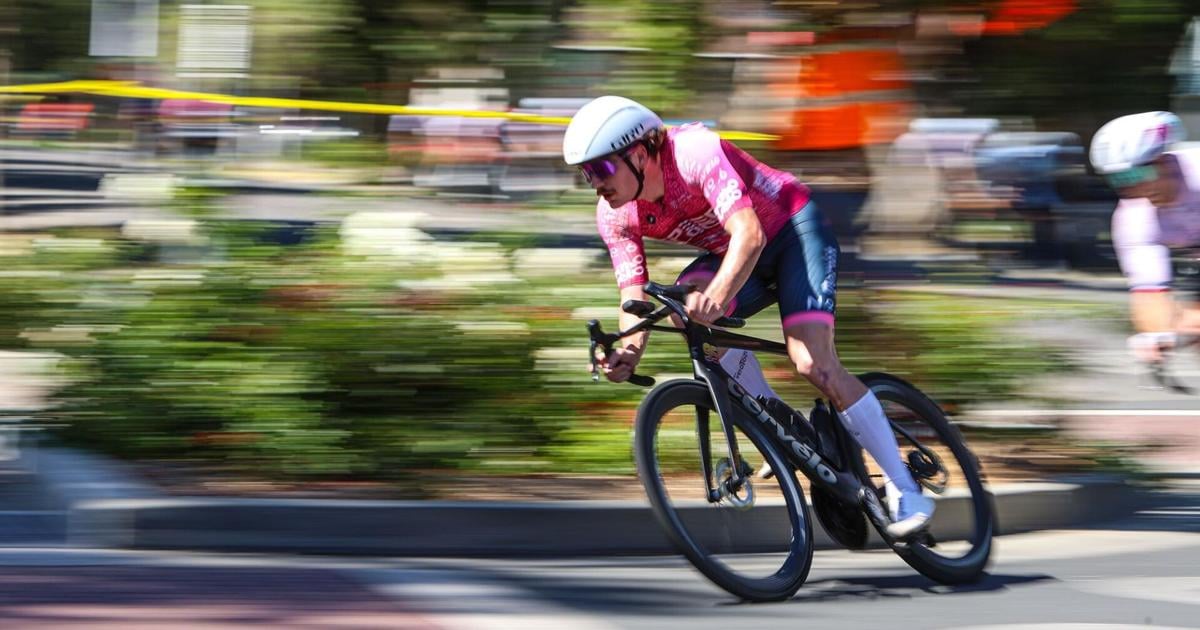
Locals and visitors celebrated the nation’s semiquincentennial with the 45th annual Davis Criterium, the Kiwanis Kiddie Parade, neighborhood baseball games and barbecues, and the City of Davis’ Fourth of July celebration at Community Park.
More than 200 cyclists raced the criterium, organized by the Davis Bike Club.
They came from far and wide to race in the Davis Criterium, for the “day full of bike racing action on a figure-eight course in Downtown Davis, with the start/finish located on Third Street between E and F Streets.” Pros, amateurs, juniors, masters, and elite men and women all took part in the day’s races.

Participants in the 2026 Fourth of July Davis Criterium women’s division zoom through the downtown Davis figure-8 course.
Monica Stark/Enterprise photo
The city of Davis’ celebration of the country’s 250th birthday was like previous years, with food, music, vendors, a game zone, fireworks, and lots of people. The crowd’s energy filled Community Park on Independence Day.
At the festival, parents proudly shared on social media the items their children sold at the kids’ market. Snacks and treats were available for purchase from local non-profit groups, a free game zone coordinated by Discovery Christian Church, live music, coordinated by the Davis Live Music Collective, featuring local band Rainbow City Park and RonKat Spearman’s Katdelic (“funk, rock, pop and afrofuturism; he is a multi-instrumentalist and a prolific songwriter, a triple platinum, Grammy and BMI songwriter award winning artist who has has written for and toured with legends.”) And the 15-minute fireworks display.
For Rainbow City Park, playing at Community Park was a dream since the band’s founding in 2022, as the name comes from the children’s playground there, though it wasn’t at the park where the band grew up. Members found each other online during the pandemic. But they like the small-town feel of Davis.
Participants in the 2026 Fourth of July Davis Criterium line up as they race through downtown.
Monica Stark/Enterprise photo
Seeing some of the same cyclists every year brings camaraderie to the criterium, named in honor of its founder, Helen Pool, who died at 95 ½ and opened B&L Bike Shop in Woodland in 1964, then in Davis. They purchased Foy’s Bike Shop in Woodland in 1984, according to the Davis Bike Club, which she also founded. Pool wanted the criterion to include not only racing but also community outreach.
Overheard near the registration table (at least once) was: “I haven’t seen you since last year!”
“It’s exciting to see everybody coming out and supporting local bike racing,” said Evan Larson, UC Davis Cycling Team incoming president. With an uptick in attendance, support from the sidelines, and an “overfilled” volunteer sheet, he said, “We had volunteers that we didn’t know what to do with, which was an excellent problem to have.”
Winners of this year’s Helen Pool Fourth of July Criterium included locals who made the leader board: Colleen Mills, Davis Bike Club; Maggie Orellana, UCD; both on the “Women Cat 4/Novice”(entry-level category); Karl Wurzbach, Davis Bike Club (Masters 60+ 1/2/3).
The Race Team co-directors, husband and wife Ray Spore and Heidi Verbeeck, both sustained injuries before this race, which they had trained extensively for. They nevertheless kept busy fielding calls from volunteers throughout race day.
Spore proudly calls Verbeeck (“the Belgian Wonder”) for having competed as a kid in the World Championships in Belgium with the country’s national team.
In tandem with the Davis Bike Club, the UC Davis Cycling team focuses on racing. If it’s a DBC event like the criterium, UCD works registration, and the same goes for the other way around. Larson says DBC has helped provide physical resources and connections with the city in making an event happen.
Larson said cycling is making a comeback post the Lance Armstrong era. “There was a golden age in the ‘80s and ‘90s, and it’s been on a trickle off since…but now we’re starting to see more Americans back in the world tour ranks, the highest rank of the sport in the professional world over in Europe. So I think people are getting more excited about American cycling and kind of seeing a bit of an upswing in things like attendance at races and attendance at community events.”
Families participate in the Kiwanis Kiddie Parade on July 4 in downtown Davis.
Monica Stark/Enterprise photo
Because of this, the Fourth of July fell on a Saturday this year, and the Kiwanis kiddie parade took place during a break in the criterium.
From some of the fastest cyclists on the road to children just learning to ride a bike, downtown Davis celebrated the Fourth as the Bicycle Capital of America.
As part of the national bicentennial celebrations in 1976, the City of Davis created a walking/bicycling tour to explore the history of Davis.
What follows is information from the city of Davis Historic Pedestrian and Bike Tour website, which encourages people to “explore these historic locations at your own pace and in any order you choose.”
1. Old Davis Library (now Hattie Weber Museum) – 445 C St – 1911
First library building in Davis. The Bachelor Girls, a social organization, collected $550 to purchase a lot on F Street to construct this building. Hattie Weber, the first librarian, remained in charge for 43 years. When the building was moved to its present site in 1988, it opened as the Hattie Weber Museum in honor of the years of service she dedicated to the citizens of Davis.
2. Lincoln Highway Marker – Central Park near B St – 1920s
Who could have imagined that the first highway connecting New York to San Francisco would pass through Davis? The Lincoln Highway, later known as U.S. 40, did just that on its final stretch from the Sierra to the Bay Area. The oak-shaded Slater’s Court on Olive Drive and the Boy Scout Cabin on First Street are glimpses of history from the 1920s era of the Lincoln Highway. Lincoln Highway markers, originally used to indicate turns in the road, stand in Central Park at the corner of Fifth and B Streets and on the south side of Russell Boulevard at Arthur Street.
3. Davis Community Church – 412 C St – 1926
The only large-scale Spanish Colonial structure in Davis is a fine example of the 1920s’ architectural achievements. Cypress trees grown from seeds brought from the Garden of Gethsemane flank the front entrance.
4. Jacobson-Wilson House – 232 B St – 1914
John Jacobson, a carpenter employed by the University, built this one-story bungalow, which fuses the Craftsman and Colonial Revival styles, in 1914. He built other houses in the neighborhood, mainly working for professors he met on campus. He lived in this house until 1919, when it was purchased by James Wilson, Professor of Animal Husbandry at the University. In 1925, Professor Wilson became the first chair of the Planning Commission and served as chair for 12 years.
5. Clancy House – 137 C St – 1913
This structurally impressive residence stands as a symbol of what diligent, hard-working immigrants could accomplish “starting on a shoestring” in the early days of California. Mathew Clancy, an Irish immigrant who settled in Davisville in 1862, built this variation of Colonial Revival style house 51 years later in 1913. He worked for various local farmers and, in 1873, leased 520 acres, where he raised wheat and livestock. By 1896, his savings enabled him to purchase 160 acres in Solano County, and he continued to rent other farms, including the land where the College Park section of Davis is now. He continued to increase his acreage, both owned and leased, and farmed until his death.
6. A.J. Plant Home – 221 1st St – 1911
This Colonial Revival house was constructed in 1911 by A.J. Plant, who was very influential in the campaign to locate the University of California’s University Farm in Davis. The building is now used as a fraternity house.
7. Barovetto Home and Tank House – 209 and 209½ 2nd St – 1915
This Craftsman bungalow, built in 1915, was the home of Giovanni Barovetto, an early employee of the University Viticulture Department.
8. Eggleston Home – 232 3rd St – 1870
This one-story Victorian house, built in 1870, is one of two remaining Victorians in the University area. It is one of the earliest houses in this part of the City, and one of the oldest surviving buildings in town. Associated with 19th-century agriculture, the house pre-dates the subdivision of lots and development of urban residential dwellings in the area. It is also associated with Lucy Eggleston, an early resident of Davis and the long-time Secretary of the Women’s Christian Temperance Union in the town.
9. Greive-Asbill Home – 310 A St – 1909
This 1 ½ story shingled Craftsman bungalow was built of Humboldt County redwood by Albert “Jack” Greive. The Greive family played a significant role in the commercial development of Davisville. The house was moved to its present location in the 1970s from its original site on the northeast corner of 3rd & A Streets.
10. McDonald House – 337 B St – 1894
This Victorian cottage with its gable detailing is an example of a simple Queen Anne style. Built in 1894, it pre-dates the establishment of the University Farm and the subdivision of the area into residential lots. Along with the Eggleston home on 3rd St, it is one of two pre-20th-century houses in what is now the University area.
11. H.J. Hamel Home – 505 2nd St – 1920
Built by Henry Jacob, son of Hartman Henry Hamel, a German immigrant who came to Davis in 1867. A typical example of the fusion of Colonial Revival and Craftsman elements.
12. Dresbach-Hunt-Boyer Mansion – 604 2nd St – 1875
The Dresbach-Hunt-Boyer Mansion, a two-story Italianate house topped by a very shallow hipped roof, is a superb example of the style and one of the few remaining mansions in downtown. The 12-room, 3500-square-foot main house and 340-square-foot water tower were built between 1871 and 1875 by William Dresbach, the original owner and Davisville’s first postmaster. Mr. Dresbach is credited with naming the town after rancher Jerome C. Davis. The land on which the mansion sits is likely some of the first residential land purchased in Davisville. Mr. Dresbach, one of Davisville’s wealthiest citizens, also owned a livery stable, general store, hotel, and saloon, and a grain warehouse.
13. Varsity Theatre – 616 2nd St – 1950
The Varsity Theatre is a superb example of a late Streamline Moderne movie palace. The architect William Bernard Davis (1905-1985) designed many movie houses in Northern California, including the Tower Theatre in Sacramento. Mr. Davis honed his skills as an apprentice to Hollywood architect S. Charles Lee, the most famous West Coast movie palace designer of the Art Deco era. Interior design was by theater decorator Santocono, with structural engineering by L.H. & B.L. Nishikian of San Francisco, a long-established San Francisco family firm specializing in theater design. Billed in 1950 as the most modern theater in the Sacramento Valley, the Varsity Theatre boasted all the latest amenities. The city of Davis remodeled the Varsity in the 1990s for use as a performing theater and conference center. It was designated a City Landmark in 1998. In 2006, the Varsity reopened under private management as a movie theater featuring independent and art films.
14. Boy Scout Cabin – 1st & F Sts – 1927
Members of the Davis Rotary Club used telephone pole logs donated by Pacific Gas & Electric Co. to build this cabin for use by local Boy Scout troops. This cabin is an example of a continued fondness for the rustic forms and images of pioneer America.
15. Davis Subway (Richards Underpass) – Richards Blvd & 1st St – 1917
The Davis Subway, better known to the community as the Richards Boulevard Underpass, is listed on the prestigious National Register of Historic Places. The subway, built in 1917, is formed by the last remaining I-beam railroad bridge in use in California. It was constructed as part of the first state highway, State Route 6. Once complete, the highway became an alternate route on the coast-to-coast Lincoln Highway, linking Sacramento to the Bay Area
16. Southern Pacific Depot – 2nd & H Sts – 1913
In 1868, the California Pacific Railroad built a branch north from Davisville to Yuba City off its main line between Vallejo and Sacramento. This “Y Junction” greatly stimulated growth in Davisville. The original frame depot was replaced in 1913 by the present Mission Revival-style structure, commonly used by the railroad to let people know they had arrived in “exotic” California. The Depot is listed on the National Register of Historic Places.
17. Brinley Block – 714-726 2nd St – 1926
An attractive example of Commercial architecture of the late 1920’s. Ornamentation primarily consists of integral patterns in the brick.
18. Anderson Bank Building – 203 G St – 1914
Built by J.B. Anderson, thefirst mayor of Davis, to house the newly formed Bank of Davis. The direct simplicity of its style reflects the influences of Louis H. Sullivan, a landmark American architect of the Prairie School.
19. Masonic Lodge – 221-225 G St – 1917
This two-story structure was formally dedicated in 1917, although the Masonic Lodge of Davis had been chartered in 1873. This is a typical American building type: a two-story structure housing a fraternal society on the second floor, with the ground floor devoted to income-producing commercial space. The Masons no longer occupy the building. Although not as visible today because of mature trees, the Renaissance Revival building is one of the largest and most imposing of the historic commercial buildings on G Street. It joins with the Brinley Block, the Anderson Bank Building, and the Bank of Yolo as visible remnants of the historic Davis commercial district along “Main Street.
20. Old Davis City Hall – 226 F St – 1938
This Spanish Colonial Revival-style building originally housed all city administrative offices and the Police and Fire Departments.
(Photo © Eastman Collection Photos, Department of Special Collections, University of California Library, Davis, CA. The Eastman Collection contains many historic photos of Davis and other Central Valley communities.)
21. Bank of Yolo – 301 G St – 1910
The building establishes a massive scale through its careful proportion. The Bank of Yolo operated until 1933. Although it did not open its doors after the Crash, depositors were paid in full within a few years.
22. First Presbyterian Manse – 619 4th St – 1884
This Classical Revival house was built in 1884 by William H. Hampton, owner of the Davisville Lumber Company and an elder and bookkeeper for the Davisville Presbyterian Church (Davis Community Church). It served as the church’s first manse (pastor’s residence), and the first occupant was Rev. J.E. Anderson. It was converted into a community center for students in 1924, but later sold to private owners and returned to residential use. In 1928, it was the home of Rev. Martin Fiske, pastor of the Davis Community Church from 1920 to 1933. Rev. Fiske was responsible for raising funds for the construction of the church building at 4th and C Streets in 1926.
23. Grady Home – 602 D St – 1913
This 1913 house is a hip-roof, rectangular-plan building with a projecting front gable half-porch. The gable end eaves turn slightly upward, and both the fascia and the exposed rafter tails are decoratively finished. Heavy, square posts support a wide lintel under the porch gable. This lintel is decoratively treated with a raised dentil motif. Knee brace brackets support the gable overhang. The raised porch has a closed rail, and low balustrades flank the entry stairs. Both the rail and balustrade are clad in the same novelty siding as the house. Fenestration consists of a wide, horizontal front window with a narrow band of muntins at the top, and elsewhere paired and single double-hung windows with a divided upper sash. The house is a good example of a single-story bungalow. It exemplifies the level of detail and careful artistry that were often applied to even the simplest houses of this period. Additionally, its single-front-gable form is similar to that of many bungalows in Old North Davis and other parts of the city. This type of bungalow form represents a distinctive architectural sub-type common to the area.
24. Liggett Home – 616 E St – 1913
This stucco Craftsman bungalow, built in 1913, is one of the oldest houses constructed in the Bower’s Addition subdivision (Old North Davis). It remains an excellent example of its architectural type and appears to be unaltered.
25. Montgomery Home – 923 3rd St – 1890s
This Victorian residence was constructed in the 1890s. It is associated with the Montgomery family, pioneer farmers in the Putah Creek area.
26. Williams-Drummond Home – 320 I St – 1914
Believed to have been built on land purchased from the Jerome C. Davis Ranch. John Drummond, a local rancher, assumed the mortgage in 1880 and, in 1918, passed it on to his daughter, Lillian, who was thought by the neighbors to be a witch. The house is of the simplified Stick style and balloon-frame construction.
27. Schmeiser Home – 334 I St – 1911
Built by Davis pioneer-inventor Theodore Schmeiser, this Colonial Revival design with Queen Anne features ornate brickwork bordering the front porch.
28. McBride Home – 405 J St – 1912
This one-story house with its hipped primary roof and gabled porch roofs is an example of Craftsman design. It was built by E.S. McBride, one of Davis’ first councilmen.
29. Tufts-Longview Home – 434 J St – 1890
Victorian residence built for Joshua and Mary Tufts, pioneers responsible for the first commercial enterprises in the area. The house combines Stick and Eastlake styles. Noteworthy details include the eave brackets, turned porch columns, fishscale shingles, and stained glass. The Tufts home is listed on the National Register of Historic Places.
30. Anderson-Hamel Home – 623 7th St – 1903
A Queen Anne cottage built by Davis’ first mayor, John B. Anderson, who came to the Davisville area in 1893 and opened the Davisville Cash Store. The Hamels, another pioneer family, bought the house in 1923 and lived there until 1945. Originally built on the corner of 2nd and F Streets, the house was moved to its present location in 1945.
31. Old Davis High School (City Hall) – 23 Russell Blvd – 1927
A group of citizens encouraged the creation of the school district by raising funds to purchase an entire city block for the future high school. Converted to city office space in the early 1980s. The present gymnasium replaced a framed one that burned in a 1937 fire.
32. College Park – across from campus near Howard Way – 1924
A residential area was developed to attract university faculty—lots sold for $475 to $500. There are 19 “landmark” trees of special interest within the park. Until 1950, this circle of stately homes was separated from the city by a sheep pasture, an indication of the town’s rapid growth in the past decades.
33. Howard Home – 445 Russell Blvd – 1924
Walter L. Howard was Assistant Horticulturalist at the University of Missouri from 1901-1903, instructor from 1903-1904, Assistant Professor from 1905-1908, and Professor of Horticulture from 1908-1915 (refer to Figure 9). Howard worked for 14 years at the University of Missouri, with a 2-year stint as Secretary of the State Board of Horticulture and 1 year as President of the American Society for Horticultural Science. In January 1915, Howard accepted an offer for a position as Associate Professor of Pomology from the University of California, Davis. He was charged with organizing the teaching and Experiment Station work in Pomology. He became a Professor in 1918 and head of the Department of Pomology in 1918. From 1924 to 1925, he was Acting Director of the College of Agriculture’s Branch, and from 1925 to 1937, he was Director of the College of Agriculture. He became Professor Emeritus in 1942.
34. First US bike lane – Sycamore Ln at Russell Blvd – 1967
A short section of lane extending north from Russell Blvd to the current northernmost driveway of the University Mall.
35. Avenue of the Trees – Russell Blvd west of Highway 113 – 1874-80
A 1.25-mile section of the transcontinental Lincoln Highway, shaded by majestic black walnut trees planted by H.M. LaRue. The trees were part of an early state and national interest in roadside beautification and improvement in the 1880s.
36. Arlington Farm & LaRue-Romani Home – 2727 Russell Blvd – 1887
Built by H.M. LaRue, this Victorian is a typical farm home of the period. It later became the headquarters of a 2060-acre family farm developed between 1867 and 1918. LaRue was a prominent agriculturalist and state legislator. Son Jacob was active in efforts to acquire the University State Farm for Davisville.
37. Davis Cemetery – 820 Pole Line Rd
Like many small California communities, Davis has one primary cemetery. The earliest grave marker in the cemetery is 1855. There may, however, be earlier unmarked or unknown graves in the older portion of the graveyard. The cemetery is located on lands originally purchased by Col. Joseph B. Chiles.
38. Werner-Hamel Home – 1140 Los Robles St – 1859
This structure, built in 1859, is a square two-story house with a hip roof. It exhibits elements of Classical Revival and Italianate styles. Classical elements occur in the porch and dentil courses, as well as in the building’s symmetry. Italianate elements include the structure’s overall form, hip roof, quoined corners and cornices, eave brackets, and porch canopy balustrades. The structure has been moved from its original site and stands in its new location without the tank house, barn, and brick sheds that once formed the farm complex for which it was the focal point. The additions to the rear and the second story were constructed in 1882.