
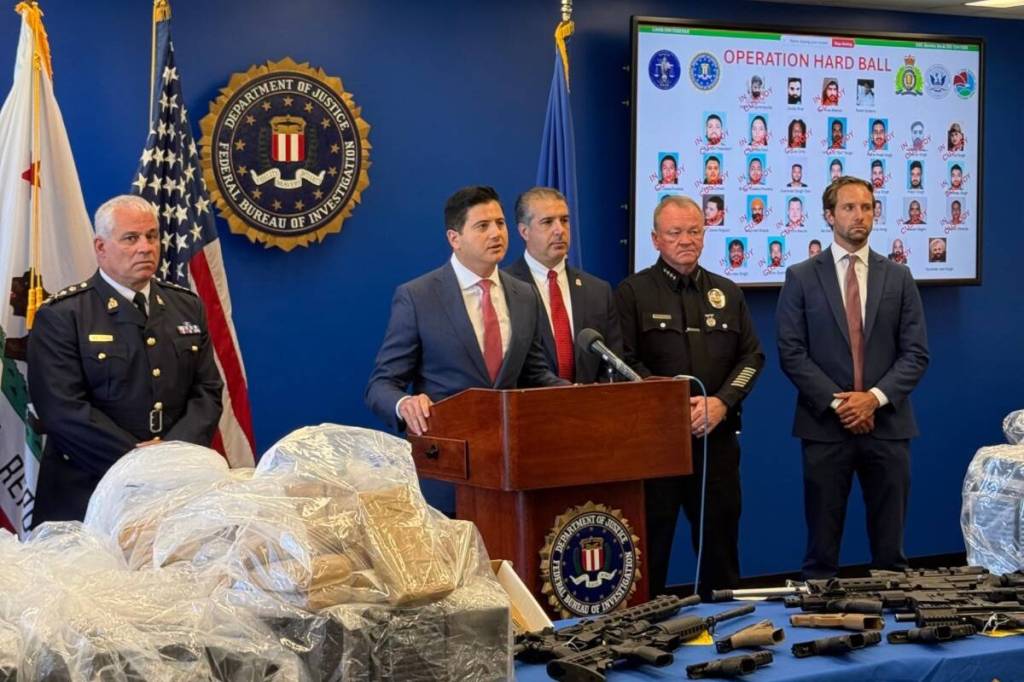
Thirty-seven people have been charged in the United States in connection with a U.S. federal investigation into Indian crime groups that are known to engage in racketeering, targeted killings, shootings, extortion and drug trafficking across international borders.
The investigation, called “Operation Hard Ball,” has led to 24 arrests of individuals connected to three Indian-based transnational organized crime groups: Lawrence Bishnoi, Ravinder Dhanda and Jaggu Bhagwanpuria. Law enforcement is looking for 10 fugitives, seven in the U.S., two in India, and one in Europe.
The details of the crime groups were laid out in three recently unsealed grand jury indictments against Lawrence Bishnoi, Ravinder Dhanda, Jaggu Bhagwanpuria, and 34 others.
Bishnoi and Bhagwanpuria are currently in prison in India for unrelated crimes but are known to run “their global criminal syndicates” from behind bars.
A February 2026 grand jury indictment in the U.S. states that Bishnoi, Brar (also known as Satinder Singh), Rohit Godaara and six others are charged with one count of racketeering conspiracy, one count of conspiracy to interfere with commerce by extortion (Hobbs Act), six counts of attempted Hobbs Act extortion, and one count of conspiracy to distribute controlled substances, namely cocaine and methamphetamine.
The indictment states that Bishnoi and Goldy Brar allegedly “ordered the assassination” of Hardeep Singh Nijjar, the president of a Surrey Sikh temple, in 2023. (Nijjar is identified only as “H.S.N.” in the court documents.)
Email newsletter signup

A June 25 grand jury indictment found that Bhagwanpuria and 16 other defendants had allegedly participated in murder-for-hire, drug trafficking, kidnappings, extortions, weapons trafficking and other crimes.
Bhagwanpuria was an associate of Bishnoi before founding his own criminal gang in India’s Punjab state and becoming one of Bishnoi’s rivals.
This group is known to work with corrupt law enforcement officers and corrupt government officials in India to “assist in extortion schemes.”
Vancouver’s Garinder Deo, 40, “though not charged as a member or associate of this criminal group, allegedly helped enrich the group by purchasing bulk quantities of cocaine and heroin that were to be shipped from Southern California to the eastern United States with the assistance of members and associates of the Bhagwanpuria enterprise.”
Bhagwanpuria, Deo and 15 other defendants have each been charged with one count of racketeering conspiracy, one count of attempted Hobbs Act extortion, two counts of conspiracy to distribute and possess with intent to distribute controlled substances, one count of distribution of cocaine, one count of conspiracy to engage in the business of dealing in firearms without a license, and one count of possession of a machine gun.
The third indictment against Vancouver’s Ravinder Singh Dhanda, 57, a.k.a. John Wick, and Surrey’s Jaskarn Baghri, 50, and nine other defendants alleges that they transported, smuggled, and distributed “hundreds of kilograms of cocaine and methamphetamine each week from the U.S. into Canada,” said the U.S. Department of Justice news release. “The cocaine and methamphetamine were concealed and transported on long-haul semi-trucks from the greater Los Angeles area – including Los Angeles, West Covina, Ontario, Fontana, and Perris – to the U.S.-Canada border. Sometimes, farm trucks from working farms were used to hide the narcotics en route to Canada.”
The indictment alleges that Dhanda operated the cocaine and methamphetamine distribution network and, alongside Surrey’s Baghri, he would “oversee and manage the storage, transportation of these controlled substances” across the U.S. Canada border.
The indictment states that Gurtej Singh Smagh, who is also charged, would get information from a person working with the Canadian Border Services Agency (CBSA) about the timing and location of border inspections and other enforcement actions.
This information was used to “assist with smuggling” the cocaine and methamphetamine across the border.
READ MORE: U.S. court documents link Bishnoi gang to the death of Hardeep Singh Nijjar
The FBI, the Los Angeles police department, the RCMP, and the United States Customs and Border Protection Office in Buffalo investigated this case.
Patrick Grandy, Assistant Director in Charge of the FBI’s Los Angeles Field Office, said, “Today’s coordinated operation strikes at the heart of three brutal transnational organizations that have terrorized families, exploited communities, and stolen lives through ruthless acts of violence in the U.S. and abroad. We, alongside our partners, remain steadfast in our commitment to identifying these violent organizations, disrupting their activities, and ensuring they face the justice they deserve.”
In a statement, RCMP Commissioner Mike Duheme said, “Together, we disrupted the operations of organized criminals who used murder, cruelty and fear to extort and control people in both Canada and the United States. We won’t pause for long to reflect on the work it took to get this job done – we’ll keep doing what we do best to preserve public safety in Canada, in the United States, and around the world.”
Duheme added that the majority of those arrested were in the United States, but three people from B.C. have been taken into custody, and three search warrants were recently executed in West Vancouver, White Rock and Surrey.
None of these allegations have been proven in court. If convicted, many of the defendants could face a minimum of 10 years and a maximum of life in federal prison.
Surrey mayor Brenda Locke released a statement Tuesday afternoon (July 7) expressing her gratitude for the work of all the law enforcement agencies that helped make these charges possible.
“This news reinforces what we’ve been saying for months: the extortion crisis affecting Surrey and cities across Canada is being driven by sophisticated transnational organized crime networks. While these arrests are an encouraging step, there is still more work to do to protect businesses, families, and neighbourhoods from intimidation and violence,” Locke said.