
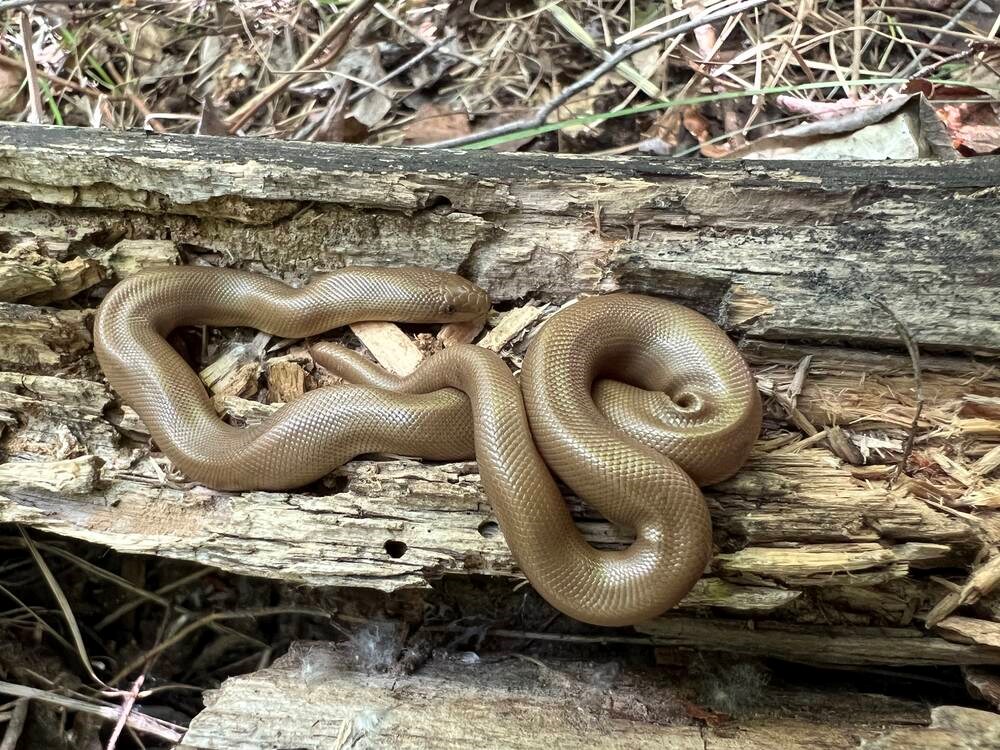
There have been unverified sightings of the snake in the Nanoose and Parksville area, but no photo evidence of its presence, researchers say.
Scientists are asking for the public’s help on Vancouver Island to solve a snake mystery.
Researchers with Thompson Rivers University in Kamloops are in the final year of a two-year project to understand more about the rubber boa and its distribution throughout British Columbia.
Though there have been some unverified sightings of the snake on Vancouver Island in the Nanoose and Parksville area, there is no photo evidence of its presence, according to Tirzah Robinson, who is part of the research team and posted a callout to the public for help on July 2.
Rubber boas are uniformly dark olive green or brown in colour, with small eyes and a pale orange-yellow belly, according to the public-engagement website B.C. Reptiles & Amphibians, which is assisting with the project. Their name comes from the small, smooth scales that give their skin a rubbery appearance.
The project marks the first intensive study of its kind, after smaller studies were done in the late 1990s. Little is known about the boa’s range in British Columbia, the only place in Canada where it’s found.
That lack of information can make conservation efforts difficult, said Maria Collins, a project researcher and master’s of science student at Thompson Rivers University.
The snake can be tricky to spot because it tends to burrow, with only a bit of its tail showing, Collins said.
“It’s very easy to not see the animal and destroy the habitat unknowingly,” Collins said. “It’s very sensitive to human activity because we can’t see the snake and it’s very easy to just scoop up a bunch of dirt, not know, and then you’ve just wiped out a local population of them.”
Juvenile snakes are particularly vulnerable because of their small size — they’re a bit like a large earthworm — and the fact that they take a long time to grow and reach sexual maturity, Collins said.
She said photos and any other information from the public can help researchers build a database of information on the snake’s range and whether its population is stable, which will help determine its potential protection and ranking with the Committee on the Status of Endangered Wildlife in Canada.
“Some person’s photo can make an incredibly huge difference for this animal’s conservation on the Island, if they are there. It can be a really life-changing thing for this animal,” Collins said. “Citizens can have a lot of impact with a photo.”
Anyone who sees a rubber boa in the wild is encouraged not to handle the snake but to note the date, time and location, take a photo and send the information to [email protected]. Submissions can also be made online through bcreptilesandamphibians.ca/ bc-boa-project.