
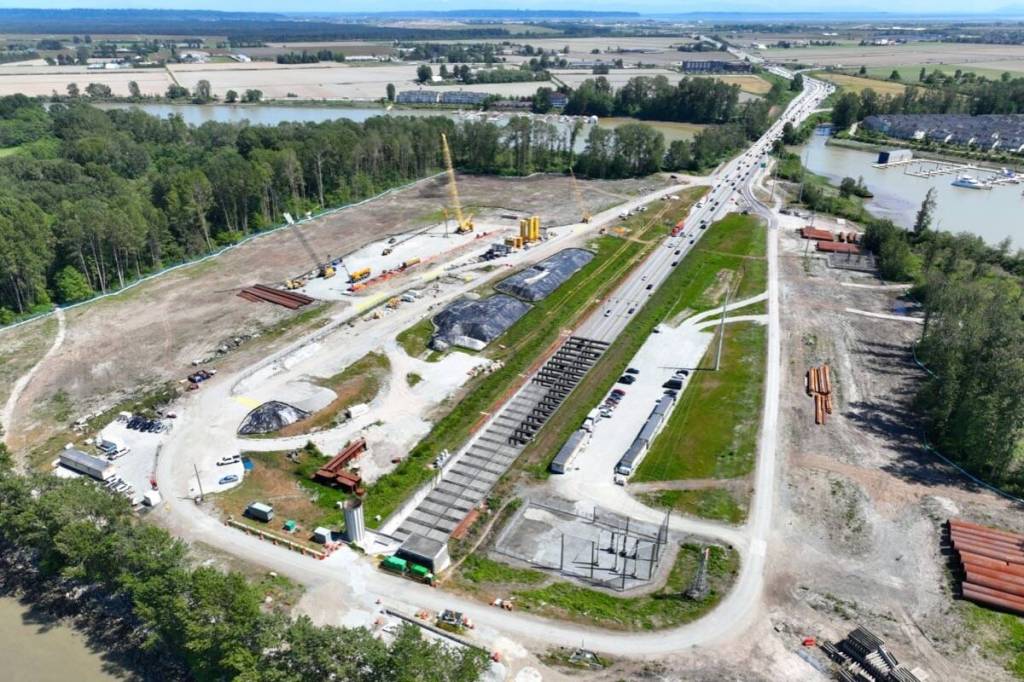
Delta city councillor Dylan Kruger is calling for greater transparency surrounding costs, timelines and procurement for the George Massey Tunnel replacement project.
On Monday (June 6), B.C. Transportation Minister Mike Farnworth announced replacing the 65-year-old tunnel will now cost about $8.5 billion — nearly twice the 2021 estimate of $4.15 billion for a new eight-lane submersed-tube tunnel beneath the Fraser River — with completion now expected by September of 2031, rather than December of 2030.
Despite the recent cancellation of the construction contract with Cross Fraser Partnership to replace the aging four-lane tunnel, Farnworth says the project will proceed as planned, with pre-construction work underway, the environmental assessment process expected to conclude by the end of this year, and major work to begin in 2027.
Farnworth’s announcement came days after Prime Minister Mark Carney promised the federal government would kick in up to $3 billion to cover as much as one third of the project’s cost, as part of a memorandum of understanding signed Thursday (July 2) with the province, and a little over two weeks after the Ministry of Transportation and Transit announced it had cancelled its agreement with Cross Fraser Partnership in favour of re-tendering the project in smaller procurement packages to “seek the best possible value for taxpayers.”
Kruger, who is running for mayor with the One Delta slate, released a statement via his campaign Monday afternoon saying the revised figures for the Massey Tunnel replacement project raise more questions than answers.
“It’s about time the province provided a cost figure that isn’t a decade old, but we still don’t have the information we need to have confidence in this new number,” Kruger said.
“Are these costs tied to design changes? Are they the result of procurement challenges? Or are they simply replacing outdated estimates that no longer reflect reality? Was the number pulled out of the air? Right now, no one can tell.”
The only thing that’s certain, Kruger said, is that the project is back to square one with procurement for a tunnel that was supposed to be starting major construction now.
“After nearly a decade of uncertainty, residents are being asked to accept new numbers without any context,” Kruger said. “That’s not accountability, that’s not transparency. The provincial government needs to release the full cost breakdown, updated timelines, and a clear explanation of what has changed and why.”
Kruger said years of shifting timelines, repeated delays and inconsistent communication have fueled concern that the project is once again drifting without a clear path forward, noting the Massey replacement has already faced a cancelled bridge, a reset tunnel plan, missed construction targets and a terminated procurement process.
With the project now years behind schedule, he said the absence of a detailed cost explanation is adding to frustration for commuters, businesses and communities south of the Fraser, adding if the bridge had gone ahead as planned, it would have already been in use for three years.
He went on to renew his call for an independent third-party investigation into the Fraser River Tunnel Project and the circumstances that led to the termination of the ministry’s construction contract with Cross Fraser Partnership, a motion unanimously endorsed by council on Monday, June 15.
“Residents and taxpayers need the province to come clean and explain how this boondoggle was allowed to happen,” Kruger said.
Kruger called on the province Monday to publish a full cost methodology and scope comparison, updated construction and completion timelines, details on procurement challenges and next steps, and a transparent explanation of how the new numbers differ from previous estimates.
“People have waited long enough. We know the numbers have changed, and we need the province to how and what that means for the future of this critical transportation corridor,” Kruger said.
Mayor welcomes investment, eager for next steps
Last Thursday, following the announcement of federal investment in the tunnel project, Mayor George Harvie — who is running for re-election in this fall’s civic election — put out statements on campaign letterhead calling the funding a significant milestone to support long-term economic growth, job creation and industrial modernization across B.C.
“By aligning our fiscal resources and strategic priorities, we are ensuring that western Canada’s most critical infrastructure requirements receive the capital prioritization they require,” Harvie said in the statement shared with the Reporter.
“Both governments understand completely the immense scope of work, collaboration and resources required to deliver large-scale infrastructure. With this new framework now established, it is imperative that we immediately identify, isolate, and systematically overcome any fiscal or logistical risks that threaten to stall or hinder progress on our region’s most vital transportation link.”
Harvie said the community is eager for next steps, and that both federal and provincial governments recognize the importance of this clarity for local leadership and residents alike.”
“We look forward to seeing the detailed project plans presented directly to the people of Delta to ensure full transparency,” Harvie said.
“We look forward to continuing our constructive, intergovernmental collaboration to ensure that the risks inherent to projects of this magnitude are managed aggressively, construction continues without interruption, and the Fraser River Tunnel [Project] remains a top-tier priority for our nation’s transit and trade corridors.”
City must have “meaningful voice at the table,” says mayor hopeful
Mayor candidate Melissa Granum and her Delta First slate issued a press release Monday morning, prior to Farnworth’s press conference, saying Thursday’s joint federal-provincial announcement makes it clear Delta is at the centre of a “linked infrastructure agenda” including Roberts Bank port expansion and and a potential new Alberta-to-B.C. pipeline route terminating at Delta’s port.
The release says federal tunnel funding “should not be viewed in isolation” as it’s part of a package that, for Delta, means “one decision cannot be separated from the others — expanded port activity, increased industrial traffic, pipeline-related risks, and tunnel replacement planning will all have direct consequences for local roads, the environment, emergency services, and quality of life.”
“Delta cannot be treated simply as the end point for major projects planned by other levels of government,” the release states, adding if these connected projects move forward, the community must have a meaningful voice at the table and a clear plan to secure direct benefits for residents — including road and transportation upgrades, strong environmental protections, investment in emergency preparedness and “fair compensation that can be invested directly into Delta.”
“Delta is one of the most strategically important communities in British Columbia,” Granum said in the slate’s press release. “We live at the crossroads of major transportation corridors, port operations and sensitive environmental areas. That means local government must be a strong, credible advocate for residents.
“When other levels of government make decisions that affect Delta, mayor and council need to ask the right questions, demand mitigation measures, and make sure our community’s interests come first.”
Granum said city council should insist on transparent consultation, early engagement and practical safeguards — to include examining environmental impacts, transportation congestion, community growth pressures and the cumulative effects of industrial expansion — before any major project advances.
“Delta needs leadership that speaks for residents before decisions are locked in, not after,” Granum said.
— with files from Mark Page