
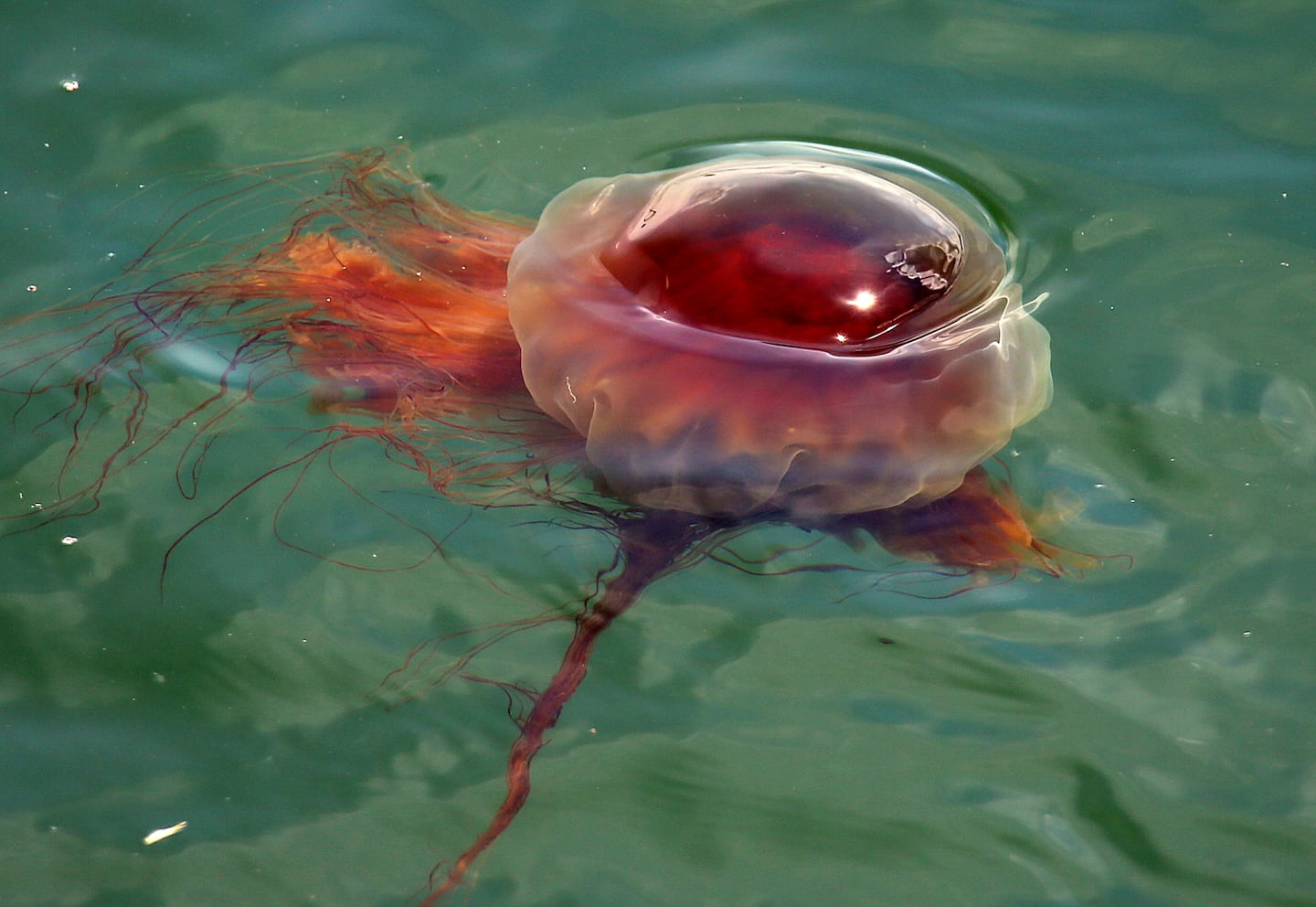
The presence of so many jellyfish has led lifeguards to urge beachgoers to avoid the creatures.
In late June, officials warned swimmers to avoid the water near M Street beach in South Boston after several people were stung, and advised against letting children swim.
“Jellyfish are visiting the beach at BCYF Curley Community Center in #SouthBoston and have stung some swimmers … swim at your own risk,” the Boston Center for Youth and Families said in a Facebook post on June 24.
Scientists said Tuesday they don’t know why the jellyfish have arrived in Massachusetts waters in such high numbers this summer.
Jellyfish do not swim, rather, they drift, said Owen Nichols, director of the Marine Fisheries Research program at the Center for Coastal Studies in Provincetown. Because jellyfish go with the flow, their large presence must have been caused by a combination of ocean currents and winds.
The lion’s mane species is native to large swaths of the Atlantic Ocean off the New England coast, Gawne said, but weather and ocean patterns usually keep them farther from shore.
“If the prevailing winds and currents are taking them out to Stellwagen [Bank National Marine Sanctuary], we don’t talk about it as much, but if they’re pushing them onto the beach like they are right now, people notice,” Gawne said.
The abundance of jellyfish this summer was not anticipated by experts, Gawne added.
“One of the questions we get a lot is how to predict this, but there’s just so many inputs, from the water temperature to prevailing currents and wind that put these into contact with people,” he said.
While some species, such as sharks, may come closer to shore in search of food, that’s not the case for jellyfish, which eat plankton and other small organisms, Gawne said.
And unlike other ocean species that are harvested commercially, people tend not to track jellyfish populations, Nichols said.
“Part of the challenge is we don’t have a lot of quantitative data on jellyfish abundance or distribution,” he said. “We don’t have data on who’s catching them and how many there are, and they’re not easily surveyed like some other marine resources.”
Beginning in early to mid-June, fishermen off the eastern and southern coasts of Cape Cod began reporting large numbers of sightings, Nichols said.
Now, lion’s mane jellyfish can be found in bays and harbors all up and down the Cape, Nichols said.
Residents have called or texted Nichols almost daily to report seeing lion’s mane jellyfish with bells up to two feet in diameter. Their long, trailing tentacles can reach as much as 100 feet in some cases, according to marine biologists.
Lion’s mane jellyfish have also been reported on the North Shore as well as the South Shore, Nichols said.
Although Gawne completes most of his work for the aquarium at the office, he said he’s received reports from fishermen and boaters who describe unusually large “jellies.”
People have been spotting the animals from Boston Harbor up to Manchester and Glouscester, Gawne said.
As a Swampscott resident, Gawne said he’s seen beachgoers get stung by lion’s manes a couple times this summer at Phillips Beach.
Because the jellyfish are so close to the shore and on the sand, more people are getting stung, officials warn.
Stings from larger specimens can be more painful, said Nichols, and the stings may feel more painful to a small child.
“I tend to find their stings unpleasant, but I’d rather have that than poison ivy on me,” Nichols said.
Experts advise against using fresh water to wash the affected area, according to Gawne, because contact with fresh water causes jellyfish stingers, called nematocysts, to “fire off” more stings, he said.
Just use seawater, he said.
“And you don’t want to sting your own hand or someone else’s trying to get those” nematocysts off, he added.
Use gloves or tweezers if they’re available.
“Even just use a credit card” to scrape them off, he said.
Claire Thornton can be reached at claire.thornton@globe.com. Follow Claire on X @claire_thornto.