

 Image adapted from Tesla/BYD
Over the past decade, electric vehicle batteries have changed faster than pretty much any other part of the car. Many electric cars now offer range comparable to petrol cars, while battery prices keep falling. But the industry has not converged on one battery of the future. Instead, two competing visions have become clearer.
Tesla champions high-energy, cylindrical cells like its 4680 battery, designed for maximum power and range. Meanwhile, BYD takes a different path with its Blade battery, a prismatic lithium iron phosphate (LFP) cell that prioritizes safety, longevity, and affordability. Both represent cutting-edge innovation — but how do they differ, exactly?
To get to the bottom of things, a team of researchers tore them apart and analyzed their components.
The “Coca Cola” formula
Unsurprisingly, producers aren’t keen to share details about their batteries. After all, this is a very competitive area. Every bit of information and research can make a difference. So, the researchers had to tear down the batteries to properly analyze them.
“There is very limited in-depth data and analysis available on state-of-the-art batteries for automotive applications,” said Jonas Gorsch, a researcher at Production Engineering of E-Mobility Components at RWTH Aachen University in Germany and lead author of the study.
Gorsch and colleagues tested the two batteries, analyzing their mechanical structure, materials, and electrical performance. They tested energy density, thermal efficiency, internal resistance, and manufacturing processes, using tools like scanning electron microscopy (SEM), thermogravimetric analysis (TGA), and direct current resistance measurements.
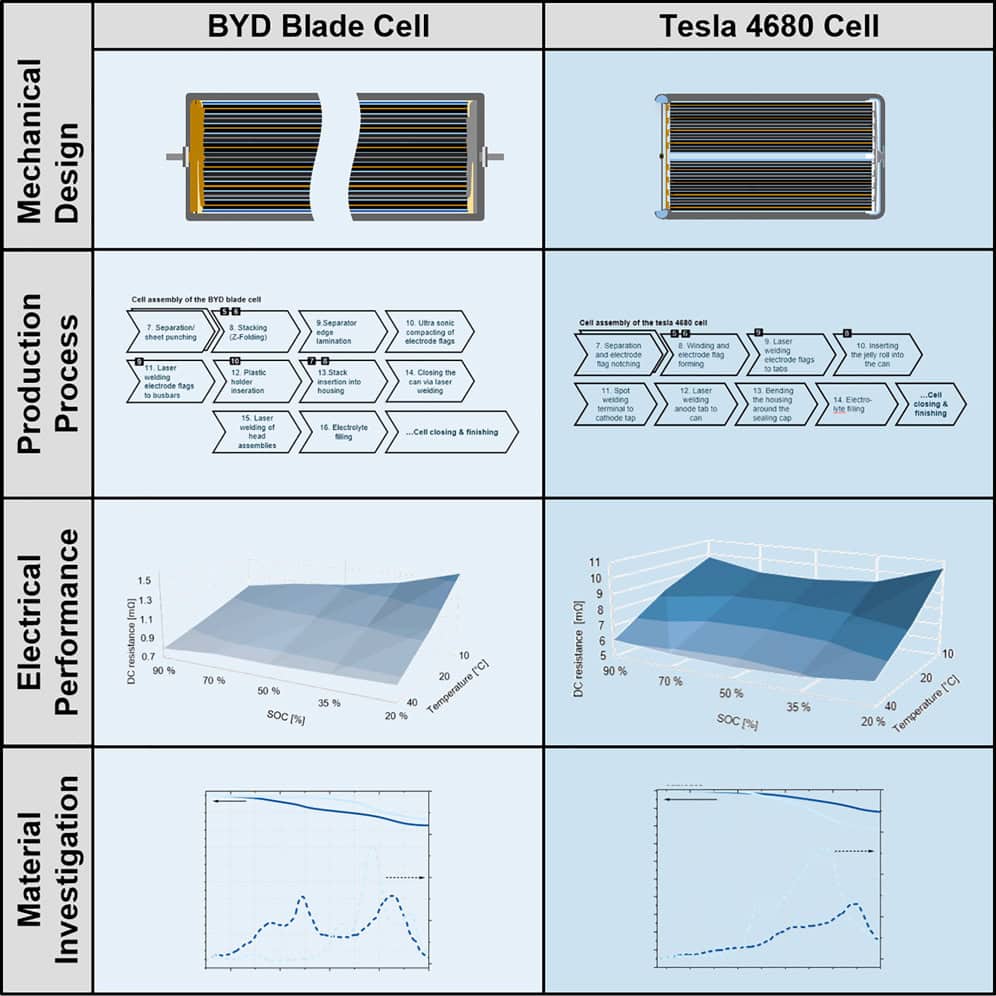 Credit: Cell Reports Physical Science.
The Tesla 4680 cell follows a cylindrical format, is 46 mm in diameter and 80 mm long. BYD’s Blade battery, on the other hand, is a long and thin prismatic cell. It measures 90 mm in height, 965 mm in length, and just 14 mm in thickness. This geometry already shows the different angles the two companies take.
When it comes to raw energy storage, Tesla’s 4680 cell has a clear advantage in both gravimetric and volumetric energy density. The Tesla cell achieves 241 Wh/kg and 643 Wh/l, significantly outperforming the BYD Blade at 160 Wh/kg and 355 Wh/l. This means Tesla’s battery packs can be lighter and more compact for the same energy output.
×
Thank you! One more thing…
Please check your inbox and confirm your subscription.
However, high energy density comes with a cost — literally. The nickel-rich cathode material in the Tesla 4680 cell is more expensive than the LFP cathode in BYD’s Blade. Moreover, LFP cells like the Blade have superior thermal stability, making them less prone to overheating or thermal runaway. This is one reason why LFP batteries are becoming increasingly popular for budget-friendly and mass-market EVs.
Expectations and surprises
 Credit: Cell Reports Physical Science.
The geometric differences of the two batteries are more than just aesthetic. The Tesla 4680 cell adopts a “jelly roll” configuration, where electrode layers are wound tightly inside the can. Meanwhile, the BYD Blade uses what is called a Z-folded electrode stack, which contributes to its superior mechanical stability.
These design differences also influence how the batteries are manufactured. Tesla employs a streamlined process that eliminates traditional tabs, using laser welding to connect electrode sheets directly. BYD, on the other hand, relies on a combination of ultrasonic and laser welding, ensuring strong electrode connections while maintaining an efficient manufacturing flow.
There were also some surprises.
“We were surprised to find no silicon content in the anodes of either cell, especially in Tesla’s cell, as silicon is widely regarded in research as a key material for increasing energy density,” said Gorsch.
The finding is a useful reminder that the batteries inside mass-produced cars don’t always follow the research hype cycle. Silicon-rich anodes, solid-state batteries and other next-generation designs attract enormous attention, but the cells that reach the road must survive manufacturing scale-up, warranty demands, fast charging, cost pressure and safety testing. The IEA expects all-solid-state batteries to remain mostly limited to premium segments until the first half of the 2030s.
Two different visions
 Pictures of the cells’ internal electrode configurations and features. Credit: Cell Reports Physical Science.
Cost remains a major factor in the widespread adoption of EVs. The study calculates that the Tesla 4680 cell, with its high-nickel cathode, has a cost disadvantage of about $10/kWh compared to BYD’s Blade. The reason is that nickel and cobalt prices have remained high, while LFP materials — mainly iron and phosphate — are more abundant and stable in cost.
Furthermore, the two batteries have different thermal efficiencies. The teardown analysis shows that the Tesla 4680 cell’s higher internal resistance leads to greater heat buildup, particularly at high charge levels. This could pose challenges for fast-charging and long-term durability.
BYD’s Blade, on the other hand, benefits from its LFP chemistry, which naturally generates less heat and is more resistant to thermal runaway. Additionally, its prismatic format allows for more straightforward thermal management strategies, a key reason why BYD batteries have been praised for safety.
The question isn’t which battery is better, but which is better suited for a particular vehicle. Luxury EVs and high-performance models may favor Tesla’s energy-dense 4680, while mass-market and commercial vehicles could thrive on the stability of BYD’s Blade.
Updates, a year later
Ultimately, the Tesla battery seems better suited for high-performance and luxury vehicles. Meanwhile, mass-market and commercial vehicles that value durability and reliability could make better use of BYD’s approach.
But things are starting to blend.
BYD is now trying to move the Blade battery beyond the old LFP reputation of “safe but slower.” In March 2026, the company unveiled its second-generation Blade Battery and FLASH Charging system, which can charge from 10% to 70% in five minutes and to 97% in nine minutes, while the battery’s energy density rises 5% over the first generation. These are company claims, not independent teardown results, but they show where BYD wants to take LFP next: not just cheaper and safer, but fast enough to compete with the refueling experience of petrol cars.
Tesla’s side of the story has also changed. In its latest investor update, the company said it has begun producing battery packs for some Model Ys using 4680 cells, pushing to reduce costs for batteries. At the same time, Tesla listed LFP production in Nevada as being in early ramp, with 7 GWh of installed annual capacity.
In other words, the old split is blurring. Tesla is still pushing high-energy cylindrical cells, but it is also moving into LFP. BYD is still the great champion of LFP, but it is now trying to answer the performance and charging objections that once favored nickel-rich batteries.
The race is also bigger than Tesla and BYD. CATL remains the world’s largest battery producer, and the IEA says Chinese producers supplied almost 75% of the batteries deployed in electric cars globally in 2025. So Tesla and BYD are useful symbols of two engineering philosophies, but they are not the whole battery industry.
Ultimately, the future of EV batteries may not be decided by a single winning chemistry. It may be decided by segmentation. Some vehicles will need maximum range and performance. Others will need low cost, long life and safety. The teardown shows why Tesla and BYD made different choices. The past year shows something else: the market is large enough, and changing fast enough, for both approaches to survive.
The study was published in Cell Reports Physical Science.
This article originally appeared in March 2025 and was updated with new information.