
SAN FRANCISCO — San Francisco Giants amateur scouting director Michael Holmes and his staff are confident the organization will select an impact player with the fourth pick in the MLB Draft on Saturday.
If any of the three players whom most mock drafts project to go at the top are still available with the fourth pick, it’s hard to imagine the Giants would let UCLA shortstop Roch Cholowsky, Texas high school shortstop Grady Emerson or Georgia Tech catcher Vahn Lackey slide any further. And if all three are off the board? Plenty of talented options remain.
The Giants could select Miami-area high school shortstop Jacob Lombard. Or Mississippi high school outfielder Eric Booth Jr. Or Georgia Tech outfielder Drew Burress. When Baseball America released its final mock draft Wednesday, the publication flipped its projection for the No. 4 pick from Lombard to Booth Jr.
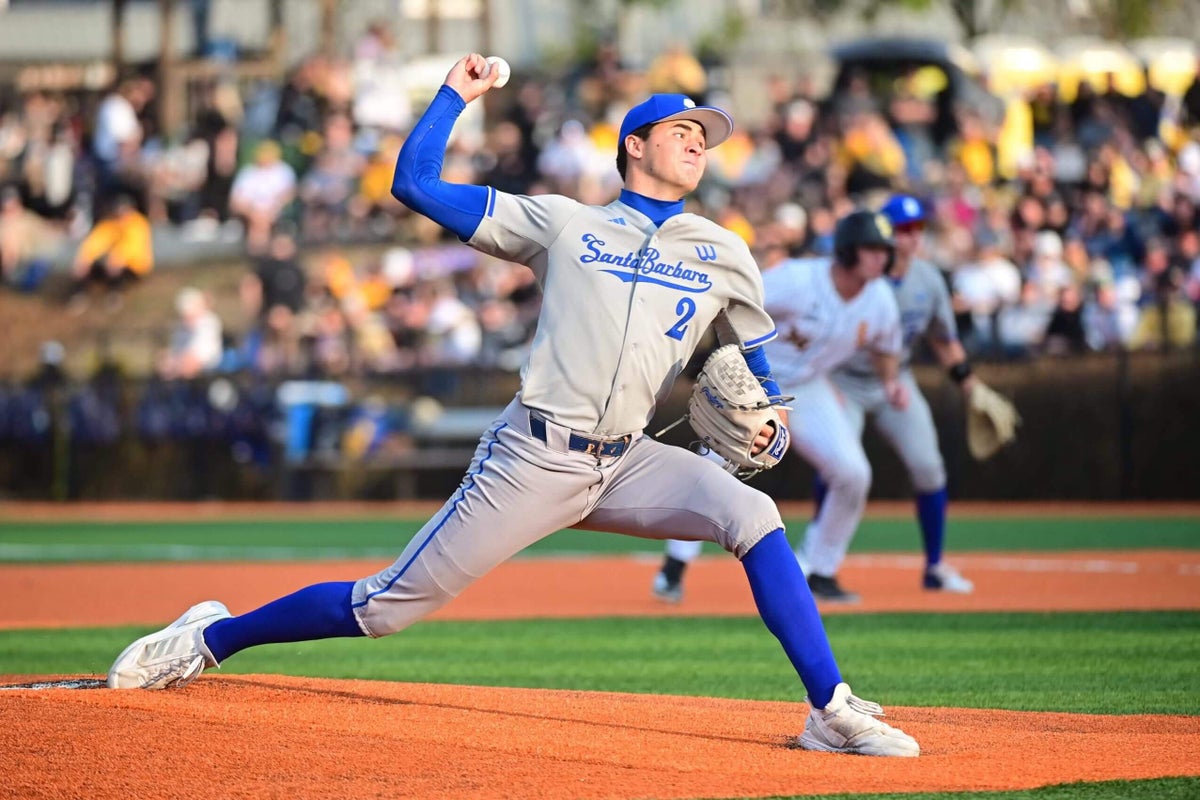
Then there’s the consensus top pitcher in this class, UC Santa Barbara right-hander Jackson Flora, who would appear to be a fit in so many respects. Flora stands an imposing 6 feet 5 and has all the equipment to pitch at the front of a rotation. He’s a college junior who could move quickly through the minor leagues. He’s also a Bay Area native who starred at Foothill High in Pleasanton, Calif. — the same high school that produced former Giants shortstop Brandon Crawford.
The latest MLB draft intel
Keith Law
And if you haven’t noticed, the Giants are in dire need of pitching at the major-league level. They’re also tilted heavily toward position players in an otherwise improving farm system.
Given the context, it might be difficult to imagine how the Giants could take anyone other than Flora.
That’s not how the draft works, though.
“At some point, we know we want to get some pitching, especially some starting pitching, and there may come a point in the draft where that becomes a little focused,” Holmes said in a dugout interview before Wednesday’s 10-0 loss to the Toronto Blue Jays at Oracle Park. “I just think up higher, we have to continue to think about taking the best available (player).”
Isn’t that what every amateur scouting director says this time of year?
“Yeah,” Holmes said with a chuckle. “And you’re going to keep hearing it.”
There’s a reason for that. With rare exceptions, the MLB Draft is not a plug-and-play exercise. No draft pick is guaranteed to reach the major leagues. Many top picks end up benefiting their first organization as a trade chip who brings back talent in another form. Drafting for need over value is asking for trouble.
Here’s the truth: Drafting for need isn’t Holmes’ job. It shouldn’t fall on him and his staff to provide an immediate remedy for a pitching deficit that has exposed three layers of organizational failure.
The Giants get an F for overestimating the strength of the pitching within their system to begin the season. They get an F for being unable to develop those arms under their third wave of pitching coaches in four years. And in retrospect, those twin shortcomings make it even more galling that ownership gets an F for not providing the resources that would have allowed Buster Posey’s front office to invest more heavily in the free-agent pitching market in the winter.
A team that did invest? The Blue Jays. They signed right-hander Dylan Cease to a seven-year, $210 million contract. They signed former Giants reliever Tyler Rogers to a three-year, $37 million deal. Cease has a 2.56 ERA in 17 starts and leads the American League in strikeouts. Rogers has a 1.73 ERA and hasn’t allowed a home run in his 43 appearances. Either of those pitchers could have made a major impact on a Giants staff that ranks No. 27 out of 30 clubs with minus-4.8 Wins Above Average.
To that point, while capturing a road series Wednesday, the Blue Jays fluttered out of town on a dovetail. Cease came within three outs of becoming the first pitcher to no-hit the Giants in the 27-year history of their waterfront ballpark at 24 Willie Mays Plaza.
Heliot Ramos broke up the bid with a clean single to center field to lead off the ninth, which saved the Giants from getting no-hit in San Francisco for the first time since June 10, 1997, when Florida Marlins right-hander Kevin Brown blanked them at Candlestick Park.
There was no saving anything else, though. The Giants fell to 16 games under .500 for the first time since the final day of the 2018 season. They’ve been shut out nine times, trailing only the San Diego Padres (10) for the most in the major leagues.
The game was lost in a five-run first inning that might rank as the unluckiest of Logan Webb’s career. It began with a jam-shot single, then a bloop single, then a one-out walk to George Springer that followed a no-call on a two-strike checked swing. Daulton Varsho followed with a softly hit single that appeared catchable but bounced away from Jung Hoo Lee’s sliding attempt in right field. Then, with the bases loaded, Kazuma Okamoto followed with an opposite-way drive that clanked off the metal facing atop the right-field arcade for a grand slam. According to Statcast, it would’ve been a home run in just two of 30 major-league ballparks.
“If you could somehow go back in time and remove some of that stuff, everybody got what they showed up for to see those two guys (Webb and Cease) go at it,” Giants manager Tony Vitello said. “They’re two of the better ones in the league at their craft. I thought today was … again, it’s hard to say, and I get it, I see the five on there, but it was a good day.”
For Webb, maybe. Not for anyone else in the home dugout. The Giants did not distinguish themselves for the rest of the afternoon. Rafael Devers made two errors at first base, and shortstop Willy Adames committed his 13th of the season while the Blue Jays padded their lead. Struggling reliever Ryan Walker might as well have been a mop-up position player on the mound in the ninth inning when he gave up a pair of home runs, including one to Vladimir Guerrero Jr., who has been allergic to the long ball this season.
There will be times the Giants are unlucky. Too often this season, they’ve been flat-out not good. Especially on the mound.
None of this should enter Holmes’ draft purview, though. It’s his department’s job to infuse the organization with as much drafted and internationally signed talent as possible. You’re only distracting him from those objectives when you expect him to compensate for the missteps of others.
So, if Holmes and his staff determine that a high school shortstop is the best available player, it shouldn’t matter that the Giants drafted another shortstop, Gavin Kilen, in the first round last year. Or that their three top-rated prospects — Jhonny Level, Josuar Gonzalez and Luis Hernández — are playing the position in the low minors.
The Giants were supposed to hold the 15th pick in the 2026 draft after finishing last season 81-81, but the lottery ping-pong balls bounced their way, and they moved all the way up to No. 4. It created a historic opportunity. This will be just the sixth time the organization holds a top-five pick. They’ve taken three franchise-altering players (Will Clark, Matt Williams and Posey) among those six picks.
The Giants also have extra flexibility after acquiring the 29th pick from the Cleveland Guardians in the May trade that sent catcher Patrick Bailey to Ohio. Folding in the $3,270,200 slot value for that pick gives Holmes a draft bonus pool of $17,350,600, which is the fourth highest among major-league organizations.
“I think it just gives you options,” Holmes said. “The past two years, we’ve been down two picks. Two years ago, we didn’t have a second or third. Last year, we didn’t have a second or fifth. Not only are you eliminating a certain part of the draft to take a high-caliber player, but you’re also limited in your money and your creativity. So, most importantly, we’re excited to get pick 29 because of the type of player we’re going to get. But the money is important, too.”
There’s been industry speculation that the Giants could use the extra pool money to make a play for Cholowsky, who, like Crawford, is a UCLA shortstop represented by agent Joel Wolfe and is believed to prefer signing with a West Coast team. Here’s how that would work: Cholowsky sends signals to the Chicago White Sox, Tampa Bay Rays and Minnesota Twins that he would demand a signing bonus exceeding his slot value, spooking them into taking other players. Then the Giants could roll the money from the No. 29 pick into the slot value for the No. 4 pick to offer him an even bigger bonus ($12.258 million) than he’d get if he went first ($11.350 million).
This is mostly cloak-and-dagger stuff that’s fun for draft enthusiasts to kick around. Even if this scenario were plausible, it’s doubtful Cholowsky would refuse to sign and return to UCLA for his senior season. Holmes wouldn’t comment on the validity of “floating” a player past other teams but acknowledged that he’s heard the chatter.
“The way I look at it is this: We just try to go out and evaluate every player, we line our board up and see how it may fall,” Holmes said. “There’s been talk out there of that, but our approach has been the same, as far as how we set our board up.”
Holmes also resists making assumptions about which players will go off the board before the Giants select.
“I’ve learned to expect the unexpected when it comes to the draft,” he said. “We’ve talked through lots of different scenarios and what may happen, and I think we’ll be prepared for all of them.”
Holmes didn’t reject the suggestion that the draft could slant a certain way for the Giants once all 20 rounds are concluded. That’s what happened in 2021 when the Giants selected pitchers with each of their first nine selections (and took the best of the crop, right-hander Landen Roupp, in the 12th round).
“You can even look at last year’s draft, where we put a focus on high-contact hitters, guys with low strikeout rates who touch the baseball,” Holmes said. “You have to look at every draft class independently of each other, and what the strengths and weaknesses are of each class. So, will there be some type of underlying theme? I’m not sure if I can really say that at this point. Yeah, there has been. In ’21, we did take a slant towards pitching. But you have to get into the draft and be fluid to move one way or the other, depending how the board plays out.”
If their draft board directs the Giants to take a position player with the fourth pick and a high school pitcher who is years away from potentially contributing at the big-league level at 29th, then so be it. It’ll be up to the Giants’ other baseball operations departments to equip next year’s roster with a functional pitching staff.
Two-time Cy Young Award winner Tarik Skubal will head a class of free-agent starting pitchers this offseason. Freddy Peralta will be right behind him. Either would fit alongside Webb at the front end of a rotation that needs plenty of augmentation. Both will be wildly expensive. Both also will be out of the picture if the Giants insist on yet again limiting their free-agent pitching signings to the bargain bin.
And that would be tough for ownership to justify after a disastrous season that nevertheless has attracted packed houses at every home game. The Giants’ attendance has been so robust that they have a chance to draw 3 million fans for the first time since 2018.
If you can’t expect ownership to loosen the purse strings after a season like this, when can you?