
Despite being asked by a councillor for a breakdown of costs to put Champlain back in the park, mayor has not provided specifics related to his decision
The cost of bringing the Champlain statuary back home, reimagining its future and, ultimately, placing it in “neutral” storage last month has cost taxpayers more than $150,000 over the last several months.
On Oct. 6, 2025 city council approved the creation of the Champlain Monument working group and appointed Mayor Don McIsaac and councillors Tim Lauer and Janet-Lynne Durnford to compose the group.
They were tasked with working on Indigenous consultation, display possibilities, and technical aspects to bring back the seven bronze male figures of the original Vernon March statue.
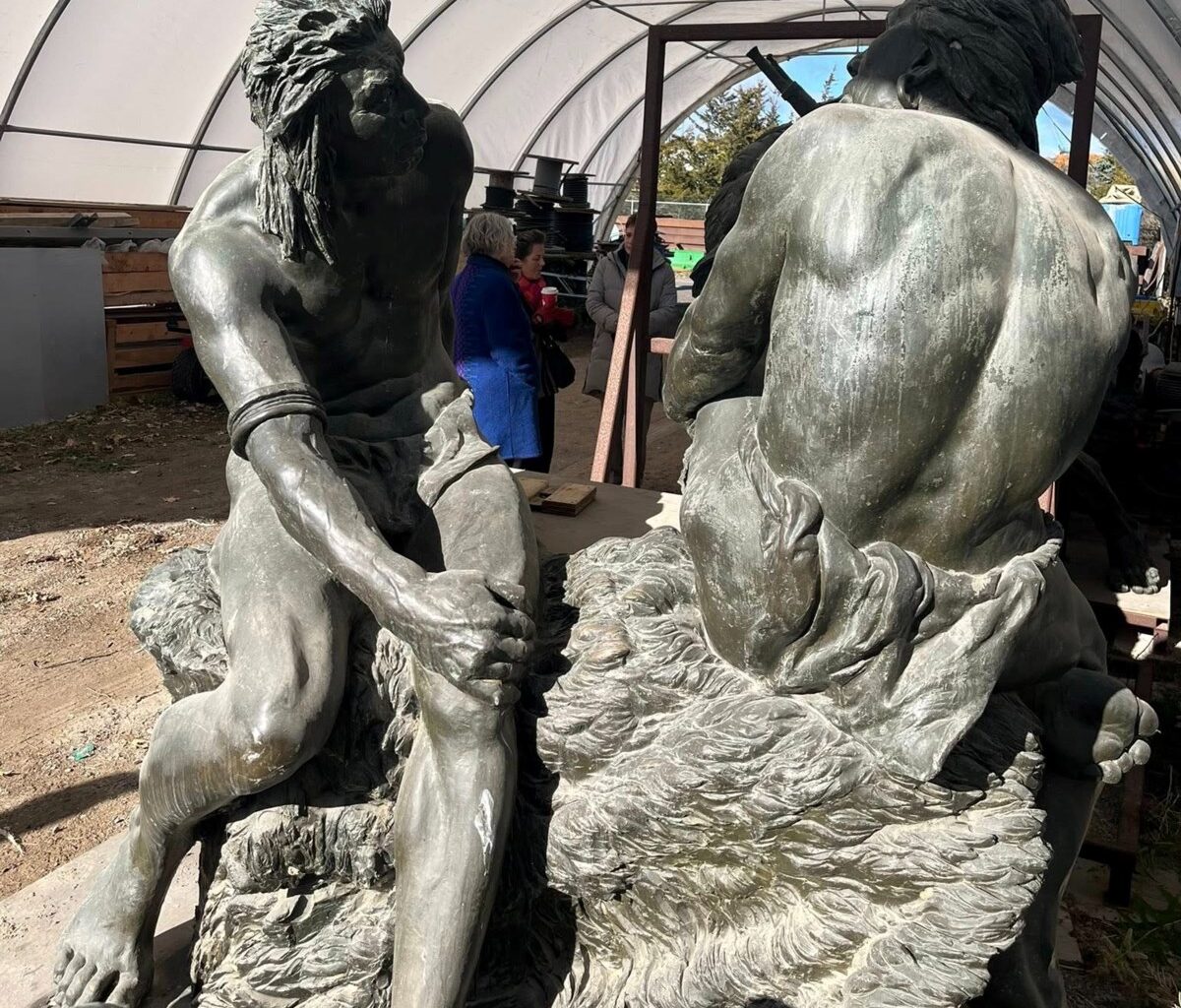
The controversial components of the famous bronze statue were moved from Parks Canada storage in Campbellford in December of 2025. After a stop in Toronto for cleaning and restoration, the pieces finally returned to Orillia for the first time since they were removed in 2017 by Parks Canada.
A redesign of the Champlain monument was presented to council on March 30 by McIsaac after Lauer and Durnford resigned from the committee, leaving the mayor as its only member.
The plan called for the separation of the figures in Couchiching Beach Park.
Samuel de Champlain was to stand alone near ground level, while the four Huron-Wendat men were clustered together on a stone patio. Behind them was a stone wall and on the other side of the wall was to be the fur trader figure. The Recollect Father was not in the plan to be re-erected in the park.
That plan called for the budget to be increased from the approved $250,000 to $950,000 with funds to be taken from the tax rate stabilization reserve. This would have allow the project to proceed with the restoration, transportation and installation of the statuary, signage, and site elements this April, with the completion expected by October.
The motion was turned down by council. City Coun. David Campbell asked the mayor, following that decision, to arrange for storage of the monument.
That’s when things went sideways.
On May 21, Orillians were shocked when the Champlain sculpture was returned to the park in a unilateral decision by McIsaac, who claimed he was following council’s direction by “storing” the monument in the park. He did not inform city councillors or staff of the decision.
Within an hour of cranes dropping it back on the cement plinth near Lake Couchiching, a crowd gathered and Krystal Brooks spray-painted the plinth in red paint reading, “Rama said no.” She was arrested and charged with mischief.
Durnford questioned the mayor’s procurement process at a fractious May 25 council meeting and demanded an accounting of costs associated with the mayor’s decision.
“Council and the public really need a break down of costs …. today we are drawing from the tax rate stabilization reserve. That is an indication to me that the $250,000 has been spent,” she said.
McIsaac said at that meeting, “There will be a CIP. The information is being assembled. You can’t report on something until it is done.”
That 12-page CIP was posted on June 3 but did not provide an accounting of the costs associated with the mayor’s decision to place the monument back in the park, nor did it speak to procurement procedures used in that process.
“To date, the concept and drawing design, repair and restoration, and transportation components have been authorized in the amount of $145,021 plus HST, with $10,000 being held back,” McIsaac wrote in the report.
“Costs associated with Indigenous consultation total $43,506 to date.” The Indigenous consultants put together the concept drawing design for the re-installation plan, that was turned down by council.
There has been no discussion at council by the mayor about the costs other than what is included in the CIP.
Durnford said no other information has been provided to her even though she asked for specific accounting of the costs.
“The only information council has is the information from that CIP,” she told OrilliaMatters.
However, officials have been transparent about the most recent costs of moving 16-foot Champlain statue out of Couchiching Beach Park and into storage on June 10.
“Three quotes were received by staff, and the contract was awarded and executed for $7,125 plus HST the lowest bid,” using money from the tax rate stabilization reserve, reads the June 10 council information package written by the city’s CAO.
It was Sidhu who called a special meeting of council on May 29 to quell community unrest over the monument’s unexpected return to the waterfront park.
At that special meeting, the majority of council voted that the Champlain statue, tarped and fenced to discourage further vandalism, be placed in secure, neutral storage.
Since then, the topic has gone national with reports done by Radio Canada, the National Post and le journal de Montréal, among others.
McIsaac is no longer communicating with OrilliaMatters over its commenting policy on articles, though he has provided multiple interviews to other media and entertained at least one in the mayor’s office.
He did not respond to specific requests for comments for this article.
The monument controversy has also attracted the attention of a far-right organization, The Dominion Society of Canada, who were in Orillia last week to shoot a video from the now-empty plinth.
The group is being investigated by the OPP after a video was posted on social media that showed several people, dressed in black, breaking through the fencing and vandalizing the monument in early June by removing the tarp.
There have also been more than a dozen offers to purchase or acquire the statuary even though it’s not for sale and the mayor has said he believes it should stay within the city’s ownership.
Why is the monument controversial?
The 16-foot bronze monument originally featured the French explorer elevated on a high stone pedestal. Below him sat four Indigenous figures depicted in positions that critics and historians have widely condemned as subservient and racist.
On one side, Indigenous people were depicted sitting at the feet of a Jesuit priest (missionary). On the other side, they were shown at the feet of a European fur trader.
Critics pointed out that this design promoted a Eurocentric, colonial narrative that marginalized the vital contributions of Indigenous peoples
The original plaque accompanying the monument openly celebrated colonialism. It stated that the monument was erected to commemorate “the advent into Ontario of the white race,” language that deeply offended Indigenous communities and modern citizens alike.
The statue was removed by its then owner, Parks Canada, to be refurbished in 2017. Then, as part of Truth and Reconciliation efforts, a working group was formed to stickhandle its potential return. That process eventually bogged down and the issue had faded into the background until McIsaac began to champion its return.
— With files from Dave Dawson